
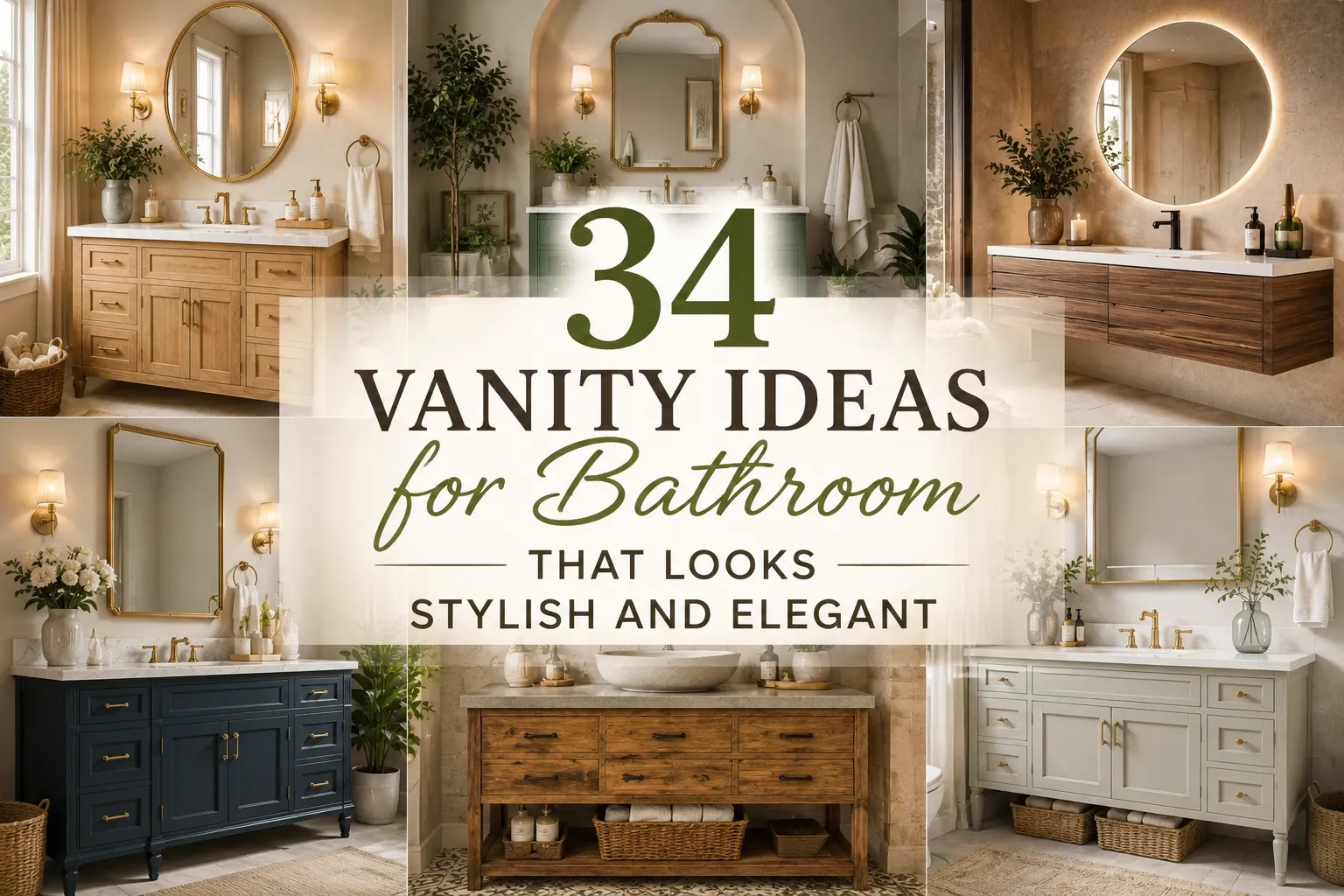
34 Vanity Ideas for Bathroom That Looks Stylish and Elegant
Vanity ideas for bathroom spaces are the design choices — cabinetry, countertop, lighting, and hardware — that turn a purely functional sink area into the visual anchor of the room. This roundup gathers 34 ideas spanning color, material, lighting, furniture, layout, and small-space solutions, each one tested against real design principles rather than trends alone.
A well-designed vanity feels like the quiet start of a good morning — light pooling across a honed stone counter, brass hardware catching a low glow, a single ceramic vessel holding its shape against clean lines. The best modern elegant vanities balance restraint with warmth, favoring tactile materials over ornamentation and letting proportion do the heavy lifting. Nothing here is loud; it’s considered. Here are 34 ideas worth saving — and stealing.
Why Modern Elegant Vanities Work So Well
Modern elegant design draws from mid-century restraint, postwar Scandinavian functionalism, and the softened minimalism popularized by designers like Kelly Wearstler and the Studio McGee aesthetic that dominates Pinterest search today. Unlike strict minimalism, it allows warmth back into the palette — rounded edges, natural veining, and metal finishes that develop character over time. What separates it from farmhouse or maximalist styles is restraint: fewer objects, better materials, more negative space around each one.
The core materials of modern elegant vanities include honed marble or limestone, white oak or walnut cabinetry, unlacquered or brushed brass hardware, and matte ceramic or zellige tile. Color palettes lean into warm greige, soft charcoal, dusty sage, and cream, rather than stark white or cool gray. These tones are specific enough to shop from directly at a paint counter using names like Benjamin Moore’s “Revere Pewter” or “Kendall Charcoal.”
This style is trending now because Pinterest search data shows a sustained rise in “quiet luxury bathroom” and “warm minimalist vanity” queries, reflecting a broader post-pandemic shift toward homes that feel restorative rather than performative. People are spending more time at home and want a vanity that functions like a small ritual space, not just a sink.
Small spaces can absolutely achieve this look. The priority for a compact bathroom is a floating or console vanity that exposes floor space, paired with one or two high-quality materials rather than several competing finishes — small rooms punish visual clutter fastest.
Element Modern Elegant Philosophy Function-first, pared-back forms Warmth through material, not ornament Materials White oak, brushed brass, honed stone Marble veining, aged brass, matte ceramic Color palette Warm greige, charcoal, cream Dusty sage, terracotta blush, deep navy
34 Vanity Ideas for Bathroom Design
1. Warm Terracotta and Brass Vanity Palette

Terracotta reads as an accent color rather than a full commitment, so it stays elegant instead of rustic. The contrast between warm clay tones and cool brass hardware creates visual tension that keeps the eye moving without overwhelming a small footprint. This is one of the most searched bathroom vanity color pairings for a reason — it photographs beautifully in low light.
Paint just the vanity base in a terracotta shade like Farrow & Ball’s “Red Earth” and leave walls neutral, so the color reads as intentional rather than accidental.
You Might Also Like: 20 Bathroom Picture Ideas by Style, Budget & Size
2. Book-Matched Marble Waterfall Vanity Countertop
A waterfall edge extends the countertop material down the cabinet’s side panel, using continuity of pattern — a core principle of visual weight — to make a small vanity feel like a single sculpted object rather than stacked parts. Calacatta marble‘s soft gray veining against a white base reads as expensive because the pattern is naturally irregular and impossible to fake convincingly at scale.
If you want a genuinely elevated vanity focal point, a waterfall-edge slab is the most effective approach, even at a smaller 24-inch width, because it removes the visual seam between top and side.
3. Backlit LED Mirror for Shadow-Free Vanity Lighting

Backlit mirrors eliminate the harsh shadows that overhead lighting casts across the face, a lighting principle photographers call “front-fill.” The even glow flatters skin tone and makes the entire vanity wall feel like a lit object rather than a fixture bolted to drywall.
Backlit LED vanity mirrors are the most effective lighting upgrade for small bathrooms because they add illumination without consuming wall space for a separate fixture.
4. Floating Vanity with Slim Profile Cabinetry

Floating vanities apply a basic proportion principle — visible floor equals perceived square footage. Removing the cabinet’s base legs lets the eye read the floor as continuous, which is especially valuable in bathrooms under 40 square feet.
Choose a vanity depth of 18 inches instead of the standard 21 inches; it barely changes usable counter space but visibly widens a narrow room’s walking path.
5. Woven Rattan Baskets for Open Vanity Shelving

Open shelving beneath a vanity trades closed storage for texture layering — the rattan’s woven surface adds visual interest without adding color, a technique that keeps a small palette from feeling sterile. It also solves a real functional problem: towels get more air circulation than they would sealed inside a cabinet.
Product Price Range Where to Shop Rattan storage basket, medium $32–$48 Serena & Lily Open oak shelf bracket kit $40–$65 IKEA Waffle-weave bath towel set $45–$70 Brooklinen Small potted fern $18–$25 Local nursery Woven lidded hamper $60–$85 Target
6. Wall-Mounted Vanity to Open Up Floor Space

Layout decisions matter as much as finishes — a wall-mounted vanity lets flooring run uninterrupted from door to shower, a technique designers call “visual flow,” which reads larger than the actual square footage would suggest on a floor plan.
If you want a bathroom under 50 square feet to feel bigger without demolition, mounting the vanity to the wall is the most effective approach.
7. Corner Vanity Nook for Compact Bathrooms

A corner-fit vanity uses otherwise dead space that most floor plans waste, applying a small-space principle of claiming underused geometry rather than shrinking a standard rectangular unit. This works especially well in half baths where a full-width vanity would block the door swing.
Measure the corner’s diagonal clearance first — most corner vanities need at least 20 inches from the point to function comfortably for hand-washing.
8. Sage Green Cabinetry with Brass Hardware

Sage green sits on the color wheel close enough to neutral to pair with almost any stone countertop, yet it carries enough saturation to function as the room’s single statement color — a strategy of restraint over repetition. Paired with brushed brass, the combination echoes early Art Deco color pairing without the full ornamentation of the movement.
9. Fluted Wood Cabinet Doors on Vanity Base

Fluted paneling introduces texture through shadow rather than color, using consistent vertical grooves to catch light differently throughout the day. This technique, borrowed from Mid-Century Modern furniture makers, adds tactile richness to a flat cabinet front without any paint or hardware change.
10. Statement Pendant Lights Flanking the Mirror

Flanking pendants light the face from both sides rather than overhead, matching the even-illumination principle professional makeup mirrors use. Positioning them at eye level, roughly 60 inches from the floor, keeps shadows from falling under the brow or chin.
The best vanity lighting for even skin tone comes from two symmetrical side sconces rather than a single overhead fixture.
11. Furniture-Style Vanity with Turned Wood Legs

A furniture-style vanity with exposed legs, rather than a solid base-to-floor cabinet, introduces negative space beneath the unit — a proportion trick that makes even a heavy wood piece feel lighter in the room.
Look for a converted antique washstand or dresser at least 32 inches wide, then have a plumber cut a single hole for a vessel sink rather than an undermount, which preserves the original top.
12. Framed Vintage Mirror Above a Modern Vanity

Pairing an ornate vintage mirror with a minimal modern vanity relies on contrast, a design principle where opposing styles sharpen each other rather than compete. The mirror’s detail reads as more special precisely because everything around it stays quiet.
13. Double Vanity Zoning for His-and-Hers Routines

A center storage tower between two sinks solves a real layout problem — elbow room — while giving each person a defined zone, applying a traffic-flow principle used in shared kitchens. It also doubles as concealed storage without adding a separate cabinet.
If you want to avoid morning bottlenecks in a shared bathroom, dividing the vanity into two distinct zones is the most effective approach.
14. Pedestal Vanity Sink to Free Up Legroom

A pedestal sink removes the cabinet base entirely, which in bathrooms under 25 square feet often matters more for circulation than any storage a vanity would provide.
Choose a pedestal with a sculptural curve rather than a straight column — the extra visual interest compensates for the storage you’re giving up.
15. Charcoal and Warm White Two-Tone Vanity

Splitting a vanity into two tones — dark below, light above — visually anchors the piece to the floor while keeping the upper half from feeling heavy, a weight-distribution technique borrowed from kitchen island design.
16. Honed Limestone Vanity Top with Soft Edges

Honed limestone has a matte, non-reflective surface, unlike polished marble, which softens light rather than bouncing it — a material choice that makes a small vanity feel calmer rather than glossy and busy. The rounded edge profile also removes the harsh right angle most stock vanities default to.
The most effective countertop material for a calm, matte vanity look is honed limestone or leathered granite rather than polished stone.
17. Dimmable Sconces for Layered Vanity Ambiance

Dimmable sconces let one fixture serve two purposes — bright task lighting for grooming, soft ambient light for evening routines — solving the layered-lighting problem most vanities ignore by installing a single fixed-brightness bulb.
18. Console Vanity with Open Shelf Below

An open console vanity treats the sink area as a piece of furniture rather than built-in cabinetry, which reads as more considered — a shift from utility-first plumbing fixture to intentional design object.
19. Ceramic Vessel Bowls Styled on the Counter

Handmade ceramic vessels, with their slightly irregular glaze, add texture layering to a flat stone counter without adding clutter, following the “one imperfect object” rule stylists use to keep vignettes from feeling staged.
20. Dusty Rose Vanity Cabinetry for Powder Rooms

Powder rooms are used briefly and by guests, which makes them the safest place in the house to commit to a saturated color like dusty rose — a strategy of contained risk that lets the rest of the home stay neutral.
Dusty rose or terracotta cabinetry works best in powder rooms specifically because the room’s small size and occasional use limit color fatigue.
21. Brushed Brass Hardware Against Matte Cabinetry

Brushed brass, unlike polished brass, has a soft, low-glare finish that photographs better against matte cabinetry — a finish pairing that avoids the competing shine of two glossy surfaces reflecting light at once.
22. Vertical Vanity Lighting for Even Face Illumination

Vertical light bars mounted at face height distribute light evenly down both sides of the face, correcting the same shadow problem overhead lighting causes, but in a slimmer footprint than full sconces — useful when wall space beside the mirror is limited.
23. Double Vanity with Individual Cabinet Towers

Separating a double vanity into two freestanding towers, connected only by a shared countertop, introduces negative space between them, a proportion technique that keeps a wide vanity from reading as one massive block.
24. Textured Hand Towels and a Single Stem Vase

A textured towel and a single stem apply the “restraint over repetition” principle directly — one object, one gesture, done well, communicates more intention than a full basket of matching accessories.
25. Deep Navy Vanity Base with Gold Accents

Deep navy functions as a neutral in low light, meaning it reads sophisticated rather than dark once paired with a light-colored countertop — a contrast principle that keeps the palette from feeling heavy.
26. Zellige Tile Backsplash Behind the Vanity
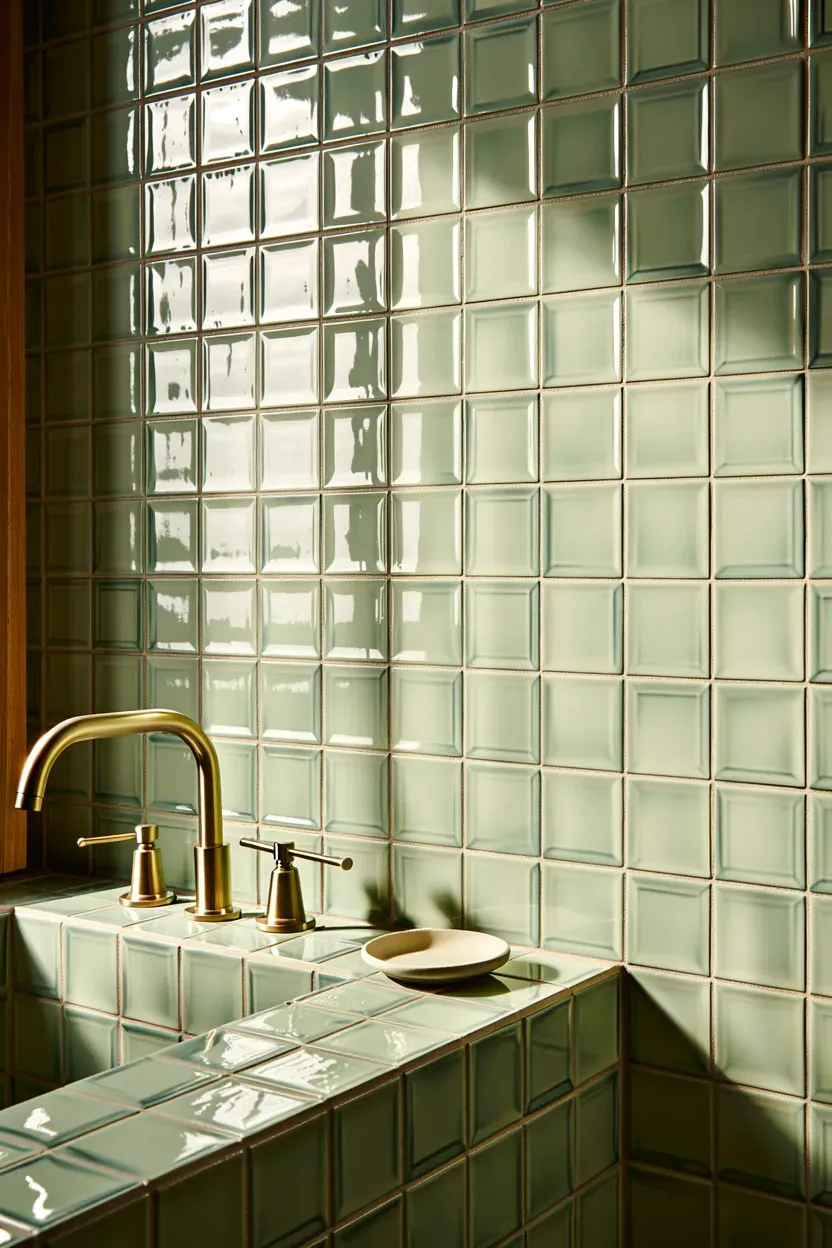
Zellige tile, a traditional Moroccan hand-glazed tile, has naturally inconsistent color and surface texture that catches light differently across every tile — a material property that mass-produced ceramic tile cannot replicate, which is why it reads as more expensive even at similar price points.
If you want a backsplash with genuine handmade texture, zellige tile is the most effective choice over standard ceramic subway tile.
27. Skylight Above the Vanity for Daylight Grooming

Daylight has a fuller color spectrum than most bulbs, which is why makeup applied under a skylight looks more accurate outdoors — a lighting-quality principle that no warm or cool bulb fully replicates.
28. Vanity Stool Tucked Beneath an Open Console

Tucking a stool beneath an open-leg vanity adds functional seating without consuming floor space when not in use, a furniture-arrangement technique that also softens the hard lines of a console with woven texture.
29. Wall-Mounted Shelf Styled with Glass Apothecary Jars

Clear glass apothecary jars turn everyday supplies into intentional styling by making their contents part of the visual composition, a technique that works only because the jars are uniform in shape and clear rather than mismatched.
30. Warm Greige Cabinetry for a Timeless Base

Warm greige sits between beige and gray, avoiding the yellow undertones that dated 2000s beige and the cold undertones that make pure gray feel clinical — a color-formulation reason it has stayed relevant across multiple design cycles.
Warm greige is the most effective cabinet color for a vanity meant to last through several style shifts without a repaint.
31. Unlacquered Brass Faucets That Age Into Patina

Unlacquered brass has no protective coating, so it darkens and develops a living patina with use — a material property that lacquered brass permanently prevents, which is why designers specify it deliberately rather than treating the tarnish as a flaw.
32. Vanity Placed Perpendicular to the Door for Flow

Positioning the vanity along a side wall, rather than directly opposite the door, follows a traffic-flow layout principle — it keeps the first thing a visitor sees from being a mirror reflecting the doorway back at them, which most people find visually jarring.
33. Reeded Glass Cabinet Panels on the Vanity

Reeded glass panels obscure the cabinet’s contents while still allowing light and shadow to pass through, giving a vanity depth and texture that a solid door cannot — a technique borrowed from Art Deco cabinetry that has resurfaced strongly in current kitchen and bath design.
34. Cream and Walnut Vanity Color Pairing

Pairing a cream cabinet with warm walnut accents keeps the palette light while still grounding it with a natural material, a combination that reads as timeless because neither element competes for attention.
You Might Also Like: 23 Bathroom Decor Ideas That Make Any Space Feel Luxurious
How to Start Your Modern Elegant Bathroom Transformation
The single first move is painting the vanity cabinet in a warm greige or soft charcoal, since the cabinet is the largest surface in the room and every other decision — hardware, mirror, accessories — gets chosen to complement it, not the other way around.
The most common mistake beginners make is mixing warm and cool metal finishes without a plan, pairing brushed brass hardware with a chrome faucet, which breaks the room’s cohesion because the eye instinctively compares nearby metals. Fix it by picking one metal tone — brass, black, or nickel — and repeating it across the faucet, hardware, and light fixtures.
Three items under $50 that create immediate impact: a $28 unlacquered brass drawer pull set, a $22 ceramic bud vase with a single dried stem, and a $18 waffle-weave hand towel in warm cream.
A full vanity transformation with new cabinetry and stone typically takes two to four weeks and runs $1,500 to $4,000 depending on countertop material. A weekend refresh — paint, hardware, and styling — costs under $200 and can be finished in a single Saturday.
Ready to Create Your Dream Modern Elegant Bathroom?
These 34 ideas cover far more than paint color — waterfall stone, layered lighting, furniture-style silhouettes, and small-space layout fixes that work together rather than in isolation. Starting with just one element, like new hardware or a single styled shelf, is a legitimate way to begin, not a compromise. If you want the fastest visible change today, swap your current cabinet pulls for a set of unlacquered brass ones and let them anchor everything else you add later. Done well, this style rewards you with a vanity that feels less like a fixture and more like the calm start of your day. Save the ideas that pulled you in — especially the ones with brass and honed stone — so they’re ready when you’re ready to start.
Frequently Asked Questions About Modern Elegant Bathroom Vanities
What is the difference between a modern vanity and a traditional vanity?
A modern vanity favors clean lines, minimal ornamentation, and flat-front cabinetry, while a traditional vanity typically includes raised-panel doors, ornate hardware, and furniture-style legs. The modern elegant approach borrows the clean lines of modern design but reintroduces warm materials like brass and walnut that strict modernism avoids. This blend is why it photographs so well for Pinterest search — it feels current without feeling cold.
What color should I paint my bathroom vanity?
The most effective vanity colors right now are warm greige, dusty sage, and deep charcoal, because each pairs well with both brass and matte black hardware. Warm greige works best for buyers who want longevity, since it avoids trend-specific undertones. Dusty sage and terracotta suit powder rooms, where a bolder color choice carries less risk.
How much does it cost to update a bathroom vanity?
A basic vanity refresh using paint and new hardware costs between $150 and $300 for materials. A full vanity replacement with a new cabinet, stone countertop, and fixtures ranges from $1,200 to $4,000 depending on the countertop material and cabinet size. Custom furniture-style vanities with vintage pieces or waterfall marble tops can exceed $5,000.
Can this vanity style work in a small or older bathroom?
Yes, modern elegant vanities adapt well to small and older bathrooms as long as the vanity is scaled down and floating or console-style rather than a bulky floor-to-ceiling cabinet. Older bathrooms with plaster walls or original tile often pair especially well with warm brass hardware, since aged materials share a similar patina quality. The key limitation is depth — stick to 18 to 21 inches in a tight footprint.
What is the best lighting for a bathroom vanity?
The best vanity lighting comes from two symmetrical side sconces or vertical light bars mounted at face height, rather than a single overhead fixture, because side lighting eliminates shadows under the eyes and chin. A backlit LED mirror is the next most effective option for small bathrooms where wall space is limited. Warm white bulbs around 2700K to 3000K flatter skin tone better than cool white or daylight bulbs.


