
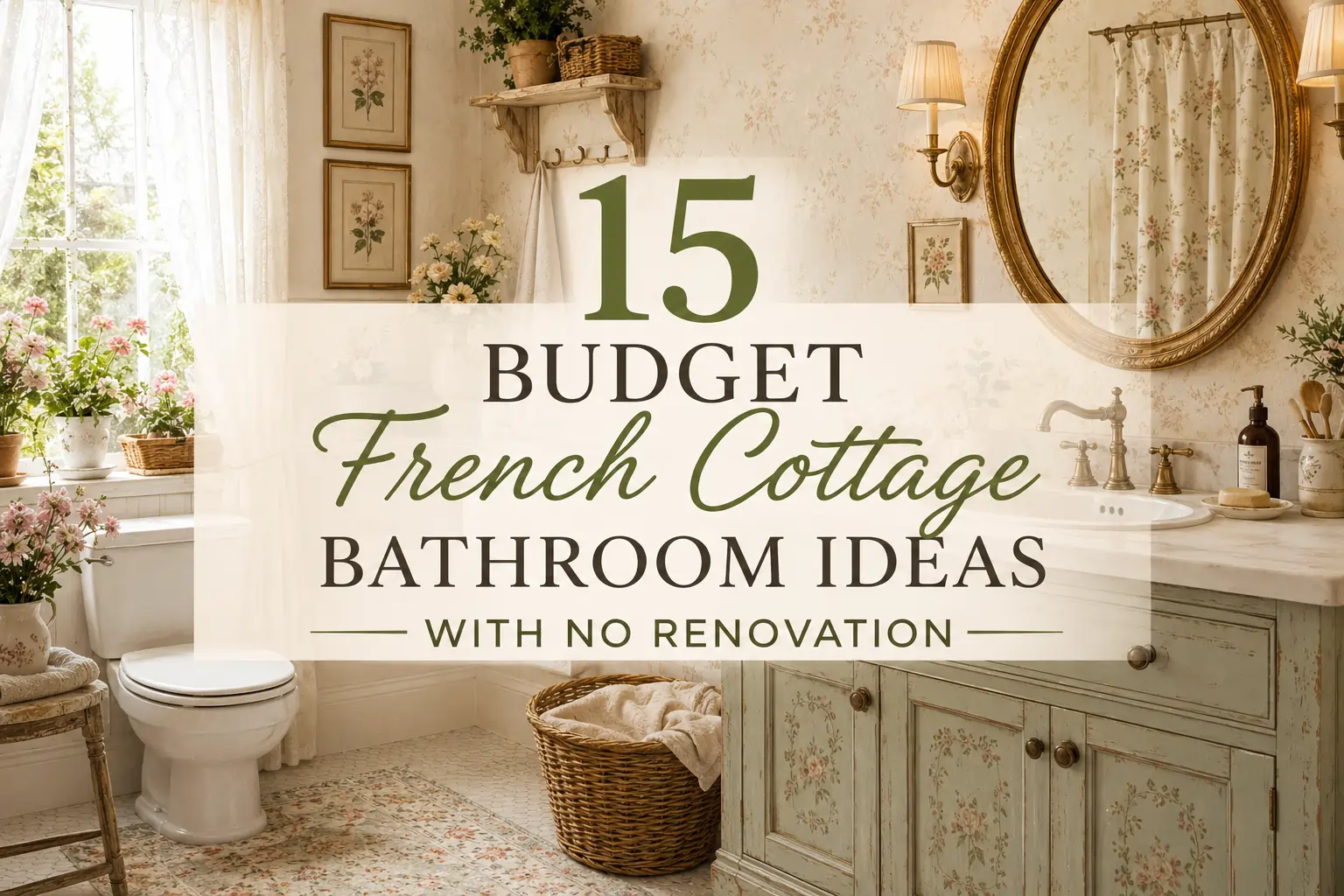
15 Budget French Cottage Bathroom Ideas With No Renovation
French cottage bathroom style is a decorating approach rooted in rural Provence and Normandy homes, built on chalky neutral walls, natural materials like linen and rattan, and aged brass or nickel hardware layered against a few imperfect vintage pieces. This guide gathers 15 French cottage bathroom ideas sized for a rented apartment, a small powder room, or a full primary bath — no demolition required.
The style feels unhurried. Morning light falls soft across a linen curtain, brass catches a warm glow instead of a cold gleam, and nothing in the room looks freshly unwrapped. It’s rustic without being rough, elegant without trying too hard — a bathroom that feels lived-in on day one. Here are 15 ideas worth saving — and stealing.
Why French Cottage Bathroom Style Works So Well
French cottage design traces back to the farmhouses and stone cottages of Provence and Normandy, where whitewashed walls and hand-finished hardware developed out of necessity, not trend. What separates it from farmhouse or coastal style is restraint: fewer black accents, more curve, and a warmth that comes from imperfection rather than pattern.
The core materials of French cottage design include linen, unlacquered brass, rattan, and lightly aged wood, paired with a palette of chalky white, dusty sage, and warm greige. These aren’t decorative choices so much as functional ones — natural fibers age well in humid bathrooms, and unlacquered brass develops a patina instead of showing wear.
Interest in the look has grown alongside a broader shift toward wellness-focused, calming bathrooms. According to the 2025 U.S. Houzz Bathroom Trends Study, more than a third of renovated bathrooms (36%) now include wellness-oriented features like upgraded lighting — exactly the kind of soft, ambient glow French cottage styling relies on.
Small bathrooms can absolutely achieve this look. French cottage works in tight spaces because its materials are inherently light-reflective and low-bulk — the priority should be one textile swap and one lighting change before anything else.
Style at a Glance
| Element | Detail |
| Philosophy | Rustic restraint over polish; imperfection reads as authentic |
| Key Materials | Linen, unlacquered brass, rattan, aged or whitewashed wood |
| Key Colors | Chalky white, dusty sage, warm greige, soft terracotta |
15 French Cottage Bathroom Ideas
1. Chalky White Walls with a Warm Undertone

Cool-toned whites read clinical under bathroom lighting, while a warm white with a hint of yellow or gray undertone mimics limewash walls found in real Provençal cottages. The undertone shift changes how the whole room reads without touching a single fixture.
Look for a matte finish paint in the “warm white” or “chalk” family — Farrow & Ball’s “Slipper Satin” or Sherwin-Williams’ “Alabaster” both work — and test a swatch against your existing tile before committing.
2. Unlacquered Brass Fixtures That Age Beautifully

Unlacquered brass — unlike chrome or lacquered gold — is designed to oxidize and darken with use, which is precisely the aged, collected quality French cottage style depends on. It’s a material choice, not just a finish, and it’s the detail most builder-grade bathrooms are missing entirely.
Replace only the faucet or cabinet pulls first; a full fixture swap for a small vanity typically runs $80–$200. Kohler’s Artifacts collection and Rejuvenation both carry unlacquered brass options designed to develop patina naturally.
3. Soft Sconce Lighting Instead of Overhead Glare

Overhead bathroom lighting creates harsh downward shadows that flatten texture and skin tone alike, while sconces mounted at eye level distribute light horizontally and soften the whole room. If you want a French cottage bathroom to feel calm rather than clinical, swapping to sconce or lamp-style lighting is the most effective approach.
Choose fixtures with fluted or frosted glass shades in a warm-white 2700K bulb, and mount them at roughly 60 inches from the floor, flanking the mirror rather than above it.
4. A Vintage Washstand-Style Vanity

A flat-panel builder vanity reads modern no matter what you decorate around it, because its visual weight and proportions don’t match cottage-era furniture. A washstand-style vanity with legs, fluting, or a furniture silhouette shifts the entire room’s proportions toward Provence-inspired design.
If replacing the full vanity isn’t in budget, add furniture-style legs or a skirt to an existing cabinet base, and top it with a marble-look laminate if real stone isn’t feasible.
5. Linen Shower Curtain in Place of Vinyl

Vinyl shower curtains reflect light in a flat, plasticky way, while linen absorbs and diffuses it, which is a small but real difference in how a small bathroom feels. Texture layering — one of the core principles behind cottagecore bathroom ideas — starts here, since the curtain covers the largest single surface in most small bathrooms.
Choose unbleached or oatmeal-toned linen with a water-resistant liner underneath, and hang it from a brass or unlacquered-brass curved rod to add a few inches of visual height.
6. Vertical Storage with a Ladder Shelf

Small french cottage bathroom layouts rarely have floor space to spare, so a leaning ladder shelf uses vertical wall space instead of footprint, which is the single biggest space-saving principle for compact rooms. It also doubles as open storage, keeping folded linens visible as intentional decor rather than clutter.
Choose a whitewashed or natural oak ladder shelf no wider than 20 inches, and style it with rolled towels, one basket, and one small plant for visual rhythm.
7. Sage Green Lower Walls with a Chair Rail Line

A two-tone wall with a chair rail divide is a classic French country bathroom decor technique that adds architectural interest without built-in millwork, using paint and a single strip of molding to imply paneling. Sage green specifically references the lavender-and-herb landscape of southern France without leaning literal.
Paint the lower third to half of the wall in a muted sage, keep the upper wall warm white, and install a simple 1-inch wood strip at the divide line.
8. Open Shelving Instead of Closed Cabinets

Closed cabinetry hides the layered, slightly imperfect styling that defines this look, while open shelving turns everyday items into visible decor — a layout choice, not just a storage one. If you want a bathroom that feels curated rather than sterile, replacing at least one closed cabinet run with open shelving is the most effective approach.
Use two floating oak shelves spaced 10–12 inches apart, and limit styling to three “zones”: folded textiles, glass jars, and one botanical accent — resist filling every inch.
9. Wicker and Rattan Baskets for Texture

Rattan and wicker introduce organic irregularity that smooth, mass-produced storage bins can’t replicate, which matters because vintage farmhouse bathroom accessories rely on visible natural imperfection to avoid looking staged. The material also holds up well in humid environments when kept away from direct water contact.
Choose one large floor basket for towels and one small counter basket for rolled washcloths, keeping the weave pattern consistent between the two for cohesion.
10. Warm-White Bulbs at 2700K

Most builder-grade bathrooms ship with 4000K or 5000K “daylight” bulbs, which cast a blue-white tone that clashes with every warm material on this list. Color temperature is measurable and consistent — swapping to 2700K instantly shifts the entire room’s mood without touching a fixture.
Replace every bulb in the bathroom with 2700K warm-white LEDs, and if your vanity light has an exposed bulb, choose one with a visible amber-toned filament for extra ambiance.
11. A Slipper-Style or Clawfoot Tub

A freestanding tub reads as furniture rather than fixture, which shifts the visual weight of the room away from built-in tile lines and toward a softer, sculptural silhouette rooted in 19th-century French bathing traditions. It’s the single largest investment on this list, and the payoff scales with it.
If plumbing allows without relocation, a slipper or clawfoot tub in the $600–$1,800 range paired with an unlacquered brass filler completes the focal point; otherwise, an acrylic tub with a decorative apron panel approximates the silhouette for less.
12. A Single Botanical Print, Not a Gallery Wall

One well-placed print creates a focal point through negative space, while a gallery wall in a small bathroom competes visually with tile, mirrors, and fixtures already doing work in the room. Restraint is a design principle here, not a limitation — it’s what keeps the space feeling composed instead of cluttered.
Choose a single botanical or floral illustration in a thin wood or brass frame, sized to roughly two-thirds the width of the wall space it occupies, and hang it at eye level rather than centered on the wall.
13. A Round Mirror to Soften Corners

Small bathrooms are full of hard right angles — cabinet edges, tile grout lines, doorframes — so a round or scalloped mirror interrupts that rigidity and makes the whole wall feel less boxed in. Curved silhouettes are a recurring principle throughout French cottage design for exactly this reason.
Size the mirror to roughly two-thirds the width of your vanity, and choose a scalloped or fluted brass frame over a plain round one for added texture.
14. Terracotta Accents Through Small Objects

Introducing terracotta only through small objects — rather than tile or paint — lets you test a bolder color commitment-free, which matters in a style built around warm neutrals where one wrong-toned accent can throw off the whole palette. It’s the clearest visual nod to southern France without overwhelming the room.
Add one or two terracotta pieces — a soap dispenser, a small planter, a trinket dish — and keep everything else in the room neutral so the color reads as an accent, not a theme.
15. Aged Wood Trays and Stools

Aged or whitewashed wood introduces warmth without pattern, balancing out the coolness of tile and porcelain that dominate most bathrooms. A wood tray or stool also adds functional surface area near a tub, which most small bathrooms lack entirely.
Choose one low wood stool beside the tub and one tray sized to rest across it, both in a matching weathered or whitewashed finish, and style the tray with no more than three objects.
How to Start Your French Cottage Bathroom Transformation
The single best first move is a paint or peel-and-stick wallpaper swap to a warm white, since color sets the undertone every other decision — hardware, textiles, lighting — has to match. Choose a warm white with a slight yellow or gray base, like Farrow & Ball’s Slipper Satin, before buying a single accessory.
The most common mistake is mixing cool-toned chrome hardware with warm brass accessories, which reads as mismatched rather than intentionally eclectic. Undertone consistency matters more than matching every piece exactly — keep hardware in one warm metal family and let texture, not metal color, provide the variation.
Three items under $50 create immediate impact: a single stem of dried lavender in a small ceramic bud vase, a set of unlacquered brass cabinet knobs, and an unbleached linen hand towel. Each one shifts the room’s tone without any installation.
A full French cottage bathroom transformation using only the ideas in this guide typically takes one to three weekends and costs between $300 and $900 for a small bathroom. A starter version — paint, textiles, and hardware only — can be done in a single weekend for under $200, while tub or vanity replacement extends the timeline to several weeks depending on plumbing access.
Frequently Asked Questions About French Cottage Bathroom Ideas
What is the difference between French cottage and farmhouse bathroom style?
French cottage bathroom style leans on soft curves, brass, and chalky neutrals, while farmhouse style favors black-and-white contrast, shiplap, and iron hardware. Both share a rustic sensibility, but French cottage draws specifically from Provence and Normandy interiors rather than American barn architecture. If you’re mixing the two, keep hardware finish consistent so the room doesn’t read as two competing styles.
What colors work best in a French cottage bathroom?
The best colors for a french cottage bathroom are warm white, dusty sage, warm greige, and small doses of terracotta. Blue and white cottage bathroom palettes also work well when the blue leans dusty or muted rather than bright navy. Avoid cool grays and stark white, which push the room toward modern rather than cottage.
How much does a French cottage bathroom refresh cost?
A French cottage bathroom refresh costs between $150 and $900 for most small bathrooms, depending on whether you stop at textiles and hardware or invest in a vanity and lighting upgrade. Renters can achieve a noticeable shift for under $150 using only removable, no-drill items. Full tub or vanity replacements push the budget past $2,000.
Can I do French cottage style in a rental bathroom?
Yes, French cottage style works well in rentals because most of its impact comes from removable elements — linen textiles, adhesive hooks, peel-and-stick wallpaper, and freestanding storage. Skip anything requiring drilling or paint if your lease restricts it, and focus on textiles and lighting bulbs instead, which need no landlord approval at all.
What’s the most important element to get right first?
The most important element to get right first is lighting, since warm 2700K bulbs shift the entire room’s mood more immediately than any accessory. Cool-toned overhead lighting undercuts every other design choice on this list, no matter how well the rest of the room is styled. Start there before buying decor.
Ready to Create Your Dream French Cottage Bathroom?
These 15 ideas cover color, materials, lighting, and layout — everything from a $12 paint swatch to a full clawfoot tub. Starting small is not a compromise here; a single linen curtain and a warm-white bulb change genuinely shift how the room feels. Pick one idea from this list and complete it before the weekend is over. Once the light turns warm and the hardware starts to soften with age, the room will feel less decorated and more like it’s simply always been this way. Save your favorites now, before the next Pinterest scroll pulls you somewhere else


