
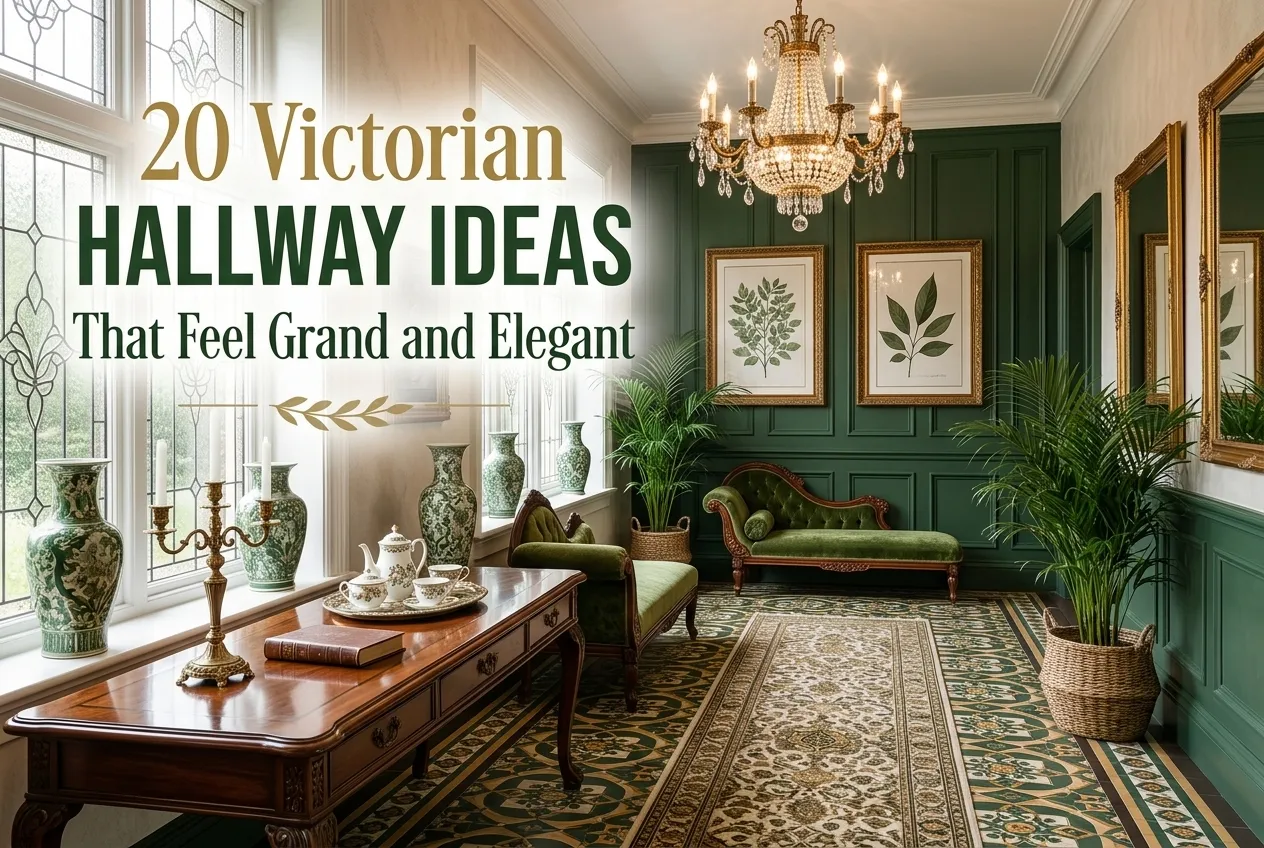
20 Victorian Hallway Ideas That Feel Grand and Elegant
Victorian hallway ideas are design approaches drawn from the 19th-century British aesthetic rich in detail, layered in texture, and built around creating a grand first impression the moment you walk through the door. Whether your home is a period property or a modern house you want to dress with character, these ideas blend ornate pattern, warm colour, and natural materials to transform even a narrow corridor into something that feels genuinely special. This article covers colour schemes, wallpaper styles, flooring choices, lighting, furniture, and accessories — all chosen to be approachable for beginners and inspiring for anyone who loves classic interiors.
Here are 20 ideas worth saving — and trying in your own home.
Why Victorian Hallway Style Works So Well
The Victorian era — roughly 1837 to 1901 — produced one of the most recognisable interior design languages in history. It was a period shaped by the Arts and Crafts movement, industrial prosperity, and a deep appetite for richness and symbolism in the home. Hallways were treated as the handshake of the house: the space that set the tone for everything beyond the front door.
The core materials of Victorian hallway design include encaustic floor tiles, dado rails, dark-stained wood, embossed wallpaper, and cast iron or brass hardware. These materials work together because each one adds a layer of visual interest — pattern against texture, warm wood against cool tile, soft candlelight against crisp white plasterwork.
Victorian style is popular now because it answers a specific mood: the desire for interiors that feel earned, layered, and deeply personal rather than minimalist and interchangeable. Pinterest users save Victorian hallway images because they feel different from everything else in their feeds. The style suggests history, warmth, and craftsmanship.
Victorian hallway ideas work well even in small spaces because the style relies on vertical height — tall wainscoting, stacked picture frames, and pendant lights all draw the eye upward, making narrow corridors feel taller rather than cramped.
20 Victorian Hallway Ideas
1. Encaustic Floor Tiles

Encaustic floor tiles were one of the defining features of Victorian entrance halls, prized for their handmade geometric patterns and earthy mineral pigments. The most classic combinations pair deep navy or teal with cream and terracotta, creating a floor that works as the visual anchor for everything above it. The tile’s matte surface absorbs light differently from polished stone, giving the floor a quiet warmth rather than a reflective sheen.
To recreate this look, choose tiles with a pattern repeat of around 10–15cm — small enough to feel detailed, large enough to read clearly. Lay them in a traditional diamond orientation for maximum period effect. If authentic encaustic tiles are outside the budget, Victorian-style porcelain alternatives from brands like Original Style or Topps Tiles cost a fraction of the price and are far more practical for busy hallways.
Budget tip: Encaustic-look vinyl floor tiles start from around £2 per tile and are available from most home improvement stores — a realistic rental-property-friendly option.
2. Deep Jewel-Tone Paint

If you want a hallway that feels genuinely Victorian, deep jewel-tone paint is the most effective single change you can make, because colour sets the entire emotional register of the space. Dark walls below a dado rail are one of the most recognisable signatures of period hallway design. The contrast between a rich green or navy lower half and a cream or off-white upper half gives the room visual structure without additional furniture.
Farrow & Ball’s Calke Green, Teal Blue, and Hague Blue are frequently used in this style and hold their depth well under both natural and artificial light. Apply the darker tone below the dado rail and carry it around door frames for a more immersive, authentic effect.
3. Dado Rail Detail

A dado rail — the horizontal timber moulding fixed at roughly chair-back height — is one of the most practical and visually useful details you can add to any hallway. In Victorian homes it originally protected plaster walls from chair damage in dining rooms, but in hallways it became purely decorative, dividing the wall into distinct colour zones. The rail works as a natural boundary between the darker lower wall and the lighter upper half, giving the composition structure and proportion.
Fix a dado rail at 90–100cm from the floor, which is the traditional height. Sand and prime bare wood before painting — the rail should contrast clearly with the wall colours on either side of it. For rooms with high ceilings, a matching picture rail near the ceiling completes the Victorian layered wall treatment.
You Might Also Like: 23 Bathroom Decor Ideas That Make Any Space Feel Luxurious
4. Victorian Wallpaper Panel

Anaglypta — a thick embossed wallpaper developed in 1887 — was a staple of Victorian hallways because it added the look of expensive plasterwork relief at a fraction of the cost. The deeply textured surface catches raking light from wall sconces and pendants, casting subtle shadows that make the pattern come alive in the evening. Modern reproductions of Victorian anaglypta are available in the original relief designs and can be painted in any colour.
Hang embossed paper below the dado rail only, then paint the upper wall in a complementary lighter shade. This limits the papering to a manageable section and keeps material costs down. Brush-painting over embossed wallpaper is easier than it looks — use a short-pile roller for the base coat, then brush into the recesses.
5. Ornate Brass Hardware

Brass hardware — door handles, coat hooks, umbrella stands, letterbox plates, and light switches — is among the smallest and most cost-effective changes you can make to shift a hallway’s character decisively toward the Victorian. The warm golden tone of solid or brass-plated fixtures reads as considered and crafted against dark paint colours. In the 19th century, polished brass was a signal of household pride, cleaned daily by domestic staff.
Replace plastic or chrome door furniture with a traditional Victorian-style set — lion’s head knockers, lever-style handles, and rim locks are available from specialist suppliers such as Ironmongery Direct or Jim Lawrence. Satin brass finishes are more forgiving than high-polish ones and develop an attractive patina over time without showing every fingerprint.
Budget tip: Brass-look coat hooks from supermarkets or discount homeware stores cost as little as £3–5 each and are visually indistinguishable from solid brass at normal viewing distance.
6. Staircase Panelling

Timber panelling along the wall of a staircase was standard in Victorian terraced and semi-detached houses, providing both visual richness and a practical layer of protection against everyday scuffs and knocks. When painted in brilliant white or soft cream and set against a deeply coloured wall, the panelling creates a strong graphic contrast that reads beautifully in photographs and in real life. The horizontal and vertical lines of the panelling add rhythm and structure to what can otherwise feel like a plain, transitional space.
To create this look in a modern home, use MDF tongue-and-groove panelling or a flat panel moulding system fixed directly to the existing wall. Prime and paint in a durable eggshell or satin finish — stairs attract significant wear. The key measurement is height: Victorian panelling typically ran to around 90–120cm, creating a deep, substantial lower section.
7. Pendant Lantern Light

Pendant lanterns were the primary hallway light source in the Victorian era, suspended from ornate ceiling roses on chains or rods. A lantern-style fitting — whether in black iron, aged brass, or verdigris — gives a modern hallway an authentic architectural centrepiece that no downlighter or flush fitting can replicate. The warm light thrown downward from an amber or flame-tip bulb casts the floor tiles and wall colour in a flattering, enveloping glow.
Choose a lantern sized to your ceiling height — for a standard 2.4m ceiling, a fitting of around 30–40cm in height looks proportionate. Use a ceiling rose canopy for a more considered finish. Pair with dimmable filament bulbs to shift between a welcoming daytime warmth and a dramatic evening atmosphere.
8. Wall Sconces

If you want warm, layered lighting in a Victorian hallway, wall sconces flanking a mirror or artwork are the most effective approach because they distribute light evenly at face height while illuminating the wall surface behind them. Victorian-era sconces were typically gas or oil — modern reproductions in antique brass, oil-rubbed bronze, or verdigris replicate the silhouette faithfully with LED bulbs. The soft light from a pair of sconces makes the wall texture of embossed paper or dado rail details visible in a way that top-down lighting never does.
Battery-powered, remote-controlled wall sconces have improved dramatically in quality and now represent a realistic no-rewiring option for renters and those who want to avoid electrical work. Place them at 150–160cm from the floor — slightly above eye level when seated, roughly at eye level when standing.
9. Stair Runner Rug

A stair runner — a long carpet that covers the centre of the stair treads while leaving the painted or stained edges of each step visible — was a fixture in Victorian homes of all sizes. The pattern of the runner adds colour and energy to the staircase while the exposed timber edges below give the composition clarity and proportion. Geometric patterns in the Moorish style, which were popular in the mid-Victorian period, look particularly strong in hallways with encaustic tiles because the two patterns echo each other without competing.
Choose a runner at least 60cm wide for a standard staircase, which leaves around 5–10cm of stair edge visible on each side. Fit brass stair rods in matching holders — these are available in kit form and fit in an afternoon without professional installation. The rods hold the runner in place and can be removed easily when the carpet needs replacing.
10. Gilded Mirror

A gilded mirror was a centrepiece of the Victorian hallway, valued not only for its practical function but as a display of taste and prosperity. In design terms, a large mirror opposite or angled toward the window doubles the apparent light and depth of any corridor, making even the narrowest entrance hall feel more generous. An ornate oval or arched frame in aged gold or verdigris fits the period character far better than a simple rectangular frame.
Look for secondhand mirrors on eBay, Facebook Marketplace, or at local antique shops — original Victorian and Edwardian mirrors with their foxed glass and gilded gesso frames are readily available and often less expensive than modern reproductions. Hang the mirror at full standing height, with the centre at approximately 150–160cm from the floor. Do not hang it too high — it should be useful as well as decorative.
Budget tip: Plain secondhand mirrors can be transformed with gold spray paint or gilding wax applied over the existing frame.
11. Botanical Print Gallery Wall

Botanical illustration — the detailed scientific recording of plant species — reached its artistic height during the Victorian era, when expeditions to tropical regions brought back hundreds of previously undocumented species. Framed botanical prints arranged in a symmetrical grid on a dark-painted wall are among the most visually cohesive and immediately recognisable elements of Victorian interior decoration. The precision and colour of botanical illustration suits dark backgrounds particularly well, as the fine linework and soft watercolour washes appear almost luminous against deep green or navy walls.
Choose prints in a consistent size — A4 or A3 — and frame them identically in simple black or dark wood frames. Arrange them on the wall in a neat grid rather than a casual cluster, which creates the formal, ordered quality that characterises Victorian interiors. Use a picture rail rather than individual wall hooks where possible — period homes had picture rails to avoid repeated damage to plaster walls.
12. Hall Console Table

The console table was an essential piece of Victorian hallway furniture — a narrow side table, typically no more than 35–40cm deep, that provided a surface for visitors to leave calling cards, hats, and gloves. In modern use it serves the same purpose at a practical level: somewhere to put keys, post, and whatever arrives with you at the front door. A dark wood console — mahogany, walnut, or ebonised oak — positioned against the lower section of the wall below a mirror is the most classically Victorian arrangement.
Style the surface deliberately: a single brass lamp, a small vase with trailing ivy or eucalyptus, and a tray for keys. Victorian hallway tabletops were never bare, but they were also never cluttered — the objects on them were chosen to represent the household’s taste. Below the table, a small wicker or rattan basket handles the practical overflow without fighting the decorative intent of the piece above.
13. Tiled Vestibule

In Victorian terraced houses, the tiled vestibule — the small covered porch between the front door and the inner hallway door — is one of the most architecturally specific and well-preserved features of the original design. Black and white geometric encaustic tiles were laid in these tiny spaces partly because the pattern is enormously hard-wearing and partly because it created an immediate visual impression of order and quality. The tiles were a public-facing statement as much as a practical floor covering.
If your home has an original tiled vestibule, preserve it: professional restoration is far less expensive than replacement. If the space has been covered or replaced, Victorian-style porcelain reproductions in classic geometric patterns are widely available. The vestibule walls are best kept simple — deep black or a very dark teal, which makes the decorative floor the centre of attention.
14. Dark Painted Front Door

The front door is the first piece of interior design a visitor encounters, and in the Victorian era it was taken seriously — painted in full gloss in deep, saturated colours and dressed with brass hardware that was polished to a mirror finish. Deep navy, racing green, and glossy black are the shades most closely associated with Victorian townhouses, and any of them transforms the first impression of a hallway dramatically. The high-gloss finish is important: it gives the door weight and formality that a matt or satin finish does not.
Painting a front door takes most of a day with preparation. Strip or sand back existing paint to a smooth base, apply a wood primer, then two coats of oil-based gloss in your chosen colour. If the door has original moulding panels, use a brush to work paint into the recesses before rolling the flat sections — Victorian door mouldings are part of the architectural character and should remain visible rather than being filled out by thick paint.
15. Cast Iron Radiator Cover

Traditional column radiators — modelled on the cast iron originals introduced in the late Victorian period — are among the most effective ways to add period-appropriate detail while solving a practical heating problem. Their vertical ribbed structure suits Victorian architectural proportions far better than modern flat panel radiators, and they work beautifully in hallways where they can double as a design feature. Painted in heritage colours — cream, anthracite, or deep forest green — they read as integral to the room rather than as an afterthought.
Replace existing flat panel radiators with cast iron or cast iron-effect column alternatives, available from suppliers such as Castrads or UK Radiators. A narrow double-column model at 600mm height suits most Victorian hallways without obstructing floor space. Fit traditional angled valves in matching brass or chrome and add a slim wooden shelf above to create a small display ledge.
16. Vintage Coat Stand

A freestanding coat stand was standard in Victorian entrance halls before fitted storage became the norm — it offered hooks for coats, hats, and umbrellas in a single tall piece of furniture that took up minimal floor space. In dark walnut or mahogany with turned legs, brass hooks, and sometimes a small base tray for umbrellas or wet shoes, a Victorian-style coat stand adds strong vertical presence to any hallway and solves the practical problem of where to put outer clothing without screwing hooks into the wall.
If you have a rented property or a period home where you want to avoid wall fixings, a freestanding stand is the single most useful and characterful piece of furniture you can add to a Victorian-style hallway. Position it near the front door where it is immediately accessible, but not so close to the entrance that it reads as clutter. Look for original Edwardian or early 20th-century stands at local auction houses or online vintage platforms.
17. Dark Wood Staircase Banister

The staircase was a Victorian household’s most visible structural statement, and its banister — the handrail, spindles, and newel posts — was typically finished in dark-stained timber that contrasted with white-painted risers and skirting. The most characteristic element is the turned spindle: a lathe-shaped upright baluster with a series of decorative swellings and grooves that gives the staircase its distinctive visual rhythm. If your Victorian home still has its original staircase, preserving or restoring these details is among the highest-value things you can do for the property’s character.
To restore a painted Victorian banister, strip the paint from the handrail, newel posts, and spindles using chemical stripper or heat — work section by section and protect the floor below. Sand back to clean wood, then apply a dark stain in walnut or ebony followed by two coats of hard-wax oil or satin varnish. Repaint the stair risers brilliant white to restore the classic contrast.
You Might Also Like: 20 Bathroom Picture Ideas by Style, Budget & Size
18. Picture Rail and Artwork Hang

The picture rail — a horizontal moulding fixed near the ceiling from which pictures were hung on hooks and cords — was a Victorian invention born of necessity. In houses with thick plaster walls and fashionable dark paint, it made far more sense to suspend artwork from a robust rail than to hammer nails repeatedly into expensive walls. Today the picture rail solves the same problem for renters and for homeowners who want flexible arrangements without damage. The rail itself is a decorative detail: painted to match either the ceiling or the cornice, it adds a horizontal line that emphasises ceiling height.
Add picture rail moulding at approximately 30cm below the ceiling, or at the level of any existing cornice. Victorian-style moulding is available from timber merchants and fits over the existing wall with adhesive and pin nails. Use traditional iron picture hooks and black or brass chain to hang artwork — the visible cord and hook is authentically Victorian and is part of the aesthetic, not a feature to hide.
19. Transom Window Detail

The transom window — a fixed window above the front door, often containing coloured or etched glass — was a defining Victorian architectural feature that served practical and decorative purposes simultaneously. It admitted natural light into the hallway in an era before electric lighting while the coloured glass cast jewel-toned pools of amber, red, and green light across the tile floor below. This play of coloured light changes through the day as the angle of sunlight shifts, creating an ever-changing quality that no artificial light source can replicate.
If your Victorian home still has its original coloured glass fanlight, preserve it carefully — it is one of the features buyers and valuers most positively respond to. If the glass has been removed or replaced with plain glazing, coloured glass panels can be made to measure and installed within the existing frame by a glazier. Alternatively, coloured glass window film — applied directly to plain glass — creates a similar effect at minimal cost.
Budget tip: Self-adhesive coloured glass film from craft and window film suppliers costs around £10–20 per metre and is convincing enough for most hallways.
20. Planted Corner

Plants were a serious preoccupation in Victorian Britain — the era that produced the Wardian case, the winter garden, and the fashion for ferns (pteridomania, as contemporaries called it). A large fern, trailing ivy, or architectural cast iron plant stand in a Victorian hallway corner anchors the space with organic life, providing a counterpoint to the formal geometry of the tiles and the stiffness of the furniture. Dark-leafed plants, in particular, suit the rich, warm colour palette of a Victorian interior far better than pale or silver-leafed varieties.
Use a terracotta pot in a deep or unglazed finish, which echoes the mineral palette of encaustic tiles, or a brass or verdigris cache-pot that matches the hardware throughout the hallway. Trailing ivy is particularly well-suited to hallways with limited natural light and can tolerate quite cool temperatures near a front door. Position the plant where it does not obstruct foot traffic but is clearly visible from the front door.
How to Start Your Victorian Hallway Transformation
The single most effective first move in a Victorian hallway is to paint the lower wall — below the dado rail, or where a dado rail will go — in a deep jewel tone. This one change immediately shifts the emotional register of the space, and everything else can follow at its own pace. Choose forest green, deep teal, navy, or a rich terracotta, and use the most durable matt or eggshell finish you can find.
The most common beginner mistake in Victorian hallway design is trying to do everything at once and ending up with a collection of period-adjacent objects that do not cohere. Adding a brass mirror, a Victorian-style lamp, and patterned wallpaper all in the same week without a clear visual plan often results in a busy rather than layered effect. The fix is to establish one main design decision — the paint colour and dado rail division — and then add objects one at a time, standing back to assess after each addition.
Three budget entry points under £50 that make an immediate difference: a pot of Earthborn Eggshell paint in a deep heritage shade (around £25 for 2.5 litres), a simple Victorian dado rail kit from a timber merchant (around £10–15 for a standard hallway length), and a secondhand gilded mirror from Facebook Marketplace or a local charity shop (typically £15–40 for a usable size).
In terms of realistic expectations: the paint, dado rail, and mirror can all be done in a single weekend for under £100 total. A stair runner, new hardware, and lighting updates typically take one to three months to source and install. A starter budget for a basic Victorian hallway refresh sits at around £100–300. A full transformation including flooring, radiator, wall panelling, and light fitting typically runs to £800–2,000 depending on material choices and whether professional fitting is required.
The best first step for a Victorian hallway is to paint below the dado rail in a deep heritage colour, which instantly establishes the period character and makes every subsequent decision easier to judge against a fixed point of reference. The most common mistake in Victorian hallway design is adding too many decorative objects before establishing the wall treatment, which is the visual foundation the entire style depends on.
Final Thoughts
These 20 Victorian hallway ideas cover the full range of what makes this style so distinctive and enduring — from the geometric tile underfoot to the ornate lantern overhead, and every dado rail, gilded mirror, and botanical print in between. You do not need a period property to try any of them, and you do not need a large budget to start. The easiest way to start is to paint the lower half of your hallway wall in a deep jewel tone and add a simple dado rail above it — that single change will transform the feel of the space more dramatically than almost anything else. Save this post on Pinterest so you can come back to it as your hallway evolves, try one idea this weekend, and share it with anyone whose entrance hall could do with a little more character.
Frequently Asked Questions About Victorian Hallway Decor
What makes a hallway look Victorian?
A hallway looks Victorian when it combines a few specific design elements: a dado rail dividing the wall into two colour zones, rich jewel-tone paint below it, encaustic or patterned tile flooring, and period-style hardware in brass or iron. You do not need all of these at once — the dado rail and dark lower-wall paint alone will shift a modern hallway significantly toward a Victorian character. Original architectural details like picture rails, cornicing, and panelled doors reinforce the period feel when present.
What colours are most authentic for Victorian hallways?
The most historically authentic Victorian hallway colours are deep forest green, teal, olive, burgundy, terracotta, slate blue, and warm cream. Victorian paint was made with mineral and earth pigments, which gave it a particular depth and warmth that many modern paints try to replicate. Farrow & Ball, Little Greene, and Edward Bulmer Natural Paint all produce ranges specifically informed by Victorian and Edwardian interior colour palettes. The two-tone wall treatment — dark below the dado rail, lighter above — is the most characteristic Victorian arrangement.
How much does it cost to create a Victorian-style hallway?
A basic Victorian hallway update — paint, dado rail, and one or two accessories — can be achieved for under £200 in most standard-sized hallways. More substantial changes including new flooring, a column radiator, and a stair runner typically cost between £500 and £1,500. A full period-style renovation including professional tiling, lighting, and bespoke joinery can reach £3,000–5,000 or more. The good news is that Victorian style is well-served by budget alternatives: secondhand mirrors, repurposed furniture, and mass-market encaustic-look tiles are all convincing at normal viewing distances.
Can Victorian hallway ideas work in a small or narrow space?
Victorian hallway ideas work particularly well in small and narrow spaces because the style relies on vertical emphasis rather than horizontal spread. Dado rails, picture rails, pendant lanterns, and tall mirrors all draw the eye upward, making narrow corridors feel taller rather than cramped. Dark paint colours — counterintuitively — often make small hallways feel more considered and atmospheric rather than smaller, because they remove the visual noise of plainly lit beige walls. A slim console table and a freestanding coat stand provide full hallway functionality without requiring width.
What flooring is most appropriate for a Victorian hallway?
Encaustic patterned tiles are the most historically appropriate flooring for a Victorian hallway, particularly in the geometric designs typical of the 1860s–1890s. Black and white geometric, navy and terracotta, and earth-tone repeating patterns are all authentic to the period. Original encaustic tiles are expensive and often need professional restoration, but high-quality porcelain reproductions from suppliers such as Original Style, Tile Source, or Victorian Plumbing are widely available and far more durable for modern use. For budget installations, encaustic-look vinyl or LVT tiles offer a similar visual effect at a fraction of the cost.