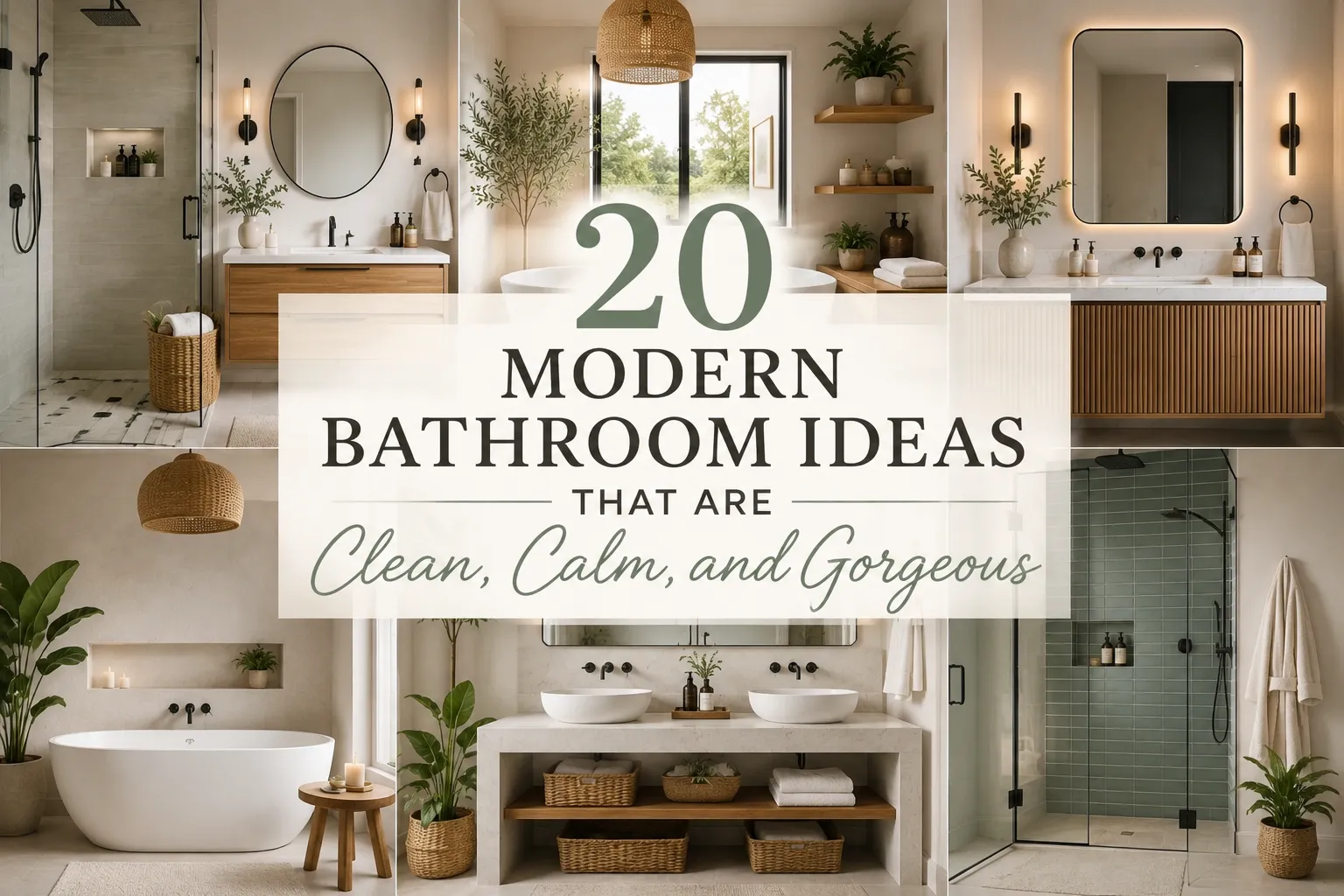
20 Modern Bathroom Ideas That Are Clean, Calm, and Gorgeous
Modern bathroom ideas are design choices — in color, material, lighting, and layout — that strip a space down to what actually matters: clean lines, honest materials, and light that does the work instead of clutter. This guide walks through 20 of them, organized so you can pull exactly what fits your space.
There’s a particular kind of quiet that a well-designed modern bathroom holds. Cool stone underfoot, a single brass fixture catching the morning light, a mirror that reflects space instead of stuff — it feels less like a room you clean and more like a room that resets you. In my experience, the bathrooms that photograph the best are rarely the most expensive ones; they’re the ones where every material was chosen on purpose. That’s the core of modern style: restraint that still feels warm, not sterile. Here are 20 ideas worth saving — and stealing.
Why Modern Works So Well
Modern bathroom design traces back to early-20th-century movements like Bauhaus and mid-century modernism, both of which prioritized function over ornament. Designers such as Dieter Rams shaped the “less but better” philosophy that still governs modern fixtures today — visible in the flat-panel vanities and unfussy hardware you’ll see throughout this list. The style isn’t cold by accident; it’s edited on purpose.
The core materials of modern bathroom design include large-format porcelain tile, honed marble or quartz, matte black or brushed nickel metal, and white oak millwork. Color palettes stay tight: warm white, greige, charcoal, and the occasional terracotta blush or dusty sage for contrast. These aren’t trend colors — they’re chosen because they read as neutral in almost any light, which is why they photograph consistently well.
You Might Also Like: 20 Bathroom Picture Ideas by Style, Budget & Size
20 Modern Bathroom Ideas
1. A Greige Wall That Grounds the Room

Greige sits between warm and cool, so it reads as neutral under both daylight and LED vanity lighting — a design principle called color-temperature flexibility. It also gives a small bathroom depth without the visual weight of a true dark tone.
Paint one wall (usually behind the vanity) in a matte greige like Benjamin Moore’s “Revere Pewter,” and keep the remaining three walls in warm white to avoid the room feeling boxed in.
2. White Oak Vanity as the Room’s Warm Anchor

Modern design leans minimal, and unfinished white oak solves the “too cold” complaint by adding grain and warmth without breaking the palette — a technique called material contrast, popularized in Scandinavian interiors.
Choose a floating oak vanity with visible, uncoated grain rather than a stained or painted finish; the natural variation does the visual work that decor otherwise would.
3. A Single Statement Pendant Over the Vanity

A single pendant, rather than a symmetrical double sconce setup, uses asymmetry as a design principle — it draws the eye and signals intentionality rather than a builder-grade default.
Hang one fluted glass pendant 30–34 inches above the counter, off-center if your mirror allows, rather than centering it directly over the sink.
4. A Bench Where the Bathtub Meets the Wall

Furniture in a bathroom — rather than built-ins only — softens the room’s hard surfaces and applies the same scale-and-proportion logic used in living rooms, making the space feel considered instead of purely functional.
Place a low, backless wood bench at the foot of the tub for towels; keep it under 18 inches tall so it doesn’t compete visually with the tub’s silhouette.
5. A Minimal Tray for Everyday Essentials

Corralling loose items onto one tray applies visual grouping, a principle that reduces perceived clutter by up to half without removing a single object from the counter.
Limit the tray to three items maximum — a soap, a lotion, and one decorative object — and rotate the rest into a closed drawer.
6. Charcoal Grout for Quiet Contrast

Dark grout on white tile creates a graphic pattern that reads as intentional rather than “dirty grout syndrome” — the most common complaint with white-on-white tile in high-moisture rooms.
Use a charcoal or dark gray sanded grout with classic 3×6 subway or square tile; keep the grout line width consistent at 1/8 inch for a clean, uniform grid.
7. Terrazzo Flooring for Subtle Texture

Terrazzo, a material that originated in 15th-century Venice from discarded marble chips, gives a modern bathroom pattern without color, satisfying the style’s rule that texture — not color — carries visual interest.
Choose a large-format terrazzo-look porcelain tile (24×24 inches or bigger) rather than small mosaic terrazzo, which reads busier and more traditional.
8. A Wet Room Layout That Removes the Shower Curb

Removing the shower curb and running one continuous floor tile through the whole room eliminates a visual “stop point,” a layout principle that makes even an average-sized bathroom read larger.
If you want a bathroom that feels bigger without adding square footage, a curbless wet-room layout with continuous flooring is the most effective approach — plan for a slight floor slope toward a linear drain.
9. Backlit Mirrors for Shadowless Light

Traditional overhead lighting casts shadows under the eyes and chin; a backlit LED mirror lights the face evenly from the front, a functional-lighting principle borrowed from professional makeup studios.
Choose a mirror with a color temperature between 3000K and 4000K — anything cooler reads clinical, anything warmer distorts how makeup and skin tone actually look.
10. A Slim Console Instead of a Bulky Vanity

An open-legged console lets floor and wall color continue underneath, which is the negative-space principle at work — the eye reads more open floor, so the whole room feels bigger even though square footage hasn’t changed.
Choose a console with legs no thicker than one inch in matte black iron, which visually disappears more than chrome or brass under bright bathroom lighting.
You Might Also Like: 34 Vanity Ideas for Bathroom That Looks Stylish and Elegant
11. Rolled Towels Displayed Like Objects

Rolling towels instead of folding them flat uses shape repetition, a display technique borrowed from spa design that turns a functional item into visual texture.
Stick to two tonal colors maximum — oatmeal and warm white, for example — so the towels read as a set rather than a mismatched pile.
12. A Terracotta Blush Accent for Warmth

A muted terracotta reads as a neutral rather than a “trend color” because its undertone is close to skin and wood tones, which is why it pairs cleanly with the white oak and marble already common in modern bathrooms.
Contain the color to a single alcove, niche, or half-wall rather than all four walls, so it acts as an accent instead of overwhelming the palette.
13. Honed Marble Instead of Polished

Honed marble — ground to a matte finish rather than polished glossy — hides water spots and etching far better in a high-moisture room, a durability fact that matters as much as the look. Calacatta and Carrara are the two marble varieties most commonly used this way.
Ask your fabricator specifically for a honed, not polished, finish; the material is the same stone, but the surface treatment changes both the look and the long-term maintenance.
14. A Corner Shower to Reclaim Floor Space

Angling a shower into a corner rather than a full wall frees up a rectangular floor zone in the room’s center — small-space design math that gains usable floor area without touching the footprint.
If you want a small bathroom to feel less cramped, a corner shower paired with a wall-hung toilet is the most effective approach, since both choices free up visible floor space.
15. Warm-Dimmed Sconces Flanking the Mirror

Vertical sconces placed at eye level on either side of the mirror — rather than a single overhead fixture — eliminate the shadow-casting angle that overhead light creates, a lighting principle used in professional vanity setups.
Mount sconces roughly 28–30 inches apart, centered at eye height, and pair them with a dimmer so the same fixture works for both bright grooming light and a softer evening mood.
16. A Freestanding Tub as the Room’s Furniture Piece

Treating a tub as a furniture-like focal point — rather than tucking it against a wall — uses the same principle interior designers apply to a statement sofa: one confident shape anchors the whole room.
Angle the tub slightly rather than squaring it to the wall, and add a low wood stool beside it to hold a candle or book, reinforcing the “furniture, not fixture” read.
17. A Single Framed Art Print Above the Toilet

One piece of art on an otherwise empty wall applies restraint as decoration — a modern-design rule where a single object carries more visual weight than a cluster of smaller ones would.
Choose one black-and-white or single-tone print in a thin matte black frame, hung at eye level, and leave the surrounding wall bare rather than adding a shelf beneath it.
18. A Charcoal Vanity for Bold Contrast

A dark vanity against light walls reverses the usual “dark floor, light walls” rule, using color-block contrast to make the cabinetry itself the room’s focal point rather than a background element.
Pair a charcoal or near-black vanity with brushed brass hardware rather than matte black, so the metal reads as a highlight instead of blending into the cabinet color.
19. Limewash Walls for Soft, Cloud-Like Texture

Limewash, a centuries-old plaster technique, creates subtle tonal variation across a wall the way flat paint can’t — giving a small bathroom texture without adding pattern or color that competes with fixtures.
Apply limewash with a natural bristle brush in cross-hatch strokes and leave the variation visible; over-blending it defeats the texture that makes the technique worth using.
20. A Galley Layout for Narrow Bathrooms

Running fixtures along two parallel walls instead of clustering them on one uses a galley-kitchen layout principle adapted for bathrooms — it distributes visual weight evenly down the length of a narrow room instead of crowding one side.
Keep the vanity and shower directly across from each other rather than staggered, so sightlines run straight down the room and read as longer and more deliberate.
You Might Also Like: 23 Bathroom Decor Ideas That Make Any Space Feel Luxurious
How to Start Your Modern Bathroom Transformation
Start with the vanity finish, not the paint color. The vanity is the single largest fixed element in most bathrooms, so choosing its material — white oak, charcoal-painted, or marble-topped — sets the tone every other decision has to match.
The most common mistake is mixing metal finishes without a plan — brushed nickel faucet, matte black hardware, and brass mirror all in one room reads as unfinished rather than eclectic. Pick one primary metal and use a second only as a deliberate accent, such as brass on lighting alone.
Three items under $50 that make an immediate difference: a matte ceramic soap dispenser ($19), a single stem in a bud vase ($22), and a set of two waffle-weave hand towels in a tonal neutral ($27).
A full modern bathroom transformation typically takes 3–6 weeks for a contractor-led remodel and runs $8,000–$25,000 depending on tile and fixture choices. A weekend refresh — paint, hardware, textiles, and lighting swaps — can shift the whole feel for $200–$600 and is genuinely achievable without a contractor.
Ready to Create Your Dream Modern Bathroom?
Twenty ideas, and not one of them requires doing everything at once — a greige wall here, a honed marble swap there, one confident pendant light instead of a builder-grade flush mount. That’s the real throughline across color, materials, layout, and lighting in this list: modern bathroom ideas work best layered in gradually, not installed all at once. Starting small isn’t a compromise; it’s how the most considered rooms actually get built.
If you’re not sure where to begin, pick one thing today: swap your hardware to a single consistent metal finish. It’s a $50 change that immediately makes the room look more resolved. I’ve seen how a change that small can shift how an entire space feels — calmer, more deliberate, less like a room you’re managing and more like one you enjoy. Save your favorites from this list, try one in your own space this weekend, and pass it along to anyone mid-renovation who needs the nudge.
Frequently Asked Questions About Modern Bathroom Design
What’s the difference between modern and contemporary bathroom design?
Modern bathroom design refers specifically to the clean-lined, function-first style rooted in early-20th-century movements like Bauhaus, while contemporary describes whatever is current right now and shifts over time. Modern favors consistent materials — white oak, marble, matte black metal — and rarely changes its core palette. Contemporary bathrooms might borrow modern elements one year and organic curves the next. If you’re searching for a timeless look rather than a current trend, modern is the more stable reference point.
What colors work best in a modern bathroom?
The most effective color palette for a modern bathroom is warm white paired with one grounding neutral like greige or charcoal. These tones stay consistent under both daylight and LED vanity lighting, which matters more in bathrooms than almost any other room. A single accent — terracotta blush or dusty sage — can be added through paint, tile, or textiles without breaking the palette. Stark cool white and pure black together tend to read clinical rather than calm.
How much does a modern bathroom remodel cost?
A modern bathroom remodel costs between $8,000 and $25,000 for a full renovation, depending on square footage, tile choice, and whether plumbing is being relocated. A cosmetic refresh — new vanity, fixtures, paint, and lighting without moving plumbing — typically runs $2,000–$5,000. Marble and large-format porcelain tile push costs toward the higher end, while ceramic tile and a prefabricated vanity keep it lower. Labor generally makes up 40–50% of the total budget.
Does modern bathroom style work with an older or traditional home?
Yes, modern bathroom style works in older homes when it’s balanced against the home’s existing architecture rather than fighting it. In a Victorian or Craftsman home, keep original trim and door casings while updating fixtures, tile, and paint to modern finishes — the contrast between historic bones and modern surfaces often looks more intentional than a fully matched modern build. The key is choosing one or two modern anchor pieces, like a floating vanity, rather than stripping every original detail.
What’s the most-searched modern bathroom feature right now?
The most-searched modern bathroom feature right now is the floating vanity, largely because it solves two problems at once: it visually enlarges small bathrooms and it’s achievable without a full plumbing overhaul in most cases. Floating vanities pair naturally with large-format tile that runs underneath them, reinforcing the open-floor effect. They’re available from budget retailers like Wayfair starting around $400, up through custom millwork pieces well over $2,000.