
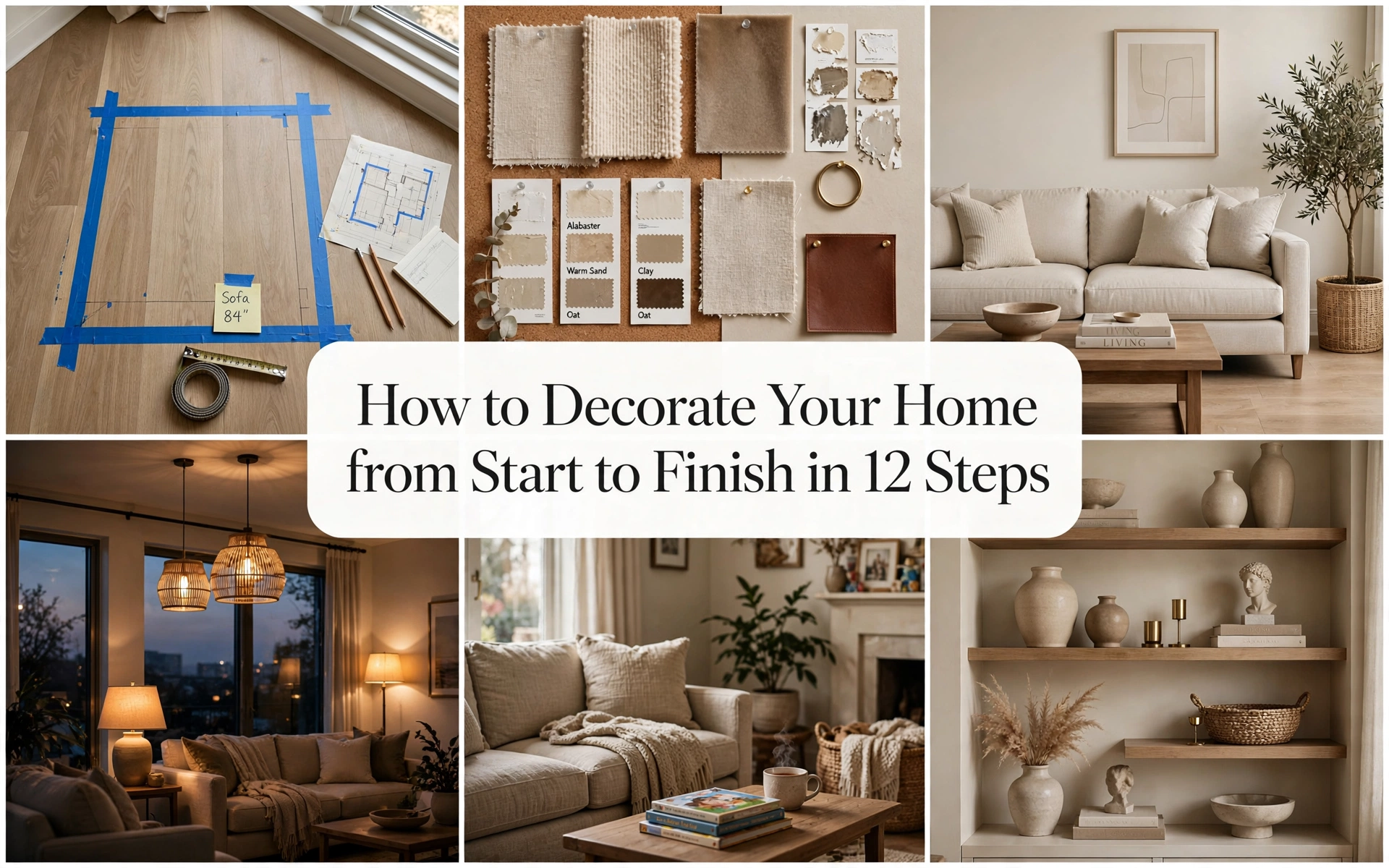
How to Decorate Your Home from Start to Finish in 12 Steps
Standing in an empty home can feel wonderfully hopeful for approximately five minutes. Then the decisions arrive: Which room comes first? Should you choose paint or a sofa? Does every wood finish need to match? What if the rug is too small? And why does the room in your head feel warmer than the collection of products in your shopping cart?
The answer is rarely “better taste.” It is usually a better sequence.
A professionally decorated home is built in layers. First comes the way you need the home to function. Next come measurements, budget, palette, layout, and permanent finishes. Furniture follows, then lighting, textiles, artwork, and the small personal details that give the rooms emotional depth.
The goal is not to finish your home as quickly as possible. It is to make each decision support the next one, so you spend less, regret fewer purchases, and gradually create a home that feels unmistakably yours.
1. Start With the Life You Live
Before naming your style, describe your life.
A family that eats dinner together every evening needs a different home from a couple who entertains large groups twice a month. A beautiful white bouclé sofa may photograph perfectly, but it will create more anxiety than comfort in a home with muddy paws, small children, or frequent takeaway dinners.
Write a short lifestyle brief for each room. Include what happens there, who uses it, what currently causes frustration, and how you want the room to feel.
For example:
“Our living room needs to seat five comfortably, hide toys at the end of the day, support movie nights, and still feel calm enough for adults after the children are asleep.”
That sentence is more useful than declaring that you want a “modern living room.” It guides the sofa size, fabric, storage, lighting, and layout.
Choose Feeling Words Before Style Labels

Select three feeling words for the whole home, such as:
- Calm, warm, and collected
- Airy, natural, and relaxed
- Tailored, elegant, and intimate
- Colorful, creative, and playful
Use these words as a filter. A piece does not need to match a rigid style, but it should reinforce at least two of the feelings.
Designer Tip: Describe what you want your home to feel like at 8 p.m., not only how you want it to appear in daylight. Evening life reveals whether the seating, lighting, privacy, and atmosphere genuinely work.
Common Mistake: Designing for an imaginary version of yourself. A formal dining room has little value if your family always eats in the kitchen and needs a homework station instead.
Budget Hack: Before buying anything, rearrange what you already own according to real activities. Better placement can solve problems that look like shopping problems.
Luxury Upgrade: Commission one tailored solution—a window seat, fitted bookcase, or precisely sized dining banquette—that supports a meaningful daily ritual.
2. Photograph, Measure, and Evaluate Your Home
Your next step is not shopping. It is observation.
Photograph each room from every corner. Pictures flatten a space, making awkward gaps, visual clutter, unbalanced furniture, and poor lighting easier to notice. Record what must remain, what can move, what needs repair, and what should leave.
Next, create a basic floor plan. You do not need professional software. Graph paper or a simple room-planning app is enough.
Record:
- Wall lengths
- Ceiling height
- Window dimensions
- Door swings
- Fireplace and radiator positions
- Electrical outlets
- Light switches
- Air vents
- Built-in features
- Hallway and staircase widths
- Elevator and doorway clearances
Measure existing furniture too. A room plan becomes much more useful when it shows what you already own.
Make a Keep, Move, Repair, or Release Inventory
Evaluate each piece based on function, condition, scale, and emotional value.
A dresser inherited from a grandparent might deserve restoration even if it is not perfectly aligned with your chosen style. A trendy chair that is uncomfortable deserves less loyalty. Personal history brings authenticity; inconvenience does not.
Styling Secret: An older piece often looks more intentional when placed beside something visibly contemporary. Contrast gives it presence. Trying to surround it with imitation antiques can make the room look themed.
Common Mistake: Treating every existing purchase as a permanent design constraint because money was once spent on it. Keeping the wrong item can lead to several additional purchases intended to make it work.
Budget Hack: Move pieces between rooms. A bedroom chest can become an entryway console, while a small dining cabinet can provide linen storage in a hallway.
3. Establish a Realistic Whole-Home Budget
A decorating budget should include more than furniture. Delivery, assembly, paint supplies, curtain hardware, electrical work, rug pads, frames, and returns can quietly consume a large portion of the total.
Divide the budget into five categories:
| Category | Suggested Share |
| Repairs and permanent finishes | 20–30% |
| Anchor furniture | 35–45% |
| Lighting and window treatments | 15–20% |
| Rugs, textiles, art, and accessories | 10–20% |
| Contingency | 10% |
These percentages can change. A renter might spend very little on permanent finishes and more on portable furniture. A renovation may require a much larger structural allocation.
Decide Where to Invest
Spend more on items that:
- Support your body
- Receive daily use
- Are expensive or wasteful to replace
- Define the scale of a room
- Need to withstand children, pets, or heavy traffic
That usually includes mattresses, sofas, dining tables, ergonomic chairs, upholstery, and quality window hardware.
Save on items that are easy to change, such as pillow covers, small side tables, decorative bowls, seasonal textiles, and trend-led colors.
Designer Tip: Calculate cost per use, not merely purchase price. A comfortable sofa used every day for ten years can be better value than a cheap sofa replaced after two.
Budget Hack: Leave intentional gaps. An empty corner costs nothing and looks calmer than a temporary piece you never really wanted.
Luxury Upgrade: Invest in professional curtain alterations. Affordable ready-made panels look considerably more expensive when they are lined, properly hemmed, and hung at the correct height.
4. Define Your Decorating Direction
Collect 15 to 25 inspiration images, but do not stop at saving them. Study the patterns.
Ask:
- Are the rooms light or moody?
- Is the furniture tailored or relaxed?
- Are the woods pale, medium, or dark?
- Is contrast gentle or dramatic?
- Are surfaces minimal or collected?
- Does the artwork introduce color?
- Are the lines mostly straight or curved?
- Which materials keep repeating?
You may discover that you do not actually want “farmhouse,” “modern,” or “traditional.” You might want warm woods, simple upholstery, aged brass, linen curtains, and one antique piece per room. That description is specific enough to guide shopping while leaving room for individuality.
Create a Decision-Making Mood Board

A useful mood board should include:
- Three feeling words
- Five or six colors
- Two wood tones
- One or two metal finishes
- Key fabrics
- Flooring
- Representative furniture shapes
- Lighting style
- Art direction
- One image showing the desired overall mood
Do not fill it with complete rooms alone. Include close-up material images so you can evaluate how the finishes relate.
Common Mistake: Copying every detail from one inspiration room. Your architecture, daylight, possessions, climate, and routines are different.
Styling Secret: Include one controlled contradiction. A sculptural modern lamp in a traditional room—or an antique table in a minimal room—prevents the design from feeling like a furniture catalog.
5. Build a Cohesive Whole-Home Palette
Cohesion does not mean painting every room the same color. It means giving the eye recognizable connections as it moves through the home.
Begin with a foundational neutral influenced by fixed features such as flooring, stone, cabinetry, and countertops. Determine whether those materials lean warm, cool, or balanced.
Then choose:
- One dominant neutral
- One supporting neutral
- Two or three recurring accent colors
- One darker grounding color
- Two principal wood tones
- One dominant metal and one supporting metal
A warm scheme might combine soft cream, mushroom, walnut, olive, muted rust, charcoal, aged brass, and a small amount of black.
Use the palette in different proportions. Olive might appear as upholstery in one room, artwork in another, and a small ceramic object in the hallway. Repetition creates connection without duplication.
Mix Woods and Metals Intentionally
Wood tones do not need to match, but each should appear more than once. If a dining table is walnut, repeat walnut in frames, chair legs, or a nearby cabinet.
Metals work similarly. Choose one dominant finish and allow a second as an accent. Black iron and aged brass often coexist well because one reads as structural and the other as decorative.
Common Mistake: Trying to match almost-identical woods. Slightly mismatched finishes can look accidental. A clearly lighter or darker second wood creates confident contrast.
Budget Hack: Use paint, stain, new knobs, or repeated frames to connect secondhand pieces with different finishes.
Luxury Upgrade: Repeat a natural stone, specialist plaster, or custom millwork color across two or three sightlines rather than using an expensive finish only once.
6. Plan Every Room Before Buying

Each room needs a focal point, an activity plan, and a clear route through it.
The focal point might be a fireplace, view, bed, artwork, bookcase, or sculptural light. Arrange the room to acknowledge it, but do not force every chair to face it directly.
Next, mark the primary walking path. People should not have to weave around tables or squeeze between furniture. In frequently used routes, aim for approximately 30 to 36 inches of clearance when space permits.
Test the Layout at Full Scale
Use painter’s tape to mark the dimensions of sofas, beds, rugs, consoles, and dining tables on the floor. Build cardboard mockups for important heights, such as a headboard or side table.
This simple exercise reveals whether:
- A sectional overwhelms the room
- A coffee table blocks circulation
- A dining chair can be pulled out
- A console feels too deep
- A bed leaves enough space for nightstands
- A pendant will align with the table
Designer Tip: Design the space between furniture as carefully as the furniture itself. Comfortable negative space is one of the strongest differences between a polished room and an overcrowded one.
Common Mistake: Pushing every piece against a wall. Floating a sofa or chair can improve conversation and make a large room feel intimate.
Budget Hack: Use online floor-planning tools and taped outlines before ordering. Preventing one unsuitable furniture purchase can save more than any sale discount.
7. Complete Repairs and Permanent Surfaces
Now deal with the parts of the home that are difficult, messy, or expensive to change later.
A practical sequence is:
- Repair moisture, electrical, plumbing, or structural issues.
- Remove unwanted built-ins, flooring, or wall coverings.
- Complete new electrical and lighting locations.
- Repair and prepare walls.
- Install or refinish flooring as appropriate to the project.
- Paint ceilings, trim, doors, and walls.
- Install fixed lighting and hardware.
- Touch up after major deliveries.
The exact order may change according to the flooring material and contractor requirements, but the principle remains: complete disruptive work before filling the room.
Test Paint in the Actual Space
Never select paint from a small store chip alone. Apply large samples to movable boards and observe them beside the flooring and trim in morning, afternoon, and artificial light.
Choose paint after establishing the broader material and furniture direction. There are thousands of paint colors but far fewer suitable sofas, stones, rugs, and fabrics. It is easier to adjust paint to an anchor item than to find an anchor item that matches a prematurely chosen wall color.
Common Mistake: Testing several tiny paint rectangles together. Adjacent colors influence one another and make accurate judgment difficult.
Budget Hack: A consistent trim color can unify rooms even when the walls differ.
Luxury Upgrade: Use durable finishes on trim and doors, then introduce depth with limewash, mineral paint, wallpaper, or subtle panel molding in one focal area.
8. Buy Anchor Furniture First

Anchor furniture determines function and scale. In most rooms, this means:
- Living room: sofa
- Bedroom: bed and mattress
- Dining room: table
- Office: desk and chair
- Entryway: storage or console
Choose these pieces before small tables and accessories.
Evaluate more than appearance. Check seat depth, cushion construction, fabric durability, maintenance requirements, dimensions, door access, stair turns, and delivery conditions.
A beautiful sofa that causes back discomfort is not a successful design choice. A dining table that seats eight but leaves no room to walk around it will make every meal awkward.
Balance the Silhouettes
If the sofa is deep and visually heavy, choose chairs with exposed legs or lighter frames. If the bed has a tall upholstered headboard, keep nearby furniture quieter. Rooms feel balanced when not every item competes for visual weight.
Designer Tip: Buy the fewest pieces required to make the room functional. Live with them briefly before deciding what is missing.
Common Mistake: Buying a matching furniture set. It removes the decisions, but it also removes the visual evolution that makes a room feel personal.
Budget Hack: Combine a high-quality anchor piece with vintage or inexpensive supporting furniture. A good sofa can elevate a thrifted side table far more effectively than the reverse.
Luxury Upgrade: Choose one exceptional material—hand-finished wood, top-grain leather, mohair, or a beautifully woven performance fabric—and allow it to be the tactile focus.
9. Add Rugs, Curtains, and Textiles
Textiles correct the acoustic and visual hardness of a room. They also introduce softness, color, pattern, and a sense of completion.
Choose a rug large enough to connect the furniture group. In a living room, the front legs of the sofa and chairs should usually rest on it. In a dining room, it should extend far enough beyond the table for chairs to remain on the rug when pulled out. Beside a bed, it should provide a comfortable landing for bare feet.
Curtains generally look most intentional when the rod is installed above and beyond the window frame, allowing the panels to frame rather than cover the glass. Full-length curtains visually stretch the wall and soften hard architectural edges.
Layer Pattern Through Scale
A balanced textile scheme might include:
- One large-scale pattern
- One smaller geometric pattern
- One subtle stripe or texture
- Several solid fabrics
Connect them through color rather than matching motifs.
Styling Secret: Texture becomes especially important in a neutral room. Linen, boucle, wool, velvet, cane, timber, and aged metal create variation without requiring several colors.
Common Mistake: Choosing a small rug to reduce cost. It often makes the furniture appear disconnected and the room smaller.
Budget Hack: Use inexpensive neutral curtain panels but double them for fullness. Upgrade the heading, hem, and hardware.
Luxury Upgrade: Add a properly sized rug pad, lined curtains, custom Roman shades, and a restrained mix of natural fibers.
10. Create Layered Lighting

A finished room should not depend on one ceiling fixture.
Use three lighting layers:
- Ambient lighting: overall illumination from pendants, chandeliers, or recessed fixtures
- Task lighting: focused light for reading, cooking, working, or applying makeup
- Accent lighting: picture lights, sconces, uplights, and cabinet lights that create depth
Place light at different heights. A ceiling fixture alone sends all illumination downward, leaving corners dull and faces shadowed. Table lamps, floor lamps, and sconces bring light closer to people and make a room feel more intimate.
For relaxing living spaces and bedrooms, bulbs around 2700K generally create a warmer atmosphere. Kitchens and work areas may benefit from slightly clearer light, but consistency within a connected space matters.
Use dimmers wherever practical.
Designer Tip: Turn off the ceiling light and walk through the home after sunset. The places that feel gloomy, unsafe, or flat show you exactly where another light source is needed.
Common Mistake: Buying fixtures before checking scale. A tiny pendant above a large table can make the entire arrangement feel underwhelming.
Budget Hack: Replace mismatched cool bulbs with consistent warm bulbs before replacing the fixtures themselves.
Luxury Upgrade: Highlight architectural depth rather than flooding every surface. A picture light, shelf illumination, or concealed glow can create more atmosphere than a brighter central fixture.
11. Add Art, Storage, and Personal Objects
This is when a furnished house starts to feel like a home.
Select art according to its relationship with the wall and nearby furniture. One large piece often feels calmer than several undersized works. Above a sofa, bed, or console, the artwork should visually belong to the furniture below rather than floating near the ceiling.
Art does not need to match the room exactly. It can introduce a surprising color or mood, provided another small element repeats that connection.
Style Surfaces With Restraint
Before decorating shelves and tables, identify what each surface must do. A coffee table needs room for drinks. A nightstand needs space for a book and water. An entry console may need a tray for keys.
Build arrangements with differences in height, shape, and texture:
- A vertical object
- A lower horizontal element
- Something organic
- Something personal
- Useful empty space
Personal objects create emotional depth: travel finds, family photographs, handmade ceramics, inherited pieces, records, books, or children’s artwork. The secret is selection, not quantity.
Styling Secret: Group small objects instead of spreading them evenly across every surface. Concentrated collections read as intentional; scattered objects read as clutter.
Budget Hack: Frame postcards, fabric remnants, pressed botanicals, children’s paintings, or pages from damaged vintage books.
Luxury Upgrade: Commission a large artwork, add museum-quality framing, or illuminate a meaningful piece with a dedicated picture light.
12. Edit the Finished Home
The final step is subtraction.
Live with the room for several days, then photograph it from the doorway and from seated eye level. Ask:
- Is one side visually heavier?
- Are there too many small objects?
- Does every seat have light and a nearby surface?
- Are pathways clear?
- Is the focal point obvious?
- Does the room contain something old, something personal, and something living?
- Does it still support the lifestyle brief?
Remove several decorative pieces and take another photograph. If the room feels calmer but not emptier, the edit worked.
Know When to Stop
A home is sufficiently finished when it functions comfortably, the primary sightlines feel balanced, and the rooms express the desired emotional tone. It does not require every corner to contain furniture.
Slow decorating is valuable because living in a space reveals needs that a shopping list cannot predict. It also gives you time to find pieces with greater durability and meaning rather than filling gaps with disposable purchases.
Common Mistake: Confusing fullness with completion.
Designer Tip: Keep a “not yet” list. Record possible additions, then wait 30 days before purchasing. Many apparent gaps stop feeling like problems.
Luxury Upgrade: Hire a professional for a final styling session rather than an entire project. A trained eye can refine furniture placement, art height, curtain fullness, and accessory scale using mostly what you already own.
The Best Room-by-Room Decorating Order
When decorating an entire home, complete the rooms that most affect daily comfort first.
1. Bedroom
Start with the mattress, bed placement, privacy, bedside lighting, and clothing storage. Sleep affects how every other part of home life feels.
2. Living Room
Establish comfortable seating, conversation, media needs, lighting, and a correctly scaled rug. This is often the room seen and used by the most people.
3. Kitchen and Dining Area
Improve task lighting, storage, seating, and traffic flow before adding decorative objects. Function should lead.
4. Entryway
Add only what the household needs to arrive and leave smoothly: shoe storage, hooks, a mirror, a bench, and a small landing surface.
5. Bathroom
Address lighting, mirrors, towel placement, storage, ventilation, and washable textiles. Small functional improvements can create an immediate sense of calm.
6. Home Office
Prioritize ergonomics, glare control, task lighting, cable management, and supplies before styling the background.
7. Guest and Occasional Rooms
Complete less frequently used spaces after the rooms that improve daily life.
This order can change. If you work from home full time, the office may move near the top. If you host weekly dinners, the dining room deserves earlier investment.
How to Make Different Rooms Feel Connected
A cohesive home repeats ideas without copying entire schemes.
Use at least three of these connections:
- The same trim color
- Related flooring or rugs
- Repeated wood tones
- A consistent dominant metal
- One accent color appearing in different forms
- Similar curtain height and fullness
- Repeated curves or straight lines
- Consistent artwork framing
- Related lampshade shapes
- Similar levels of visual formality
The living room might contain an olive chair, while the kitchen uses olive ceramics and the bedroom introduces olive through a patterned cushion. The color becomes a quiet thread.
Open sightlines deserve special attention. Stand in each doorway and notice what is visible in the next room. Coordinate those views more closely than rooms separated by halls or closed doors.
Conclusion
Imagine coming through your front door and feeling the change before you consciously identify it. The entry catches the things that once collected on a chair. The living room invites people to sit facing one another. Evening light comes from warm pools around the room instead of one glaring fixture. The bedroom feels quiet, the artwork means something, and no purchase seems to be apologizing for another.
That feeling is not created in one expensive shopping trip. It develops when your home begins to reflect how you actually move, rest, gather, and live.
Start with one room and one honest question: What would make life here feel better? Measure it, plan it, and complete its most important layer. Then add the next. Your home does not have to become perfect to become deeply satisfying. It only needs to become more deliberate, more comfortable, and more recognizably yours with every decision.
Frequently Asked Questions
1. What is the first thing to do when decorating a home?
Begin by documenting how each room needs to function. Identify the people, activities, storage requirements, frustrations, and desired feeling before selecting colors or furniture. This prevents attractive but impractical purchases.
2. In what order should you decorate a house?
Complete repairs and permanent surfaces first, followed by anchor furniture, rugs, window treatments, layered lighting, supporting furniture, artwork, and accessories. Finish by editing the space and removing unnecessary pieces.
3. Should I choose paint or furniture first?
Choose difficult-to-source anchor items and the broader material palette before finalizing paint. Paint is available in far more colors than sofas, rugs, stone, or upholstery, making it easier to coordinate paint with those items.
4. Which room should I decorate first?
Start with the room that most improves daily life. For many people, that is the bedroom or living room. Remote workers may benefit more from completing the home office first.
5. How do I find my interior design style?
Collect inspiration, then identify repeating colors, furniture shapes, materials, contrast levels, and moods. Describe those patterns instead of relying on one style label. Your preferences may naturally combine several styles.
6. How do I make my whole home look cohesive?
Repeat a limited palette of colors, wood tones, metals, shapes, and materials. Change their proportions between rooms so the home feels related without looking identical.
7. How can I decorate my home on a small budget?
Plan before buying, reuse furniture in new rooms, shop secondhand, paint existing pieces, improve lighting, buy correctly scaled textiles, and leave gaps rather than filling them with temporary purchases.
8. What furniture should I buy first?
Begin with the largest piece that supports the room’s main function: the sofa, bed, dining table, or desk. Its dimensions and visual weight will guide the supporting pieces.
9. How do I know if furniture will fit?
Measure the room, doors, stairways, hallways, and elevator. Mark the furniture dimensions on the floor with painter’s tape and confirm that doors, drawers, and walking paths remain usable.
10. Can every room have a different color?
Yes. Use related undertones and repeat several colors or materials throughout the home. Adjoining rooms and open sightlines should receive the closest coordination.
11. How many colors should a home have?
A practical palette includes one dominant neutral, one supporting neutral, two or three recurring accent colors, and a dark grounding shade. Individual rooms can use different proportions of the same palette.
12. How do I mix decorating styles without creating clutter?
Choose one dominant style, use a second as contrast, and connect both through color, scale, or material. Avoid adding several unrelated statement pieces in the same sightline.
13. How long should decorating a home take?
There is no ideal deadline. Functional essentials can be completed first, while art and distinctive furniture are collected gradually. A slower process often creates a more personal result and reduces impulse purchases.
14. How do renters decorate without permanent changes?
Focus on portable improvements: rugs, curtains, lamps, artwork, furniture, removable wallpaper, tension rods, freestanding storage, and landlord-approved paint. Keep original hardware and document the property before changes.
15. How do I know when a room is finished?
A room is finished when it supports its intended activities, has comfortable circulation, balanced lighting, appropriate scale, and personal character. Empty space is acceptable; every wall and surface does not need decoration.


