
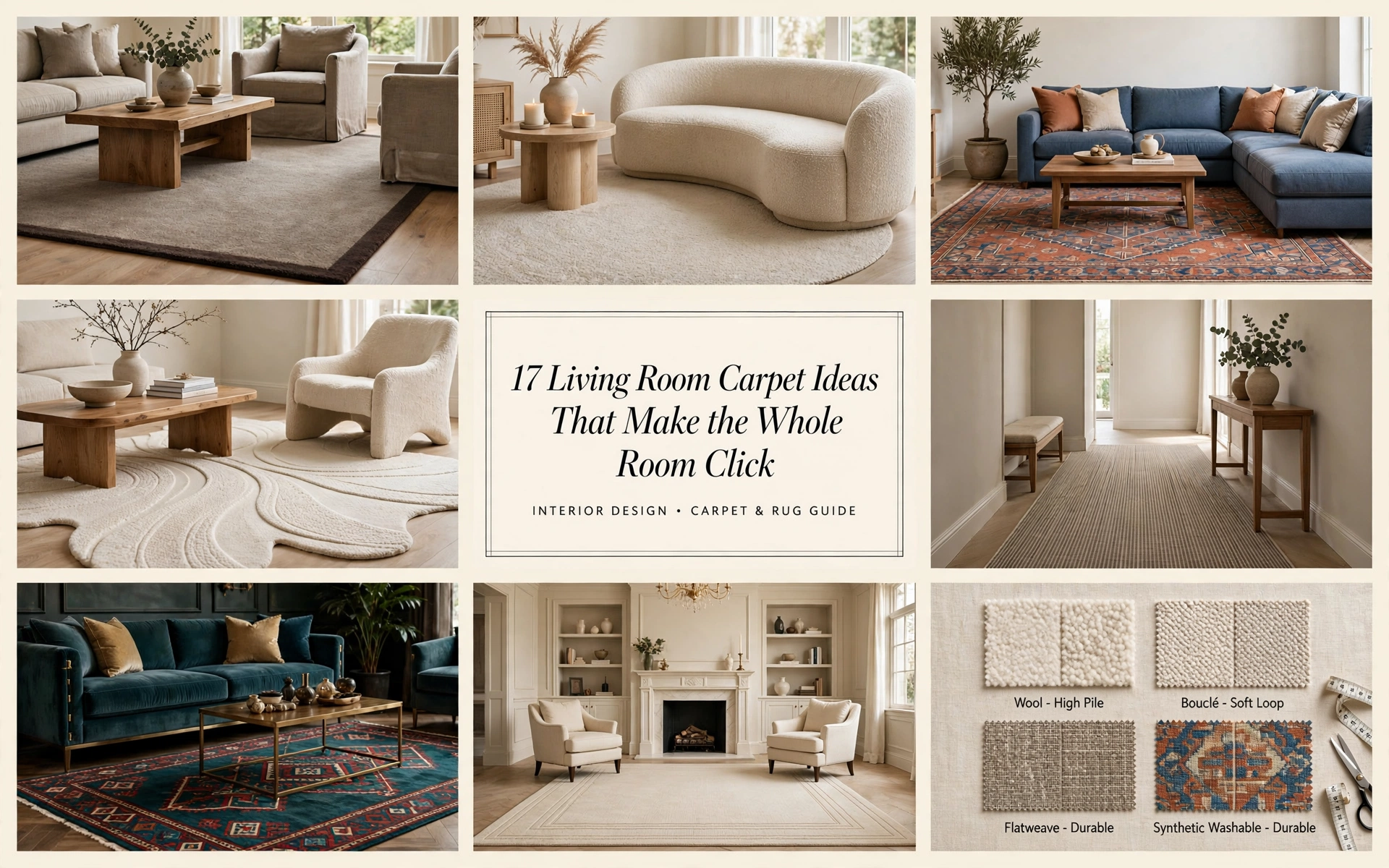
17 Living Room Carpet Ideas That Make the Whole Room Click

A living room can contain a beautiful sofa, thoughtful lighting, and art you genuinely love—and still feel as though every piece arrived separately. The missing link is often underfoot. A well-chosen carpet draws the seating into one visual conversation, softens echo, warms hard flooring, and gives the eye a clear place to settle.
That is why the best living room carpet ideas begin with the room’s proportions and daily habits, not a trending color. A pale shag may look dreamy in a styled photograph but become exhausting beside a garden door and a shedding dog. A smaller “budget” rug may cost less yet make the sofa look bulky and the room feel fragmented. The successful choice is the one that is beautiful and believable for your life.
This guide includes both area rugs and fitted carpet because people use the terms interchangeably. Each idea explains where it works, how to recreate it, what can go wrong, and how to make it look elevated at either end of the budget.
Before You Choose: The Five-Minute Carpet Plan
Decide between an area rug and fitted carpet
Choose an area rug when you want to preserve visible wood or tile, define one seating zone, move the covering later, or change the look seasonally. Choose wall-to-wall carpet when softness, insulation, safer footing, and quieter acoustics matter across the entire room. In a cold apartment or upstairs family room, fitted carpet can make the space physically more comfortable—not merely prettier.
Measure from the furniture, not only the walls
First arrange the seating as you actually use it. Then measure the rectangle that can hold at least the front legs of the sofa and all primary chairs. In most rooms, leave roughly 12–18 inches of visible floor between an area rug and the walls; a generous room may handle 18–24 inches. If furniture floats in the room, a rug that holds all four legs usually looks most resolved. Use painter’s tape to mark the proposed dimensions for 24 hours before buying.
Designer Tip: Photograph the taped outline from the doorway. A camera makes an undersized rug more obvious than standing inside the arrangement does.
Match fiber and pile to real life

Wool is resilient, warm, and naturally handsome, but it can shed initially and costs more. Nylon is a strong choice for hard-wearing fitted carpet. Polypropylene and many performance blends resist stains and suit busy households, although they may not have wool’s depth. Jute and sisal bring beautiful texture but feel firmer and dislike moisture. Low pile is easier around doors, wheels, pets, and robot vacuums; deep pile creates comfort but shows traffic and traps more debris.
Common Mistake: Choosing from a tiny sample under showroom lighting. Borrow the largest sample available and inspect it morning, afternoon, and evening beside the sofa and curtains.
1. Use an Oversized Warm-Neutral Rug to Pull Everything Together

An oatmeal, mushroom, or warm greige rug succeeds because it creates continuity without competing with art or upholstery. The important word is oversized. Let the rug reach beneath the sofa’s front legs and fully support the chairs; that shared surface makes separate furniture feel like a single arrangement.
This is best for calm contemporary, Scandinavian, organic-modern, and transitional rooms. Recreate it with a subtle heathered weave rather than a perfectly flat beige, which can look washed out and reveal every mark. Repeat the rug’s warm undertone in one lamp shade, cushion, or wood finish.
Budget Hack: Buy a large plain carpet remnant and have the edges bound. The result can look custom for much less than a branded rug.
Luxury Upgrade: Choose hand-loomed wool with a faint high-low texture and add a dense nonslip pad; the extra weight and softness create the quiet “expensive” feeling people notice before they identify why.
2. Wrap the Room in Tonal Wall-to-Wall Wool Carpet

Wall-to-wall carpet feels current when it is treated as a quiet field of color rather than a default beige floor. A dense, low or medium-pile wool in putty, camel, or warm gray softens sound and removes visual breaks, making it particularly effective in upstairs sitting rooms and formal lounges.
Keep the walls within the same tonal family but a shade lighter or darker. The room gains depth through texture instead of sharp contrast. Avoid very plush velvet pile in a busy family room because it displays footprints and vacuum lines; reserve that finish for lower-traffic spaces.
Designer Tip: Ask the installer where seams will fall before approving the plan. Position seams away from the strongest window light and busiest traffic routes whenever the room allows.
Luxury Upgrade: Upgrade the underlay before upgrading the carpet. A firm, resilient cushion improves comfort and helps the surface recover; always follow the carpet manufacturer’s thickness and density requirements.
3. Let a Vintage Persian-Style Rug Tell the Story

A vintage rug introduces irregular color, softened pattern, and a sense that the room evolved over time. It is especially powerful beneath clean-lined furniture because the contrast prevents both the rug and the modern pieces from feeling predictable.
Choose a pattern containing one color already present in the room and one color you would like to introduce. You do not need to match every cushion. In fact, a room feels more collected when the tones relate without repeating perfectly. For an undersized vintage find, layer it over a larger plain wool or natural-fiber rug.
Common Mistake: Centering the rug on the room while the seating is off-center. Align it with the furniture group or fireplace—the visual composition matters more than the bare walls.
Budget Hack: Look for hand-knotted rugs with repairs or gentle fading. Honest wear often adds character, but check for odors, brittle foundation threads, active moth damage, and unstable dye before buying.
4. Layer a Soft Rug Over a Natural-Fiber Foundation

Layering solves two problems at once: a large jute or sisal base establishes the right scale, while a smaller wool, kilim, or plush rug adds softness and personality where feet land. It is useful when the rug you love is vintage, costly, or too small to anchor the entire seating group.
Allow a visible natural-fiber border of roughly 8–12 inches so the composition looks deliberate. Keep the base low and flat, and secure both layers to prevent ripples. This is best for relaxed coastal, bohemian, rustic, and organic spaces, but less convenient for anyone using a walker or rolling mobility aid.
Styling Secret: Contrast textures more than patterns. A quiet woven base beneath a faded patterned rug feels rich; two similarly busy patterns tend to look accidental.
5. Add Structure With a Black-and-Cream Graphic Carpet

A black-and-cream geometric rug gives a pale room a visual skeleton. Broken stripes, offset grids, or broad abstract curves are easier to live with than tiny high-contrast motifs, which can flicker visually and dominate photographs.
This works for modern, mid-century, and monochrome rooms that need energy without another strong color. Recreate the look by repeating black only two or three times—in a lamp, frame, or chair leg—so the rug feels connected rather than dropped in.
Common Mistake: Combining a sharp graphic rug with equally strong patterned curtains and cushions. Let one pattern control the room, then support it with solids and subtle textures.
Budget Hack: A flatwoven indoor-outdoor rug can deliver the graphic effect inexpensively and tolerate family life; soften it with a good rug pad and tactile upholstery..
6. Ground the Room With an Earthy Olive Carpet

Olive behaves almost like a neutral because it echoes foliage, stone, and aged finishes. It brings life to beige upholstery without the visual volume of emerald. A muted olive rug also connects beautifully to walnut, oak, terracotta, brass, and off-white walls.
This is ideal for rooms with garden views or homeowners who want color but fear tiring of it. Test the sample beside both daylight and warm lamplight; yellow-based greens can turn muddy at night. Choose a gray-green olive for cooler rooms and a mossy olive for warm, earthy schemes.
Luxury Upgrade: Commission a tonal wool rug that shifts between olive and lichen through mixed yarns rather than printed color. The variation hides wear and looks exceptionally dimensional.
7. Embrace Chocolate Brown for Cocooning Warmth

Chocolate brown carpet makes a bright living room feel grounded and a dim room feel intentionally cocooning. Unlike flat dark gray, brown contains warmth that flatters timber, leather, cream, ochre, dusty blue, and burgundy.
Choose a mottled or ribbed texture so lint and footprints are less obvious. In a small room, keep the ceiling and upper walls light, then repeat brown at eye level in slim accents. A dark carpet with dark bulky furniture can feel bottom-heavy, so include at least one pale upholstered piece.
Styling Secret: Place a cream throw or pale stone coffee table over the dark field. The contrast makes both materials appear richer.
8. Choose a Quiet Checkerboard Instead of a Loud Pattern

A large-scale checkerboard in two neighboring tones—cream and sand, taupe and brown, or sage and olive—adds rhythm without turning the floor into a focal-point battle. The pattern helps disguise everyday variation and brings architectural order to a room with simple furniture.
The idea suits contemporary and playful interiors, including rentals where the walls must stay plain. Align the grid with the main sofa or architecture. A diagonal checkerboard can energize a square room, but it is harder to balance and more likely to date.
Budget Hack: Join modular carpet tiles in two close colors. Order extras so damaged tiles can be swapped later, and follow the manufacturer’s installation method.
9. Cool a Sunny Room With Soft Blue-Gray

Blue-gray creates psychological coolness in a south- or west-facing room that receives intense warm light. It pairs especially well with pale oak, chalky white, navy, rust, and cognac leather. The result feels calm without becoming coastal unless you add obvious nautical details.
Avoid a blue-gray that is too icy in a shaded room. Take the sample home and compare it with the wall paint, because neighboring grays can expose unexpected green or purple undertones. A heathered weave is more forgiving than a flat solid.
Designer Tip: Use the carpet as the coolest element, then warm the room with timber and one rust or camel accent. Temperature contrast creates depth.
10. Turn Broadloom Into a Custom-Bound Area Rug

Broadloom carpet cut to size and professionally bound is one of the smartest living room carpet ideas for unusual dimensions. It allows you to create a 10-by-13-foot rug, a long narrow size, or a near-room-width foundation without paying for a fully bespoke handwoven piece.
Choose a subtle wool, wool blend, or patterned commercial-quality carpet, then specify a narrow matching edge for discretion or a contrasting fabric border for definition. The bound rug should still leave a deliberate perimeter of visible flooring.
Luxury Upgrade: Use a wide linen, leather, or suede-look border that repeats the sofa or drapery color. Precise corners are essential; inspect the fabric for stretching before approving it.
11. Soften an Awkward Layout With a Round Rug

A round rug interrupts a room dominated by rectangles. It works beneath a curved sofa, a circular coffee table, in a bay-window sitting area, or where several doorways make a conventional rectangle difficult to position.
Scale it to hold the central furniture group, not merely the coffee table. A tiny circle beneath a large sofa looks like a coaster. Repeat the curve once or twice in a lamp, side table, or chair back, but avoid making every object round.
Budget Hack: Use a round braided rug in a single muted color. The construction adds texture while the restrained palette keeps it sophisticated.
12. Make Family Life Easier With a Washable Low-Pile Rug

Washable rugs make sense where spills are inevitable, but practicality still requires planning. Confirm that the size fits your washing machine or whether a commercial machine is required. Thin rugs can wrinkle, curl, or shift, so use the compatible pad and smooth the rug after washing.
This is best for homes with young children, pets, frequent entertaining, or direct garden access. Mid-tone patterns hide the interval between cleans better than solid ivory or black. Choose a design with nuanced color so a mark does not become the room’s only focal point.
Common Mistake: Assuming “washable” means maintenance-free. Vacuum grit regularly, blot spills promptly, follow the label, and avoid over-washing, which can age some printed surfaces.
13. Add Interest With a High-Low Sculpted Carpet

When you want a neutral floor that does not feel bland, choose a carpet whose pattern is created by pile height. Arcs, broken lines, or organic relief catch changing daylight and add depth without introducing another color.
Use this in adult sitting rooms or moderate-traffic spaces. Deep carved channels collect debris and may challenge wheels, so flatter relief is smarter for busy family rooms. Keep nearby upholstery smoother so the floor texture remains legible.
Luxury Upgrade: Choose hand-tufted wool with restrained asymmetry and a carved edge. The surface reads like artwork while remaining tonally calm..
14. Stretch a Narrow Room With Stripes

Stripes can correct perceived proportions. Run them across a long narrow living room to make it seem wider; run them lengthwise when you want to emphasize depth toward a fireplace or view. Soft irregular stripes are forgiving, while crisp high-contrast lines create a more graphic effect.
This strategy works in townhouses, apartments, and pass-through living rooms. Align the carpet carefully with the longest furniture edge; a slightly skewed stripe makes the whole layout look crooked.
Budget Hack: A flatwoven striped rug is often affordable and reversible. Add a nonslip pad so the lightweight weave stays square.
15. Build the Palette Around a Jewel-Tone Rug

A saturated rug in teal, garnet, aubergine, or sapphire can carry an otherwise restrained room. Color feels intentional when it is distributed by proportion: let the carpet hold most of the saturated hue, repeat it once in a smaller accent, and leave breathing room through neutral walls and upholstery.
This suits confident decorators, formal rooms, and spaces used mainly in the evening. In strong sunlight, ask about colorfastness and watch for fading. With a bold rug, choose pattern scale according to room size; larger motifs usually feel calmer from a distance than many tiny elements.
Styling Secret: Start with the rug, then pull the wall and upholstery neutrals from its least obvious background tones. The room will coordinate without looking matched.
16. Use Two Rugs to Zone an Open-Plan Living Space

In an open plan, rugs can act like invisible walls. Give the living area one generous rug and the adjacent reading or dining zone another. They need not match, but they should share a color, material, or visual weight.
Leave a visible strip of flooring between rugs so each zone can breathe. If they touch or nearly touch, either layer them intentionally or choose one larger rug; an accidental two-inch gap looks like a measurement error. Keep pile heights compatible near circulation paths.
Designer Tip: Judge both rugs from the main entrance and the kitchen, not only from the sofa. Open rooms are experienced from several sightlines.
17. Frame the Seating With a Custom Inset Border

A bordered rug creates architectural definition even in a plain room. The center can be wool, sisal, or a subtle texture, while a contrasting band echoes the fireplace surround, sofa, or dark window frames. Because the border outlines scale so clearly, measurements must be exact.
This is best for formal, transitional, and tailored contemporary rooms. Position the furniture so the border remains visible rather than disappearing unevenly beneath chair legs. A very wide dark border can visually shrink the center, so tape both outer and inner lines before ordering.
Luxury Upgrade: Commission a hand-finished wool rug with a double border or corner detail derived from the room’s millwork. It will feel designed with the architecture, not purchased after it.
Living Room Carpet Size and Placement Guide

| Layout | Best placement | Useful starting size | What to avoid |
| Small room, sofa against wall | Front sofa legs and front chair legs on rug | Often 6×9 or 8×10 ft | A rug holding only the coffee table |
| Medium conversation area | All front legs on; smaller pieces fully on | Often 8×10 or 9×12 ft | Different furniture pieces touching the rug inconsistently |
| Large floating arrangement | All furniture legs on rug | Often 9×12, 10×14 ft, or custom | Rug ending directly at sofa sides |
| Sectional sofa | At minimum, front legs of every section on rug | Usually 8×10 ft or larger | A rug narrower than the sectional’s main span |
| Open plan | Rug defines the complete seating zone | Determined by furniture footprint | Centering on the room instead of the seating group |
Standard sizes are only starting points. Leave enough rug beyond the sofa sides to prevent a squeezed look—approximately 8 inches is a useful minimum, while more often looks better. Maintain comfortable circulation around the coffee table, usually about 14–18 inches from seating. Tape the full shape before purchase, including any border.
Best Carpet Materials by Household

| Household need | Strong starting choice | Why it works | Watch for |
| Busy family room | Dense low-pile wool, nylon, or performance blend | Resilience and easier cleaning | Very pale solids and deep carved texture |
| Pets | Low-pile cut pile or pet-rated performance rug | Easier vacuuming; fewer loops for claws | Loose loops, fringe, and unstable backing |
| Young children | Soft low/medium pile with secure pad | Comfortable play surface and safer grip | Harsh chemical assumptions—check product certifications and care guidance |
| Allergy-sensitive home | Low-pile surface cleaned with an effective vacuum | Easier routine soil removal | Neglected deep pile and poor ventilation |
| Formal low-traffic room | Wool, plush cut pile, or silk blend | Rich color and tactile depth | Footprints, sunlight, and higher maintenance |
| Coastal or rustic room | Jute, sisal, seagrass, or wool-jute blend | Organic texture and earthy color | Moisture, scratchiness, and difficult spot cleaning |
| Rental | Bound remnant, flatweave, or washable rug | Portable and lower commitment | Curling corners and missing nonslip pad |
No fiber is universally “best.” The right selection depends on traffic, exterior access, sunlight, pets, mobility, cleaning habits, and whether the room is used for formal entertaining or everyday lounging. For fitted carpet, also ask about construction, twist, density, cushion compatibility, emissions certification, installation, seams, and warranty requirements.
Conclusion:
Imagine walking into your living room and no longer seeing a sofa here, a chair there, and a coffee table floating between them. Instead, the whole arrangement feels held—warmer beneath your feet, quieter when people gather, and more generous because every piece belongs to the same visual island.
Start with painter’s tape tonight. Mark the larger size you have been hesitant to consider, live with the outline, and notice how it changes the proportions before you spend anything. Then bring home samples and watch them from breakfast light to evening lamplight. The right carpet will not simply fill an empty floor. It will make the room feel ready for the life you want to live in it.
Frequently Asked Questions
1. What type of carpet is best for a living room?
For a frequently used living room, choose a dense, resilient, low-to-medium pile in wool, nylon, or a quality performance blend. Match the fiber and construction to traffic, pets, sunlight, exterior access, and cleaning habits. A formal low-traffic room can support a plusher, more delicate surface.
2. What carpet color makes a living room look bigger?
Light to medium colors with low contrast—such as warm beige, mushroom, pale taupe, or soft blue-gray—can make the floor feel more continuous and spacious. Size matters as much as color: a generous area rug generally expands a seating group visually, while a small rug can make the furniture feel crowded.
3. Should a living room rug go under the sofa?
Usually, yes. At minimum, place the sofa’s front legs and the front legs of primary chairs on the rug. In a large floating arrangement, putting all furniture legs on the rug produces the most cohesive result. Keep placement consistent across the seating group.
4. How much bigger should a rug be than a sofa?
Aim for the rug to extend at least about 8 inches beyond each side of the sofa, and preferably more when space permits. The exact amount depends on side tables, chairs, and room dimensions. Tape the proposed size on the floor before ordering.
5. Is an 8×10 rug big enough for a living room?
An 8×10-foot rug often suits a small or medium seating arrangement if it supports the front legs of the sofa and chairs. It may be too small for a large sectional or floating furniture group. Measure the furniture footprint rather than choosing by room name alone.
6. Can I put an area rug over wall-to-wall carpet?
Yes. An area rug can add pattern and define a seating zone over fitted carpet. Choose a relatively low-profile rug, use a pad specifically designed for carpet-on-carpet applications, and avoid thick layers that create a trip edge or interfere with doors.
7. What carpet hides dirt and stains best?
Medium-value, heathered, flecked, or subtly patterned carpets disguise routine soil better than very light or very dark solid colors. Multi-tonal taupe, olive, brown, and muted patterns are forgiving. Stain resistance does not replace prompt blotting and regular vacuuming.
8. Is wool carpet practical in a living room?
Wool is practical when its construction suits the traffic and the owner accepts its price and care needs. It is resilient, naturally warm, and visually rich. It may shed initially, and stains still require correct treatment. Ask for a sample and product-specific maintenance guidance.
9. What is the best carpet for pets?
Choose a dense, low-pile carpet or rug with good stain performance and minimal loose loops. Cut pile is generally less tempting to claws than prominent loop pile. Avoid long fringe, secure the edges, and confirm that cleaning products are compatible with the fiber and backing.
10. Are light carpets a bad idea in a family living room?
Not automatically. A warm mid-light tone with subtle variation is more forgiving than pure white or flat cream. Select a cleanable, appropriately rated material, use doormats, remove outdoor shoes if practical, and treat spills promptly. A washable rug is useful only if its size is realistically washable.
11. Should the carpet match the sofa?
The carpet and sofa should relate, not match exactly. Connect them through undertone, contrast, or one repeated color. A cream sofa might sit on olive, rust-patterned, blue-gray, or mushroom carpet. Exact matching can flatten the room because the two large surfaces merge.
12. Can I use a round rug in a living room?
Yes, especially with curved furniture, a circular coffee table, a bay window, or an awkward multi-door layout. The round rug must be large enough to anchor the seating, not only the coffee table. Repeat its curve sparingly elsewhere for visual continuity.
13. How do I choose carpet pile height?
Use low pile for heavy traffic, pets, doors, rolling furniture, and easier vacuuming. Medium pile balances comfort and practicality. High pile is soft and luxurious but traps more debris, shows traffic, and may complicate mobility. Always consider door clearance and the rug pad.
14. How can I make an inexpensive carpet look luxurious?
Prioritize size, correct placement, secure edges, and a quality pad. A large bound broadloom remnant, understated flatweave, or tonal performance rug can look refined when it fits the seating perfectly. Add luxury through tactile curtains, good lighting, and disciplined color repetition rather than a fussy motif.
15. How often should a living room carpet be cleaned?
Vacuum frequency depends on traffic, children, pets, and exterior access; high-use areas may need several passes a week. Blot spills immediately and follow the manufacturer’s care instructions. Schedule professional deep cleaning according to the fiber, warranty, soil level, and manufacturer guidance rather than using one universal timetable.