
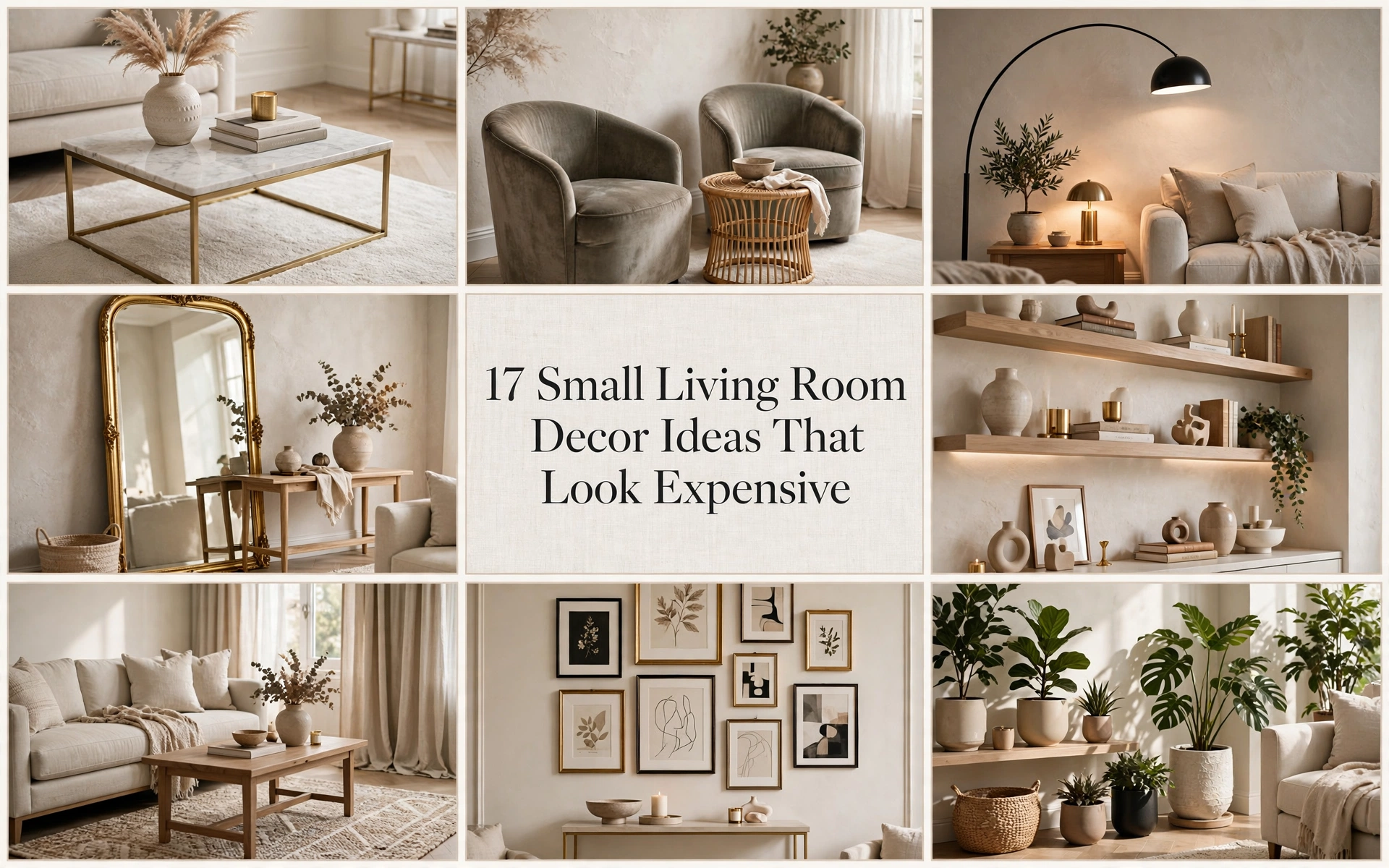
17 Small Living Room Decor Ideas That Look Expensive
A small living room rarely feels uncomfortable because of its measurements alone. More often, the real problem is competition: too many pieces compete for floor space, too many accessories ask for attention, and no single feature tells the eye where to rest.
The most effective small living room decor ideas do not attempt to disguise the room. They improve its proportions, simplify movement, and give every visible object a reason to be there. The result feels spacious because it is composed—not because it has been stripped of personality.
Before buying anything, measure the room, including doors, windows, radiators, outlets, and walking routes. Then photograph it from the entrance. That first view usually reveals the visual problem immediately: a bulky sofa arm, tangled cables, undersized rug, crowded corner, or curtain rod cutting the wall in half.
What follows is not a collection of decorative shortcuts. It is a complete approach to making a compact living room feel comfortable, expressive, and far more polished.
1. Start With the Room’s Most Important Job

A room designed to support every imaginable activity often performs none of them comfortably. Decide whether your living room’s primary purpose is conversation, television, reading, entertaining, working, or family time.
Let that decision control the largest furniture piece. A television room needs an unobstructed viewing line. A conversation room benefits from seating facing inward. A living-work space needs a compact desk or concealed workstation before it needs another occasional chair.
This works because the room gains a visible hierarchy. When everything has equal importance, the eye reads disorder.
Best for: Studios, multipurpose apartments, and family rooms with competing demands.
How to recreate it: Write down the three activities that happen most frequently. Give the largest share of space to number one, then accommodate the others with movable or dual-purpose pieces.
Designer Tip: Preserve a main walkway approximately 30–36 inches wide where possible. Secondary gaps between furniture can be closer to 18–24 inches.
Common Mistake: Designing for rare events. Keeping two permanent chairs for occasional parties can make daily life inconvenient.
Budget Hack: Rearrange what you already own before shopping. Removing one unnecessary table can improve a layout more than buying a storage unit.
Luxury Upgrade: Commission a slim built-in that combines media storage, bookshelves, and a discreet workspace.
2. Use One Properly Scaled Sofa

Filling a small room with several tiny seats can make it feel like a furniture showroom. One comfortable, appropriately scaled sofa often looks calmer than a loveseat surrounded by multiple chairs.
Look beyond width. Sofa depth and arm thickness determine how much usable space it consumes. A sofa around 34–38 inches deep, with narrow arms and a moderately upright back, can provide generous seating without projecting excessively into the room.
Best for: Couples, small families, and anyone who values everyday lounging.
How to recreate it: Mark the sofa dimensions on the floor with painter’s tape. Open doors and walk through the room before committing.
Styling Secret: A sofa close in color to the wall reduces visual interruption, helping a substantial piece feel quieter.
Common Mistake: Buying a shallow sofa with an uncomfortable seat simply because it is marketed for apartments.
Budget Hack: Keep your existing sofa but remove bulky side tables and replace large cushions with fewer, better-shaped ones.
Luxury Upgrade: Choose a tailored sofa with a bench cushion, recessed legs, and performance upholstery.
3. Create a Floating Conversation Area

Pushing every item tightly against the walls can emphasize the perimeter and make an awkward room feel like a waiting area. Even pulling a sofa forward by four to six inches creates a shadow line that adds depth.
In a narrow living room, place the sofa along one long wall but allow the opposite chair to turn slightly inward. In a squarer room, float a compact sofa across the space to define the living zone without constructing a divider.
Best for: Open-plan apartments and rooms where the front door opens directly into the living area.
How to recreate it: Anchor the floating arrangement with a rug and ensure the sofa back is visually tidy.
Designer Tip: If the sofa faces away from the entrance, place a narrow console behind it—but only if at least 30 inches of circulation remains.
Common Mistake: Floating furniture without considering floor outlets and lamp cords.
Budget Hack: Use an existing low bookcase behind the sofa to create a boundary and gain storage.
Luxury Upgrade: Add a custom sofa-back console with integrated outlets and concealed cable management.
4. Choose Furniture With Visible Floor Beneath It

The more continuous flooring you can see, the easier it is for your brain to understand the room as one open surface. Sofas and cabinets on raised legs allow light to travel beneath them and reduce the appearance of heaviness.
The goal is not to put every piece on spindly legs. A room needs one or two grounded forms—perhaps the sofa or storage cabinet—to keep it from feeling insubstantial. Mix visual weights deliberately.
Best for: Dark rooms, narrow rooms, and compact spaces containing several furniture pieces.
How to recreate it: Introduce an open-base chair, slim-legged side table, or wall-mounted console.
Common Mistake: Selecting exposed-leg furniture but filling the space beneath it with baskets, wires, and shoes.
Budget Hack: Replace a bulky cabinet with a secondhand legged dresser that can serve as a media console.
Luxury Upgrade: Install a floating stone or timber console from wall to wall.
5. Replace the Coffee Table With Flexible Pieces

A conventional rectangular coffee table can dominate the center of a small room and interrupt the natural walking route. Two nesting tables, a storage ottoman, or a pair of lightweight stools can provide the same function with greater flexibility.
Round pieces are particularly forgiving because they eliminate sharp corners near knees and narrow passages. They can be separated when guests arrive and nested when more floor space is needed.
Best for: Families, renters, entertainers, and homes with children.
How to recreate it: Keep approximately 14–18 inches between the sofa and the nearest table edge.
Designer Tip: Match the visual weight of the table to the sofa. A deep, solid sofa benefits from a lighter table; a delicate sofa can handle a grounded ottoman.
Budget Hack: Group two secondhand stools and unify them with matching paint or stain.
Luxury Upgrade: Combine nesting stone tables with a tailored upholstered ottoman.
6. Use a Large Rug to Visually Expand the Floor

An undersized rug creates a small island in the middle of the room, visually separating every piece around it. A larger rug connects the furniture and persuades the eye to read the seating area as one generous composition.
At minimum, the front legs of the sofa and chairs should sit on the rug. In many compact rooms, leaving a consistent border of exposed flooring around the rug feels more intentional than centering a tiny rug under the coffee table.
Best for: Rentals, open plans, and rooms needing warmth or zoning.
How to recreate it: Outline potential rug dimensions with painter’s tape before ordering.
Common Mistake: Buying a rug based on the coffee table rather than the complete seating arrangement.
Budget Hack: Layer a smaller patterned rug over a larger natural-fiber rug.
Luxury Upgrade: Use a custom-cut wool rug that follows the room’s proportions exactly.
7. Build Storage Upward

Small rooms usually lack wall-to-wall storage more than they lack floor area. Tall shelving uses otherwise wasted height and draws attention upward, making the ceiling feel more generous.
Paint shelves the same color as the wall when you want them to recede. Use a contrasting finish when the shelving is intended to become the room’s architectural focal point. Keep the lower section closed for cables, paperwork, toys, and electronics; reserve open shelves for books and a few meaningful pieces.
Best for: Book lovers, families, collectors, and homes without separate storage rooms.
How to recreate it: Fill open shelving only 60–70 percent. Alternate vertical books, horizontal stacks, art, and empty space.
Styling Secret: Repeat one material or color at least three times to make mixed objects feel curated.
Common Mistake: Installing many short shelves that create more visual lines and clutter.
Budget Hack: Place two affordable bookcases together, secure them safely, and paint them and the wall one color.
Luxury Upgrade: Extend built-ins to the ceiling and add integrated picture lights.
8. Frame the Window With Full-Height Curtains

Curtains hung directly above a window visually compress the wall. Mounting the rod close to the ceiling and extending it beyond the window frame makes both the window and ceiling appear larger.
Allow curtains to stack mostly outside the glass so they do not steal daylight. Choose a soft full-length break or a clean one-inch hover depending on your preferred style.
Best for: Rooms with low ceilings, small windows, or limited daylight.
How to recreate it: Select panels totaling approximately 1.5–2 times the width of the rod for graceful fullness.
Common Mistake: Using short curtains that stop below the sill without relating to anything else.
Budget Hack: Join ready-made panels or use iron-on hemming tape to create the correct length.
Luxury Upgrade: Install a concealed ceiling track with lined ripple-fold drapery.
9. Layer Lighting at Different Heights

One bright ceiling fixture illuminates the room but often flattens it. Multiple softer light sources create pools of brightness, shadow, and depth, allowing corners to recede.
Combine an overhead fixture with a wall sconce, floor lamp, and small table lamp. Wall-mounted swing-arm lamps are especially useful because they free side-table surfaces.
Best for: North-facing rooms, rentals, and living rooms used in the evening.
How to recreate it: Use warm bulbs with compatible color temperatures, generally around 2700K for a comfortable residential effect.
Designer Tip: Place light near a textured surface, artwork, or plant so it illuminates something rather than floating without purpose.
Budget Hack: Use plug-in sconces with paintable cord covers.
Luxury Upgrade: Add dimmable circuits and concealed shelf lighting.
10. Place a Mirror Where It Can Reflect Light

A mirror is effective only when its reflection contributes something worthwhile. Opposite or adjacent to a window, it distributes daylight. Behind a lamp, it multiplies evening glow. Facing a cluttered shelf, however, it doubles the visual noise.
One substantial mirror usually produces a calmer result than a gallery of small mirrors. A tall mirror can also emphasize ceiling height when placed above a low cabinet.
Best for: Dim rooms, interior apartments, and living rooms with a pleasant exterior view.
How to recreate it: Stand where the mirror will hang and examine what it will reflect before drilling.
Common Mistake: Placing it too high. A mirror should relate to the furniture beneath it and provide a useful reflection from seated height.
Budget Hack: Upgrade an inexpensive mirror by painting its frame to match the walls.
Luxury Upgrade: Use antiqued, bronze-tinted, or custom-panelled mirror for softer reflection.
11. Create a Controlled Color Story

A small room does not require white walls. What it needs is color continuity. Repeating a controlled palette prevents the eye from stopping at unrelated objects.
Begin with one dominant neutral or atmospheric wall color, one supporting upholstery color, and one accent. Repeat the accent sparingly across a cushion, artwork, and small decorative object.
Dark colors can work beautifully when they are carried across walls, trim, and sometimes the ceiling. This softens boundaries and creates an enveloping effect instead of outlining every edge.
Best for: Anyone who wants character rather than a generic “airy” room.
How to recreate it: Pull three colors from a favorite rug or artwork and vary their tones rather than adding unrelated shades.
Common Mistake: Introducing a different accent color in every accessory.
Budget Hack: Paint trim and shelves with leftover wall paint for greater continuity.
Luxury Upgrade: Use tonal fabrics in wool, velvet, linen, and leather to add depth without expanding the palette.
12. Add One Confident Oversized Feature

Many tiny decorative items create many points for the eye to process. One large artwork, pendant, mirror, or sculptural branch can make a compact room feel more confident and composed.
Scale creates drama without occupying additional floor space. A nearly wall-filling painting can even make the wall appear more substantial because it emphasizes a broad visual plane.
Best for: Minimalists, art lovers, and rooms that feel unfinished despite having plenty of accessories.
How to recreate it: Choose one feature and give it breathing room. Remove smaller items competing around it.
Styling Secret: Repeat one color from the statement piece elsewhere to connect it to the room.
Common Mistake: Combining oversized art, dramatic wallpaper, a large pendant, and many bold accessories without hierarchy.
Budget Hack: Frame a large textile, vintage map, or downloadable public-domain artwork.
Luxury Upgrade: Commission a site-specific piece sized for the wall.
13. Use Curves to Improve Movement

Rounded tables, barrel-back chairs, curved sofa arms, and circular rugs soften a tight floor plan. The eye travels around curved forms more easily, while people can move past them without navigating sharp corners.
You do not need a completely curved furniture scheme. One circular coffee table or rounded accent chair is enough to interrupt a room dominated by rectangular walls, windows, and cabinetry.
Best for: Narrow walkways, homes with children, and boxy apartment rooms.
How to recreate it: Replace the piece located closest to the main walkway with a rounded version.
Common Mistake: Choosing an extremely wide curved sofa whose footprint wastes corner space.
Budget Hack: Introduce curves through a round secondhand table, lamp, cushion, or mirror.
Luxury Upgrade: Add a compact asymmetric chair upholstered in textured bouclé.
14. Hide Everyday Clutter in Attractive Furniture

Visual clutter makes a room feel smaller because the brain must examine more individual shapes. Closed storage gives the eye larger, calmer surfaces while keeping useful items nearby.
A storage ottoman can hold blankets. A shallow wall cabinet can conceal electronics. A vintage dresser can serve as both an elegant focal point and substantial storage. Choose fewer storage pieces with meaningful capacity instead of scattering baskets everywhere.
Best for: Families, hobbyists, pet owners, and anyone without a utility closet.
How to recreate it: Assign each cabinet a category. Storage fails when unrelated items are placed together without a simple retrieval system.
Designer Tip: Leave at least one horizontal surface nearly empty. That visual pause makes the entire room appear more controlled.
Budget Hack: Convert a secondhand dresser into a media unit by drilling discreet ventilation and cable holes.
Luxury Upgrade: Install touch-latch cabinetry painted to blend into the wall.
15. Turn an Empty Corner Into a Useful Zone

An awkward corner often becomes a holding area for unrelated objects. Give it one defined purpose: reading, working, displaying art, listening to music, or caring for plants.
A reading corner needs only a compact chair, wall-mounted lamp, and narrow drinks table. A workspace may fit into a 36-inch-wide recess with a floating desktop. Treating the corner as a complete mini-room makes the entire living room feel more intentional.
Best for: Studios, work-from-home households, and rooms with alcoves.
How to recreate it: Use a small rug, pendant, paint color, or artwork to visually identify the zone.
Common Mistake: Filling every corner. Leave one area open so the room retains breathing space.
Budget Hack: Pair a secondhand chair with a clip-on reading lamp and wall-mounted picture ledge.
Luxury Upgrade: Build a fitted banquette with storage and integrated lighting.
16. Make the Television Visually Quieter

A large black television can dominate a small room even when switched off. Instead of adding numerous decorations around it, integrate it into one deliberate composition.
Mount the television at a comfortable viewing height, conceal its cables, and surround it with a low console, tonal wall color, or restrained cabinetry. Painting the wall a deeper color reduces the contrast between the screen and its background.
Best for: Everyday television rooms and open-plan spaces where the screen is always visible.
How to recreate it: Center the television according to the seating position, not automatically according to the entire wall.
Common Mistake: Mounting the screen too high and filling the surrounding wall with tiny frames.
Budget Hack: Paint the television wall deep charcoal, olive, navy, or brown and use an inexpensive cord cover.
Luxury Upgrade: Conceal the screen behind sliding art panels or motorized cabinetry.
17. Finish With Texture Instead of More Objects

When a room feels plain, the instinct is often to buy additional accessories. Texture adds richness without adding visual clutter.
Combine a smooth painted wall, woven rug, linen curtain, timber table, soft upholstery, and one tactile throw. These material contrasts become especially important in a neutral scheme, where they prevent beige and white from feeling flat.
Edit accessories using a simple test: if removing an object makes the surrounding pieces easier to appreciate, leave it out.
Best for: Neutral, minimalist, Scandinavian, organic-modern, and rental interiors.
How to recreate it: Introduce three contrasting tactile qualities—soft, rough, and reflective—while keeping the colors connected.
Styling Secret: Fold or drape textiles with intention. Too many casually tossed throws can look like unfinished tidying.
Budget Hack: Change cushion covers, add a thrifted wool throw, and display a single textured ceramic vessel.
Luxury Upgrade: Invest in full-length linen drapery, a hand-knotted rug, and one beautifully crafted timber piece.
Conclusion
Imagine opening the door and seeing a room that no longer apologizes for its size. The sofa feels generous rather than intrusive. The rug brings everything together. Evening light settles softly across the walls, and the everyday things you need are close at hand without demanding to be seen.
That transformation can begin without replacing the entire room. Move the furniture away from the wall. Test a larger rug outline. remove the table everyone walks around. Hang the curtains higher. Give one neglected corner a purpose.
The best small living room decor ideas do more than create the illusion of extra square footage. They make the space feel considered, personal, and comfortable enough that its dimensions become the least interesting thing about it.
Frequently Asked Questions
1. How do I decorate a small living room without making it cluttered?
Use fewer pieces with stronger scale and purpose. Select one main sofa, one flexible table arrangement, one large rug, and one statement feature. Hide practical items in closed storage and leave at least one surface mostly empty.
2. What colors make a small living room look bigger?
Warm white, pale beige, muted blue, soft green, and light gray can reflect daylight and soften boundaries. However, continuity matters more than brightness alone. A darker color carried across walls, trim, and shelving can also create depth and cohesion.
3. Can I use dark colors in a small living room?
Yes. Deep olive, navy, brown, burgundy, and charcoal can make a small room feel intimate and sophisticated. Avoid sharply contrasting trim if spaciousness is the goal; a tonal treatment prevents the walls from appearing visually chopped up.
4. What type of sofa is best for a small living room?
Look for narrow arms, a moderately upright back, useful seat width, and a depth of approximately 34–38 inches. Measure doorways and circulation space as carefully as the wall where the sofa will sit.
5. Should a small living room have a sectional?
A compact sectional can work well when it replaces several separate pieces and fits tightly into the layout. Avoid overly deep chaise sections that block entrances or reduce access to windows and storage.
6. How should I arrange furniture in a narrow living room?
Place the largest seat along a long wall, create a focal point on the opposite side, and use one angled or rounded chair to interrupt the corridor effect. Preserve a clear route through the room and avoid lining both long walls with bulky furniture.
7. Should furniture touch the walls in a small room?
Not necessarily. A gap of several inches behind a sofa can create depth and make the arrangement appear more deliberate. Furniture should only be floated when sufficient walking space remains.
8. What size rug should I use?
Choose a rug large enough for at least the front legs of the sofa and chairs to rest on it. An 8-by-10-foot rug commonly suits compact seating groups, but the correct size depends on the room and furniture dimensions.
9. How can I add storage without losing floor space?
Use floor-to-ceiling shelving, floating cabinets, wall-mounted ledges, storage ottomans, and furniture with drawers. Combine closed storage below with edited open display above.
10. Are floating shelves good for a small living room?
Yes, when used sparingly. One long shelf often looks calmer than several short shelves. Secure it properly, keep the styling edited, and avoid mounting it where people may strike their heads.
11. Where should I place a mirror?
Place it opposite or adjacent to a window, behind a lamp, or where it reflects an attractive focal point. Check the reflection from both standing and seated positions before mounting it.
12. How can renters improve a small living room?
Use full-height curtains, plug-in sconces, freestanding shelves, removable wallpaper, large artwork, an appropriately sized rug, and multifunctional furniture. These changes provide scale and character without permanent construction.
13. How do I make a small living room look expensive?
Prioritize correct curtain length, concealed cables, coordinated lighting temperatures, substantial artwork, restrained accessories, and rich texture. Precision and editing often communicate luxury more effectively than expensive objects.
14. How many decorative items should a small room contain?
There is no ideal number, but accessories should form clear groups rather than being spread across every surface. Leave visible negative space around important pieces and remove objects that neither serve a purpose nor contribute meaning.
15. How do I make a small living room cozy but not crowded?
Layer lighting, textiles, wood, and warm colors while keeping circulation and surfaces clear. Cozy rooms rely on sensory richness; crowded rooms rely on object quantity. Choose tactile materials instead of continually adding decorations.


