
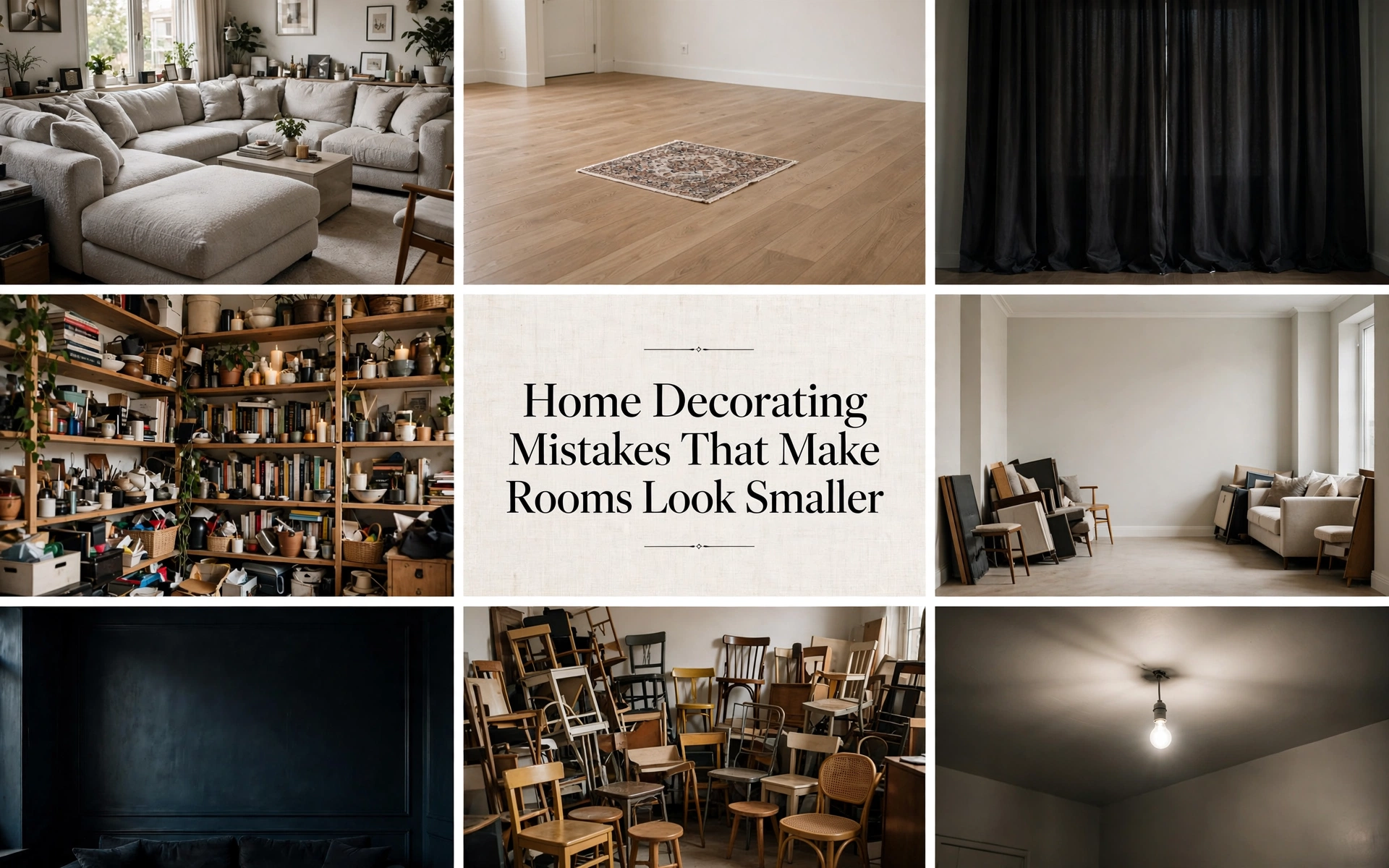
Home Decorating Mistakes That Make Rooms Look Smaller (And What to Do Instead)
Have you ever looked around your home and wondered:
“Why does this room feel so cramped?”
The strange thing is that the room may not actually be small.
The furniture may fit.
The walls may not have moved.
The square footage may be exactly the same.
Yet something about the space feels uncomfortable, crowded, or smaller than it should.
This happens because interior design is not only about measurements. It is about perception.
A room is experienced through the eyes before it is experienced through the body. The way light travels, how furniture is arranged, where your eyes naturally move, and how much visual information surrounds you all influence whether a space feels open or restricted.
This is why professional designers can walk into the same empty room and create completely different feelings simply by changing proportions, colors, lighting, and placement.
Many homeowners accidentally make their homes feel smaller through decorating choices that seem logical at first.
A large sofa feels comfortable.
Extra furniture feels practical.
More decorations feel personal.
Dark colors feel sophisticated.
Heavy curtains feel luxurious.
But when these choices are combined incorrectly, they can quietly steal visual space.
The good news?
Most of these issues can be corrected without knocking down walls or spending thousands of dollars.
With the right design strategies, even a small apartment, narrow bedroom, or compact living room can feel brighter, calmer, and significantly larger.
In this guide, we will explore the biggest home decorating mistakes that make rooms look smaller, why they happen, and exactly what professional designers do instead.
You will learn how to:
- Choose furniture that improves space instead of overwhelming it
- Use color to expand your room visually
- Create better furniture layouts
- Increase natural light
- Reduce visual clutter
- Make ceilings appear taller
- Design a home that feels intentional and spacious
Your home does not need more square footage.
It needs better visual decisions.
Why Rooms Feel Smaller Than They Actually Are
Before fixing decorating mistakes, it helps to understand why our brains perceive some rooms as larger than others.
Interior designers often work with a concept called visual perception.
This means the human brain does not judge space only by actual dimensions.
Instead, it interprets:
- Light
- Color
- Texture
- Scale
- Balance
- Empty space
- Movement patterns
For example, a room with light walls, open pathways, and properly sized furniture may feel twice as large as a darker room filled with oversized pieces.
The physical size has not changed.
The experience has.
The Psychology Behind Spacious Rooms
Large-feeling rooms usually share several characteristics:
1. The Eye Can Travel Easily
When your eyes can move from one area to another without interruption, the room feels deeper.
Blocked views create visual walls.
2. The Room Has Breathing Space
Empty areas allow the brain to process the room more easily.
This is why luxury homes often look calm rather than crowded.
3. Furniture Feels Balanced
Furniture should support the room, not dominate it.
4. Light Reaches Multiple Areas
Bright spaces naturally feel more open.
5. Colors Create Flow
A connected color palette allows spaces to feel continuous.
Designer Tip
Think like a photographer.
A good photograph is not filled with every possible object.
It has composition, focus, and breathing room.
Your room works the same way.
Mistake #1: Choosing Furniture That Is Too Large
One of the most common home decorating mistakes that make rooms look smaller is purchasing furniture based on appearance rather than proportion.
Many homeowners make this mistake because furniture showrooms are designed to make pieces look attractive.
A large sectional sofa displayed inside a massive showroom may appear elegant and comfortable.
However, place that same sofa inside a small living room, and suddenly it becomes the only thing you notice.
The room disappears.
The furniture takes over.
Why Oversized Furniture Shrinks a Room
Large furniture affects space in three ways.
It Reduces Walking Space
When furniture occupies too much floor area, movement becomes restricted.
A room that should feel relaxing begins to feel crowded.
It Blocks Visual Flow
The eye can no longer easily see walls, corners, or open areas.
It Creates Heavy Visual Weight
Some furniture pieces feel heavier because of:
- Dark colors
- Thick arms
- Solid bases
- Tall backs
- Bulky shapes
Real-World Example
Imagine a 12-foot by 14-foot living room.
A homeowner places:
- A large sectional sofa
- Oversized coffee table
- Large entertainment cabinet
- Two accent chairs
Technically, everything fits.
But the room feels packed.
A designer would likely replace this with:
- A medium sofa with exposed legs
- Smaller coffee table
- Wall-mounted television
- One accent chair
The room instantly feels more open.
What To Do Instead
Choose furniture based on your room measurements.
Before buying anything:
Measure:
- Wall length
- Door openings
- Walking paths
- Window placement
Look for:
✓ Raised furniture legs
✓ Slim silhouettes
✓ Rounded edges
✓ Multifunctional pieces
✓ Appropriate proportions
Furniture that allows you to see more floor creates a larger visual footprint.
Budget Hack
You do not need to replace everything.
Start with the largest problem piece.
Removing one oversized item often creates the biggest transformation.
Luxury Upgrade
Luxury designers frequently use custom furniture because proportion is everything.
A perfectly sized sofa can make an ordinary room feel professionally designed.
Common Mistake
Buying the largest sofa you can afford instead of the sofa that fits your room.
Comfort matters.
But comfort without proportion creates visual imbalance.
Mistake #2: Using Furniture That Is Too Small
While oversized furniture is a common issue, the opposite mistake can also make rooms look smaller.
Many homeowners believe:
“Small room = tiny furniture.”
This is not always true.
A room filled with many small pieces can feel cluttered and fragmented.
Why Too Many Small Pieces Create a Smaller Feeling
Imagine a living room with:
- Two tiny chairs
- Small side tables
- Small decorative stools
- Several small storage units
Each item takes up visual attention.
Instead of one clear design statement, the eye sees many interruptions.
The room feels busy.
Designer Approach
Professional designers often prefer:
“Fewer, better-sized pieces.”
A properly scaled sofa and one beautiful chair can make a room feel larger than five smaller furniture pieces.
Best For
This approach works especially well for:
- Apartments
- Studio homes
- Small living rooms
- Guest rooms
Budget Hack
Remove unnecessary small furniture before buying anything new.
Sometimes subtraction creates more space than addition.
Styling Secret
Large, simple shapes often create a more luxurious feeling than many small decorative elements.
Mistake #3: Filling Every Empty Corner
One of the biggest misunderstandings in home decorating is believing every empty space needs something.
Many homeowners see an empty corner and immediately think:
“What should I put there?”
But professional designers often ask:
“Should anything be there?”
Why Overfilling Makes Rooms Feel Smaller
Every object creates visual information.
When too many objects compete, the brain reads the room as crowded.
This is why minimalist luxury interiors often feel larger.
They are not empty.
They are edited.
What To Do Instead
Allow some areas to remain open.
Examples:
Instead of:
- Chair + plant + basket + lamp in every corner
Try:
- One statement plant
- One beautiful lamp
- One intentional empty area
Designer Tip
Negative space is not wasted space.
It is what allows your favorite pieces to stand out.
Budget Hack
Before purchasing new decorations, remove 20% of what you already own.
Many rooms improve immediately.
Mistake #4: Pushing All Furniture Against the Walls
This is one of the most common furniture arrangement mistakes.
Many people believe placing everything against walls creates maximum space.
But the result is often the opposite.
Why This Layout Can Make Rooms Feel Smaller
When every piece touches the wall:
- The center becomes awkwardly empty
- Conversation areas feel disconnected
- Furniture loses relationship
The room may actually have more open floor space but feel less comfortable.
What Designers Do Instead
Designers often “float” furniture.
This means positioning pieces slightly away from walls.
Even a few inches can create depth.
Example
Instead of:
Wall → Sofa → Empty Center → Wall
Try:
Wall → Space → Sofa → Coffee Table → Chairs
The room develops layers.
Layers create depth.
Depth creates spaciousness.
Budget Hack
Try a new furniture arrangement before buying anything.
A free layout change can completely transform a room.
Luxury Upgrade
Create intentional conversation zones instead of simply filling walls.
Luxury homes feel designed because furniture has relationships.
Mistake #5: Choosing the Wrong Rug Size

Many homeowners underestimate how much an area rug affects room size perception.
A rug is not just decoration.
It is an anchor.
The Small Rug Problem
A tiny rug underneath furniture creates disconnected sections.
The sofa appears separate.
The chairs appear separate.
The room feels chopped apart.
Why This Makes Rooms Look Smaller
Your brain interprets disconnected areas as separate zones.
Separate zones feel smaller.
A larger rug creates unity.
Designer Recommendation
For living rooms:
At minimum:
- Front legs of furniture should sit on the rug.
For larger rooms:
- Place the entire furniture arrangement on the rug.
Budget Hack
If large rugs feel expensive:
Choose affordable natural fiber rugs and layer decorative rugs on top.
Luxury Upgrade
Custom-sized rugs create the most polished designer appearance.
Styling Secret
A bigger rug usually makes a room feel bigger.
Many homeowners make the mistake of going too small.
Mistake #6: Blocking Natural Light
Natural light is one of the most powerful tools for making rooms feel larger.
Yet many decorating choices accidentally block it.
Common examples include:
- Heavy curtains
- Tall furniture in front of windows
- Dark window treatments
- Too many decorations on windowsills
Why Natural Light Expands Space
Bright rooms feel larger because light reduces visual boundaries.
Dark corners disappear.
Walls appear farther away.
The entire room feels more open.
What To Do Instead
Maximize daylight.
Use:
- Sheer curtains
- Light fabrics
- Reflective surfaces
- Mirrors
- Open window areas
Budget Hack
Simply cleaning windows and removing unnecessary items near windows can improve brightness.
Designer Tip
Never underestimate the power of a clear window.
A window is not just a source of light.
It is a visual extension of your room.
Mistake #7: Using Dark Colors Without a Design Strategy
Dark colors are often misunderstood in interior design.
Many homeowners hear that light colors make rooms feel bigger, so they avoid darker shades completely.
But professional designers know the truth:
Dark colors do not automatically make a room feel smaller.
The problem is not the color itself.
The problem is using it without balance.
A carefully designed dark room can feel elegant, dramatic, cozy, and even spacious. A poorly planned dark room can feel closed in and heavy.
The difference comes down to lighting, contrast, texture, and proportion.
Why Incorrect Dark Colors Make Rooms Feel Smaller
Dark colors absorb more light than lighter shades.
When a room has:
- Limited natural light
- Heavy furniture
- Dark flooring
- Dark ceilings
- Minimal lighting
the walls visually appear closer.
The space feels enclosed.
The Psychology of Color Perception
Light colors reflect more light, creating the illusion of expansion.
Soft shades such as:
- Warm white
- Cream
- Beige
- Light gray
- Pale green
- Soft blue
help surfaces blend together.
When walls, ceilings, and furnishings have similar tones, the eye moves smoothly through the room.
Smooth visual movement creates spaciousness.
How Designers Use Dark Colors Correctly
Professional designers often use dark colors strategically.
Examples:
One Accent Wall
A darker wall behind a bed or sofa can create depth.
Dark Lower Cabinets
In kitchens, darker cabinets below with lighter upper areas create balance.
Dark Accessories
Black frames, lamps, and furniture accents add sophistication without overwhelming the room.
Best For
Dark colors work beautifully in:
- Large bedrooms
- Dining rooms
- Home offices
- Rooms with abundant natural light
Budget Hack
Instead of repainting the entire room, introduce darker shades through:
- Pillows
- Artwork
- Throws
- Decorative objects
Luxury Upgrade
Use rich dark materials such as:
- Velvet
- Walnut wood
- Matte finishes
- Textured wallpaper
Luxury interiors often use darkness as a contrast tool.
Designer Tip
A room needs contrast.
The goal is not making everything light.
The goal is creating balance.
Common Mistake
Painting every wall, ceiling, and furnishing dark without adding enough light sources.
Mistake #8: Creating Too Many Visual Distractions
A beautiful home should tell a story.
But when every object tries to become the main character, the room becomes visually exhausting.
One of the biggest home decorating mistakes that make rooms look smaller is creating too many competing elements.
What Creates Visual Clutter?
Examples include:
- Too many colors
- Too many patterns
- Too many decorative objects
- Different furniture styles
- Excessive wall art
- Overloaded shelves
Each individual item may look attractive.
The problem appears when everything competes.
Why Visual Clutter Shrinks a Room
The human eye needs places to rest.
When every surface demands attention, the brain interprets the environment as busy.
Busy environments feel smaller because there is no clear visual pathway.
Designer Solution: Create Visual Hierarchy
Professional designers create a ranking system.
One element becomes the star.
Others support it.
For example:
Living room:
Primary focus:
- Fireplace
- Artwork
- Statement sofa
Supporting elements:
- Cushions
- Plants
- Accessories
The Three-Color Rule
A simple designer technique:
Use:
- One dominant color
- One secondary color
- One accent color
This creates harmony without feeling boring.
Budget Hack
Before buying new decor:
Remove items first.
You may discover that your room already has enough personality.
Luxury Upgrade
Invest in fewer but higher-quality pieces.
A single beautiful artwork often creates more impact than ten small decorations.
Styling Secret
Luxury spaces are not expensive because they contain more.
They feel expensive because everything has purpose.
Mistake #9: Hanging Curtains Too Low

Curtains are one of the most underrated tools for changing how large a room feels.
Unfortunately, many homeowners install them incorrectly.
A common mistake is mounting curtain rods directly above the window frame.
Why Low Curtains Make Rooms Look Smaller
Curtains visually influence wall height.
When curtains stop close to the window:
- Walls appear shorter
- Ceilings appear lower
- Windows appear smaller
The entire room loses vertical presence.
The Designer Curtain Rule
Install curtain rods:
- Higher than the window frame
- Closer to the ceiling
Allow curtains to fall all the way to the floor.
This creates a vertical line that draws the eye upward.
Before and After Effect
Before:
Small window + short curtains = compressed feeling
After:
Tall curtains + full-length fabric = taller, more elegant room
Best For
This technique works especially well in:
- Apartments
- Bedrooms
- Small living rooms
- Rooms with low ceilings
Budget Hack
You do not need expensive curtains.
Simply changing placement can create a dramatic improvement.
Luxury Upgrade
Choose custom floor-to-ceiling drapery with premium fabrics.
Designer Tip
Curtains are not just window coverings.
They are architectural tools.
Mistake #10: Using Only One Light Source
Many homes rely on a single ceiling fixture.
While this technically provides illumination, it rarely creates a designer-quality atmosphere.
Lighting is not just about brightness.
It is about creating depth.
Why Poor Lighting Makes Rooms Feel Smaller
A single overhead light often creates:
- Harsh shadows
- Dark corners
- Flat appearance
- Uneven brightness
Dark areas visually disappear, making the room feel compressed.
The Designer Lighting Formula
Professional designers use three layers:
1. Ambient Lighting
General illumination.
Examples:
- Ceiling fixtures
- Recessed lights
- Chandeliers
2. Task Lighting
Focused lighting.
Examples:
- Reading lamps
- Desk lamps
- Kitchen lighting
3. Accent Lighting
Decorative lighting.
Examples:
- Wall lights
- Artwork lighting
- LED strips
Why Layered Lighting Works
Multiple light sources create depth.
The eye moves through different levels of brightness.
That movement makes rooms feel larger.
Budget Hack
Add:
- Floor lamps
- Table lamps
- Warm bulbs
Small lighting changes create major impact.
Luxury Upgrade
Use:
- Smart lighting systems
- Hidden LED lighting
- Architectural lighting
Styling Secret
A room with beautiful furniture but poor lighting will always feel smaller than a modest room with excellent lighting.
Mistake #11: Overdecorating Every Surface
A common decorating belief is:
“More decorations make a home feel complete.”
However, professional designers understand that restraint creates elegance.
Why Too Much Decor Shrinks Rooms
When every surface is covered:
- Tables feel crowded
- Shelves feel heavy
- Countertops feel messy
- The room loses calmness
The brain reads this as limited space.
The Power of Negative Space
Negative space is the empty area around objects.
It allows important pieces to stand out.
Think about luxury hotels and designer homes.
They rarely display hundreds of objects.
They display carefully selected items.
What To Remove
Consider reducing:
- Excess photo frames
- Too many candles
- Random decorative objects
- Unused furniture
Budget Hack
Create a “decor rotation.”
Store some accessories and change them seasonally.
Your home feels refreshed without buying more.
Luxury Upgrade
Use statement pieces:
- Large artwork
- Sculptural lighting
- Designer accessories
One exceptional piece can replace many average ones.
Designer Tip
A room should have personality, not visual noise.
Mistake #12: Ignoring Vertical Space
Many homeowners decorate only from the floor upward a few feet.
Professional designers use the entire height of a room.
Why Ignoring Height Makes Rooms Feel Smaller
When everything sits at the same level:
- Ceilings appear lower
- Walls feel shorter
- The room loses drama
Ways To Use Vertical Space
Tall Bookcases
They draw attention upward.
Vertical Artwork
Long artwork creates height.
Tall Plants
They introduce natural vertical movement.
Floor-to-Ceiling Curtains
They stretch the walls visually.
Best For
Especially effective in:
- Small apartments
- Rooms with low ceilings
- Narrow spaces
Budget Hack
You do not need expensive built-ins.
Try:
- Taller shelves
- Vertical mirrors
- Stacked artwork
Luxury Upgrade
Custom floor-to-ceiling cabinetry creates both storage and architectural impact.
Styling Secret
When the eye travels upward, the room feels taller.
Mistake #13: Using Too Many Small Furniture Pieces
A small room does not always need small furniture.
This is one of the biggest misconceptions in decorating.
Why Many Small Pieces Make Rooms Feel Smaller
Imagine walking into a room containing:
- Two small sofas
- Three tiny tables
- Multiple stools
- Several storage boxes
Nothing is huge.
Yet the room feels crowded.
Why?
Because there are too many visual interruptions.
Better Approach
Use fewer, stronger pieces.
Examples:
Instead of:
Four small chairs
Choose:
One comfortable sofa + one accent chair
Instead of:
Multiple small tables
Choose:
One functional coffee table
Designer Tip
Large simple shapes create calm.
Too many small shapes create clutter.
Mistake #14: Ignoring Traffic Flow
A room should not only look beautiful.
It should work.
Poor traffic flow is one of the hidden reasons rooms feel smaller.
What Is Traffic Flow?
Traffic flow refers to how easily people move through a room.
A well-designed room allows movement naturally.
Signs of Poor Flow
- Walking around furniture
- Narrow pathways
- Blocked doors
- Furniture collisions
- Awkward corners
Designer Guidelines
Aim for:
- 30–36 inches for main pathways
- Enough space around chairs
- Clear access points
Budget Hack
Create a temporary furniture layout test.
Move pieces around for a few days before making permanent decisions.
Luxury Upgrade
Professional space planning creates effortless movement.
High-end homes feel comfortable because circulation is carefully designed.
Common Mistake
Prioritizing how much furniture fits instead of how people move.
Mistake #15: Creating Too Many Focal Points
Every room needs a focal point.
But many homes accidentally create several.
Examples of Competing Focal Points
A room with:
- Large TV
- Bright artwork
- Patterned rug
- Decorative wall
- Bold furniture
has too many places demanding attention.
Why This Makes Rooms Feel Smaller
The eye constantly jumps around.
There is no visual direction.
What Designers Do Instead
Choose one hero element.
Examples:
Living room:
- Fireplace
- Artwork
- Beautiful sofa
Bedroom:
- Headboard wall
- Lighting
- View
Budget Hack
Use what already exists.
A window, artwork, or architectural feature can become your focal point.
Luxury Upgrade
Create custom focal points through:
- Built-ins
- Statement walls
- Architectural details
Styling Secret
A room with one strong focal point always feels more organized and spacious.
PART 3 — SEO SKYSCRAPER ARTICLE CONTINUATION
Mistake #16: Ignoring Reflective Surfaces
Reflective surfaces are one of the oldest interior design techniques for making rooms appear larger.
Designers have used mirrors, glass, polished metals, and glossy finishes for centuries because they manipulate how light moves through a space.
However, many homeowners either avoid mirrors completely or place them without considering their purpose.
Why Reflective Surfaces Make Rooms Feel Larger
Reflection creates the illusion of additional depth.
A mirror does not physically add space, but it extends what your eyes perceive.
When positioned correctly, a mirror can:
- Reflect natural light
- Create longer sightlines
- Brighten darker areas
- Add architectural interest
Where To Place Mirrors
The best mirror locations include:
Opposite Windows
This doubles the impact of natural light.
Behind Furniture
A large mirror behind a console table can create depth.
Narrow Hallways
Mirrors prevent corridors from feeling tight.
Common Mistake
Using many small decorative mirrors instead of one properly sized mirror.
Small mirrors often create visual noise rather than spaciousness.
Budget Hack
A large affordable mirror can create a bigger impact than expensive decorations.
Luxury Upgrade
Use:
- Antique mirrors
- Custom wall-to-wall mirrors
- Mirrored furniture details
Luxury hotels often use reflection to create a feeling of openness.
Designer Tip
A mirror should have a job.
Do not hang mirrors randomly.
Ask:
“What beautiful view or light source is this reflecting?”
Mistake #17: Choosing Bulky Storage Solutions
Storage is necessary in every home.
But the wrong storage choices can quietly reduce the feeling of space.
Large cabinets, heavy wardrobes, and oversized shelving units often dominate rooms.
Why Bulky Storage Makes Rooms Feel Smaller
Storage creates visual weight.
A large dark cabinet can appear like an additional wall.
This reduces openness.
Better Storage Solutions
Consider:
- Floating shelves
- Built-in storage
- Hidden storage furniture
- Under-bed storage
- Vertical cabinets
The goal is not simply adding storage.
The goal is adding storage without overwhelming the room.
Living Room Example
Instead of:
Large entertainment cabinet covering an entire wall.
Try:
- Wall-mounted television
- Floating shelves
- Closed storage below
The wall remains visible, creating openness.
Budget Hack
Remove unnecessary storage containers.
Sometimes clutter creates the illusion that you need more storage.
Luxury Upgrade
Custom built-ins designed around your architecture provide maximum function with minimal visual disruption.
Styling Secret
The best storage is the storage you barely notice.
Mistake #18: Overloading Open Shelving
Open shelving has become extremely popular in modern homes.
It creates personality and allows homeowners to display beautiful objects.
But when styled incorrectly, it becomes one of the fastest ways to make a room feel smaller.
Why Open Shelves Can Shrink a Room
Every visible object contributes to visual weight.
A shelf filled with:
- Books
- Decorative objects
- Plants
- Frames
- Containers
can quickly become overwhelming.
How Designers Style Open Shelves
Professional styling usually follows balance:
Use Groups
Objects look better grouped in threes.
Mix Heights
Combine tall, medium, and small objects.
Leave Empty Space
Empty areas create elegance.
Budget Hack
Remove half your shelf items.
Most people immediately notice the improvement.
Luxury Upgrade
Use curated collections:
- Handmade ceramics
- Art books
- Sculptural pieces
Quality creates sophistication.
Designer Tip
Open shelving should display your personality, not your entire storage inventory.
Mistake #19: Blocking Sightlines
Sightlines are one of the most important concepts in professional interior design.
A sightline is what your eyes see when entering or looking across a room.
Why Blocked Sightlines Make Rooms Feel Smaller
When objects interrupt your view:
- The room feels divided
- Depth disappears
- Spaces feel disconnected
Common Sightline Problems
Examples:
- Tall furniture blocking windows
- Large plants in narrow pathways
- Furniture positioned directly in front of entrances
Designer Solution
Create visual pathways.
Allow your eyes to travel:
- From doorway to window
- Across the living area
- Through connected spaces
Budget Hack
Walk through your home slowly.
Notice where your eyes stop.
Remove unnecessary obstacles.
Luxury Upgrade
Open-plan homes often succeed because designers carefully manage sightlines between spaces.
Styling Secret
The farther your eye can travel, the larger the room feels.
Mistake #20: Creating a Home Without Design Cohesion
The final mistake is perhaps the most underestimated.
A room can contain beautiful furniture and expensive decorations but still feel small if everything feels disconnected.
What Is Design Cohesion?
Cohesion means elements work together.
This includes:
- Colors
- Materials
- Furniture styles
- Textures
- Shapes
Why Lack of Cohesion Shrinks Rooms
When every area looks different, the brain divides the room into separate sections.
Separate sections feel smaller.
A connected design allows the eye to move smoothly.
How To Create Cohesion
Repeat:
- Similar wood tones
- Matching metal finishes
- Related colors
- Consistent textures
Example
A living room with:
- Warm wood
- Beige fabrics
- Black accents
- Natural textures
feels intentional.
A room with:
- Silver furniture
- Orange sofa
- Blue rug
- Different wood tones
may feel visually fragmented.
Budget Hack
You do not need new furniture.
Create cohesion through:
- Matching pillows
- Coordinated artwork
- Similar accessories
Luxury Upgrade
Professional designers often create custom palettes before selecting furniture.
Designer Tip
A calm room feels larger because the brain processes it easily.
Room-by-Room Solutions: How Designers Make Spaces Feel Larger
The decorating mistakes above apply throughout the home, but every room has unique challenges.
Let’s explore practical solutions by space.
Living Room Mistakes That Make Rooms Look Smaller
The living room is usually the most challenging area because it combines:
- Seating
- Entertainment
- Storage
- Conversation areas
Mistake: Oversized Seating
Large sofas often dominate small living rooms.
Better Approach:
Choose:
- Raised-leg sofas
- Smaller sectionals
- Comfortable chairs
Mistake: Poor TV Placement
Large entertainment centers consume valuable visual space.
Better Approach:
Use:
- Wall-mounted televisions
- Slim consoles
- Hidden wiring
Mistake: Too Many Accent Chairs
Multiple chairs can make a room feel crowded.
Better Approach:
Create one clear conversation zone.
Living Room Designer Formula
A spacious-looking living room needs:
✓ Open pathways
✓ Balanced furniture
✓ Layered lighting
✓ One focal point
✓ Controlled accessories
Bedroom Mistakes That Make Rooms Look Smaller
Bedrooms should feel peaceful, not crowded.
Mistake: Oversized Bedroom Furniture
Large wardrobes and heavy bed frames consume visual space.
Better Approach:
Choose:
- Slim bedside tables
- Beds with visible legs
- Vertical storage
Mistake: Heavy Bedding
Dark, oversized bedding can visually weigh down a bedroom.
Better Approach:
Use:
- Light layers
- Textured fabrics
- Neutral colors
Mistake: Poor Lighting
A single bedside lamp rarely creates enough atmosphere.
Better Approach:
Use:
- Wall lights
- Bedside lamps
- Soft ambient lighting
Kitchen Mistakes That Make Rooms Look Smaller
Kitchens often feel smaller because every surface is functional.
Mistake: Leaving Counters Crowded
Too many appliances and containers reduce openness.
Solution:
Keep only daily-use items visible.
Mistake: Poor Cabinet Color Choices
Very dark cabinets in low-light kitchens can feel heavy.
Solution:
Balance dark cabinets with:
- Light counters
- Reflective surfaces
- Good lighting
Bathroom Mistakes That Make Rooms Look Smaller
Bathrooms are naturally limited spaces.
Small design decisions matter.
Mistake: Tiny Mirrors
A small mirror wastes wall space.
Solution:
Use a larger mirror to increase reflection.
Mistake: Too Many Products Visible
Open bottles create clutter.
Solution:
Use organized storage.
Entryway Mistakes That Make Homes Feel Smaller
The entryway creates the first impression.
Mistake: Too Much Furniture Near the Entrance
Crowded entrances make the entire home feel smaller.
Better Approach
Use:
- Slim console tables
- Wall hooks
- Minimal decor
The Designer Formula: 10 Rules To Make Any Room Feel Bigger
Professional designers repeatedly use these principles.
1. Protect Natural Light
Never block your home’s best light source.
2. Choose Furniture Carefully
Scale matters more than style.
3. Create Negative Space
Empty areas create elegance.
4. Use Mirrors Strategically
Reflection increases perceived space.
5. Layer Lighting
Brightness creates openness.
6. Emphasize Height
Draw the eye upward.
7. Reduce Visual Noise
Less clutter creates calm.
8. Improve Flow
Movement should feel effortless.
9. Create Cohesion
Connected design feels larger.
10. Decorate Intentionally
Every item should serve a purpose.
30-Minute Room Expansion Checklist
Want quick results?
Try this today.
First 10 Minutes
Remove:
✓ Unnecessary decorations
✓ Random furniture pieces
✓ Visible clutter
Next 10 Minutes
Adjust:
✓ Furniture spacing
✓ Curtain placement
✓ Lighting position
Final 10 Minutes
Improve:
✓ Pillow arrangement
✓ Surface styling
✓ Room balance
Small adjustments often create the biggest improvements.
Weekend Small Space Transformation Plan
Day One: Reset
- Declutter
- Rearrange furniture
- Improve lighting
- Clean windows
Day Two: Style
- Add textiles
- Adjust artwork
- Introduce plants
- Create focal points
By the end of the weekend, your home can feel completely refreshed without major spending.
FAQ SECTION
1. What home decorating mistakes make rooms look smaller?
The biggest home decorating mistakes that make rooms look smaller include oversized furniture, poor lighting, excessive clutter, incorrect rug sizes, and blocking natural light. These choices reduce visual flow and make spaces feel more crowded than they actually are.
2. Does dark paint always make a room look smaller?
No, dark paint does not always make a room feel smaller. When used correctly with proper lighting, reflective surfaces, and balanced furniture, dark colors can actually create depth and make a room feel more sophisticated.
3. What type of furniture makes a small room look bigger?
Furniture with slim profiles, exposed legs, lighter materials, and proper proportions can make a small room appear larger. Choosing fewer well-scaled pieces is usually better than filling the space with multiple small items.
4. Should furniture always be placed against the walls?
No, pushing all furniture against the walls is not always the best solution. Floating furniture slightly away from walls can create better depth, improve conversation areas, and make the room feel more thoughtfully designed.
5. How can I make my living room look bigger without renovating?
You can make a living room appear larger by rearranging furniture, improving lighting, using a larger rug, reducing clutter, and adding mirrors. Small styling changes can create a noticeable difference without expensive renovations.
6. What curtain mistakes make rooms look smaller?
Hanging curtains directly above the window frame can make ceilings appear lower and walls feel shorter. Installing curtain rods closer to the ceiling with floor-length panels creates the illusion of taller and more spacious rooms.
7. Do mirrors really make a room look bigger?
Yes, mirrors can visually expand a room by reflecting natural light and creating the illusion of additional depth. A large mirror placed opposite a window is one of the easiest designer tricks for making spaces feel brighter.
8. What colors make a room look bigger and brighter?
Soft neutral shades like warm whites, light grays, beige, and pale earth tones often make rooms feel more open. These colors reflect light better and create a smoother visual connection between walls, furniture, and decor.
9. How much decoration is too much for a small room?
A small room becomes overwhelmed when every surface is filled with accessories, artwork, and decorative objects. Keeping only meaningful pieces and leaving some empty space helps create a cleaner and more spacious appearance.
10. Does lighting affect how large a room feels?
Yes, lighting has a major impact on spatial perception. A combination of natural light, ceiling lighting, lamps, and accent lighting eliminates dark corners and makes rooms appear brighter and more expansive.
11. Is a large area rug better for a small room?
In most cases, yes. A properly sized large rug connects furniture pieces together and creates one unified area, while a small rug can visually divide the room and make it feel fragmented.
12. How do professional designers make small rooms look luxurious?
Designers create luxury by focusing on proportion, balance, texture, lighting, and quality materials rather than adding more items. A carefully styled room with fewer intentional pieces often feels more expensive and spacious.
13. Can furniture arrangement change how big a room feels?
Absolutely. The right furniture arrangement improves traffic flow, opens sightlines, and creates better balance throughout the space. Sometimes simply moving furniture can make a room feel completely transformed.
14. Should small rooms use large artwork?
Yes, large artwork can actually make small rooms feel bigger because it creates a strong focal point and reduces visual clutter. One statement piece often works better than several small frames competing for attention.
15. What is the fastest way to make a room look bigger?
The quickest improvements usually come from removing clutter, opening windows, adjusting furniture placement, adding better lighting, and using mirrors strategically. These simple changes can immediately improve the feeling of space.
CONCLUSION
Your home does not need more walls, bigger rooms, or expensive renovations to feel spacious and beautiful. The secret is understanding how design choices influence the way we experience space. By correcting common home decorating mistakes that make rooms look smaller, you can create interiors that feel brighter, calmer, and more comfortable. A well-designed room allows light to move freely, furniture to breathe, and every detail to serve a purpose. Start with one small change, whether it is rearranging furniture, removing unnecessary clutter, or improving lighting. Over time, these thoughtful adjustments will transform your home into a space that feels larger, more inviting, and truly designed around the way you want to live.


