
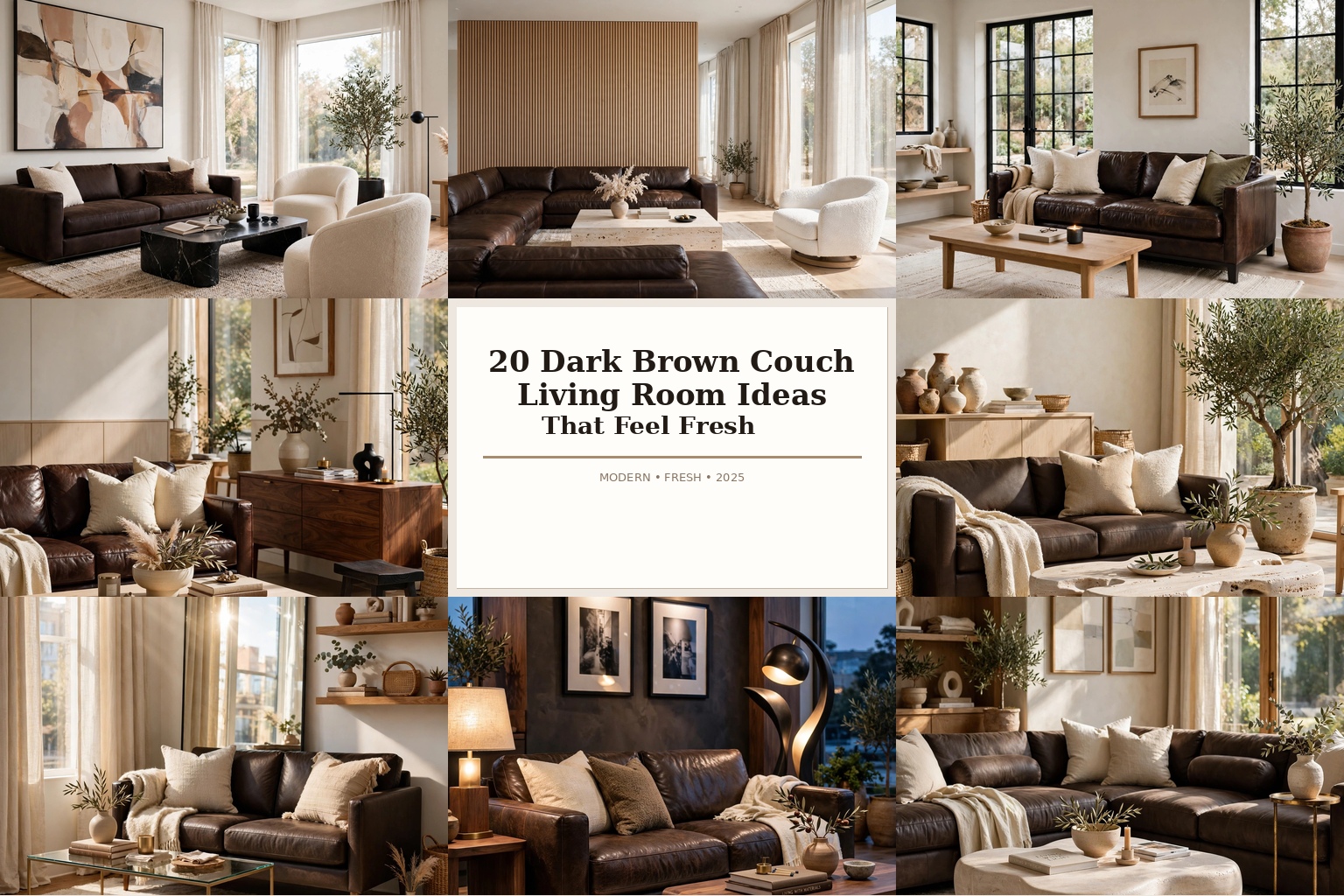
20 Dark Brown Couch Living Room Ideas That Feel Fresh
A dark brown couch is often blamed for problems it did not create.
The sofa looks heavy because the rug is too small. It appears old-fashioned because every surrounding surface is another similar shade of brown. It makes the room dark because one ceiling fixture is being asked to do the work of four lamps. Replacing the sofa may feel like the obvious answer, but it is rarely the most intelligent first move.
Dark brown can be warm, grounding, durable, and extraordinarily versatile. It has the visual authority that paler sofas often lack, and leather becomes richer as it develops a natural patina. The goal is not to disguise that depth. It is to give it contrast, softness, light, and context.
Before decorating, take a photograph of your sofa in daylight. Is the brown reddish, orange, yellow, gray, or nearly black? That undertone determines which creams, woods, metals, and accent colors will make the room feel harmonious.
1. Identify Your Couch’s Undertone Before Choosing Colors

Two dark brown couches can behave like entirely different colors. A red-brown Chesterfield may look magnificent with forest green and antique brass, while the same colors can make a yellow-brown microfiber sofa appear muddy.
Look at the couch beside a sheet of white paper during daylight:
- Red or burgundy brown: works with forest green, dusty blue, camel, and aged brass.
- Orange or cognac brown: suits navy, teal, cream, olive, and black.
- Yellow or tobacco brown: pairs with warm white, ochre, charcoal, and muted green.
- Cool espresso brown: works with mushroom, stone, soft gray-blue, and polished nickel.
- Neutral chocolate brown: accepts almost any balanced palette.
This undertone test is best for anyone planning paint, curtains, or a large rug. It prevents expensive near-matches that make the room feel subtly wrong.
Designer Tip: Test colors against the couch—not across the room. A paint chip that looks beautiful near the window may change beside the upholstery.
Common Mistake: Treating all browns as interchangeable.
Budget Hack: Photograph the couch in daylight and create a digital color board before shopping.
Luxury Upgrade: Order large fabric, paint, and rug samples and evaluate them beside the couch from morning through evening.
2. Build the Room Around a Warm White Background

Warm white gives a dark brown couch the clean contrast it needs without making the room feel cold. Look for whites with gentle cream, putty, or beige undertones rather than icy blue-white.
This works especially well in smaller rooms, low-ceilinged spaces, and homes with limited windows. Paint the walls and trim in related warm whites, then repeat brown in smaller details so the sofa does not appear isolated—a picture frame, woven basket, or slim wooden table is enough.
Avoid surrounding a red-brown couch with stark brilliant white and cool gray. The contrast can make the leather appear more orange than it really is.
Styling Secret: Use a matte or eggshell wall finish. Soft light diffusion looks more relaxed beside leather than a reflective wall.
Budget Hack: Paint only the wall behind the couch and refresh the remaining space with warm-white textiles.
Luxury Upgrade: Replace flat white paint with mineral paint, limewash, or subtle plaster for atmospheric variation.
3. Layer Cream, Oatmeal, and Flax Instead of One Beige

A single beige repeated everywhere can look flat. Several warm neutrals create a much richer relationship with dark brown.
Combine an ivory rug, oatmeal curtains, flax cushions, and a stone-colored chair. The small tonal differences soften the sofa while maintaining a calm palette. This approach is ideal for minimal, transitional, Scandinavian, and rental living rooms where repainting is not possible.
Texture must do the work that strong color normally performs. Mix linen, wool, boucle, cotton, paper, pale timber, and matte ceramic rather than buying five objects in identical beige fabric.
Common Mistake: Choosing beige upholstery that is almost—but not quite—the same brown as the couch.
Budget Hack: Replace only the cushion covers and add one substantial cream throw.
Luxury Upgrade: Use Belgian linen curtains, a hand-knotted wool rug, and one bouclé lounge chair.
4. Add Olive Green for an Earthy, Collected Look

Brown and olive work because both originate visually in nature. Brown provides stability; green introduces life without creating a sharp or playful contrast.
Use olive on an accent chair, patterned rug, cushions, or painted cabinetry. Add cream between the two dark colors so the composition retains clarity. A large plant can reinforce the palette, but greenery alone is not a substitute for deliberate color repetition.
This combination is particularly effective with warm brown leather, walnut furniture, traditional architecture, and rooms receiving golden afternoon light.
Designer Tip: Repeat olive at least twice—perhaps in art and one cushion—so it feels intentional.
Common Mistake: Combining brown, olive, burgundy, and dark wood without a light neutral break.
Budget Hack: Introduce olive through thrifted books, cushion covers, and garden branches.
Luxury Upgrade: Add an olive mohair chair or custom built-ins in a complex muted green.
5. Pair Dark Brown with Dusty Blue

Blue cools the warmth of brown, creating one of the most dependable complementary palettes. The secret is choosing a softened blue rather than an aggressively bright shade.
Dusty blue walls, blue-gray curtains, or a faded blue rug can make chocolate leather look refined and timeless. Navy produces greater drama, while powder blue feels lighter and more traditional.
This scheme suits readers who want their room to feel calm rather than strongly earthy. Connect the two colors through artwork that contains both blue and warm ochre or brown.
Common Mistake: Introducing only one tiny blue cushion. The color will look accidental rather than structural.
Budget Hack: Add a faded blue throw and repeat the shade in affordable framed prints.
Luxury Upgrade: Use a hand-knotted blue-and-rust rug with custom blue-gray drapery.
6. Introduce Terracotta and Rust for Warmth

Terracotta and rust sit close to brown on the color wheel, so they create harmony rather than high contrast. The result feels warm, relaxed, and sun-washed.
Use this palette in Mediterranean, Southwestern, bohemian, rustic, or autumnal interiors. Keep the walls light and add black, charcoal, or deep green sparingly to prevent the room from becoming uniformly orange.
Choose terracotta with a muted clay quality. Bright pumpkin orange can make glossy brown leather feel dated.
Styling Secret: Add one cooler element—perhaps a charcoal lamp, olive branch, or blue-gray artwork—to sharpen the warm palette.
Budget Hack: Use rust cushion covers, terracotta pots, and a clay-colored throw.
Luxury Upgrade: Add handmade zellige tile, an antique Turkish rug, or a sculptural rust velvet chair.
7. Use Black Accents to Make Brown Feel Contemporary

Black gives brown a cleaner edge. Slim black frames, a black floor lamp, dark curtain rod, or narrow metal coffee-table base can prevent an earthy palette from becoming excessively rustic.
This is best for modern, industrial, masculine, and organic-modern rooms. Because both black and dark brown carry substantial visual weight, keep the black accents narrow and distribute them around the room.
A black coffee table, black rug, black curtains, and black wall behind a dark couch will usually overwhelm an average living room. The goal is definition, not darkness.
Designer Tip: Choose one dominant metal finish. Matte black can be primary while aged brass appears only as a warmer supporting note.
Budget Hack: Replace mismatched frames with inexpensive slim black versions.
Luxury Upgrade: Add blackened-steel shelving, a sculptural designer lamp, or custom steel-framed doors.
8. Ground the Sofa with a Large Light-Colored Rug

A dark couch often looks too heavy because it sits directly on a dark floor or above a rug that is too small. A generous light rug creates a visual platform and separates the sofa from the flooring.
In most living rooms, the rug should extend beneath at least the front legs of the sofa and accompanying chairs. Ideally, it should be wider than the couch on both sides. An ivory, oatmeal, sand, or soft greige rug will brighten the zone without creating stark contrast.
For children and pets, avoid pure white high-pile rugs. Choose a low-pile, washable, heathered, or subtly patterned design that disguises daily wear.
Common Mistake: Buying a 5-by-7-foot rug for a full-size sofa grouping when the layout needs an 8-by-10 or larger.
Budget Hack: Layer a smaller vintage-look rug over a large natural-fiber base.
Luxury Upgrade: Order a hand-knotted wool rug sized to maintain an even border around the furniture.
9. Use a Patterned Rug to Connect the Entire Palette

A patterned rug can solve several color problems at once. Look for a design containing the couch’s brown plus two or three additional colors you want to repeat in the room.
A faded rug with cream, blue, rust, and brown makes it easy to select cushions, curtains, and artwork. Because the colors share one surface, the entire scheme feels connected.
Traditional Persian-style designs soften modern leather, while geometric rugs sharpen a traditional roll-arm sofa. This contrast keeps the room from becoming a literal style theme.
Styling Secret: Let the rug introduce the most complex pattern, then keep curtains and large upholstery quieter.
Budget Hack: Search vintage markets or washable printed-rug collections.
Luxury Upgrade: Choose an antique rug with natural wear and colors that become more nuanced in daylight.
10. Soften Brown Leather with Tactile Textiles

Leather is smooth, cool, and reflective. Pairing it only with more hard surfaces creates a room that may look expensive but feel emotionally distant.
Introduce matte and touchable materials: washed linen, chunky wool, velvet, boucle, cotton, and woven fibers. Instead of covering the couch with many small cushions, use two or three generous pillows and one casually folded throw.
For a standard three-seat sofa, begin with two 22-inch pillows near the arms and one smaller lumbar pillow. Adjust according to the sofa’s dimensions and avoid hiding its entire back.
Common Mistake: Using shiny polyester cushions that compete with the leather’s sheen.
Budget Hack: Buy feather inserts once and change covers seasonally.
Luxury Upgrade: Combine mohair, handwoven wool, washed linen, and embroidered textiles in a controlled palette.
11. Frame the Room with Full-Length Curtains

Curtains introduce vertical softness that balances the horizontal mass of a dark couch. Hang them high and wide so the windows appear larger and more daylight remains visible.
Warm white, flax, oatmeal, or pale mushroom curtains are the safest choices. Dusty blue or olive can work when those colors are already established elsewhere.
Use enough fabric to produce fullness. Two narrow panels stretched across a wide window will look thin beside a substantial couch.
Designer Tip: Extend the rod beyond the window frame so open curtains rest mostly against the wall.
Budget Hack: Combine two ready-made panels on each side of a wide window.
Luxury Upgrade: Install ceiling-mounted, lined, pinch-pleat curtains with a concealed track.
12. Create a Properly Scaled Art Moment Above the Couch

Small artwork can make a substantial brown couch appear even heavier. Choose one large work or a cohesive grouping that occupies approximately two-thirds of the sofa’s width.
Hang the lower edge around 6–10 inches above the sofa, adjusting for the artwork and back height. The art should visually relate to the couch rather than float near the ceiling.
A landscape introduces softness, abstract art can modernize the room, and a textile adds texture without glass reflection. Select art with one brown-adjacent tone plus a contrasting color used elsewhere.
Common Mistake: Hanging three unrelated small frames with wide gaps.
Budget Hack: Frame a vintage textile, public-domain print, or personal photograph at an oversized scale.
Luxury Upgrade: Commission a work based on the room’s proportions and emotional atmosphere.
13. Mix Wood Tones Intentionally

A brown couch does not require matching espresso-brown furniture. In fact, a full dark-brown suite often makes the room look heavier and more dated.
Choose a dominant wood tone and add one contrasting tone:
- Dark brown couch + pale oak for freshness
- Dark brown couch + medium walnut for richness
- Dark brown couch + weathered wood for rustic character
- Dark brown couch + blackened wood for modern drama
Connect different woods through repeated undertones rather than exact color. If the couch is warm, choose woods with visible warmth. Insert a light rug or stone surface between similar dark elements.
Styling Secret: A room generally feels collected when wood tones differ but furniture shapes share a common design language.
Budget Hack: Strip or paint one matching end table instead of replacing the whole set.
Luxury Upgrade: Add one beautifully crafted solid-wood piece with visible grain and refined joinery.
14. Add Glass, Stone, or Light Metal to Break Up the Brown

When a couch, floor, coffee table, and cabinet are all brown, the eye reads one large uninterrupted block. Introduce a material that behaves differently.
Glass creates visual openness. Travertine and pale marble introduce natural pattern and brightness. A thin metal base supplies definition without another bulky volume. These options are particularly helpful in rooms dominated by a large sectional.
Consider daily life before choosing. Glass shows fingerprints, sharp stone corners may not suit toddlers, and highly polished metal can feel too formal in a casual family room.
Budget Hack: Use a small glass side table or light ceramic stool rather than replacing the central table.
Luxury Upgrade: Add a sculptural travertine, marble, or artisan plaster coffee table.
15. Layer Lighting Around the Couch

A dark sofa absorbs light and creates deeper shadows, especially in the evening. One ceiling fixture often leaves the upholstery looking like a dark mass.
Use at least three light sources where space permits:
- Ambient ceiling light
- Reading lamp beside the couch
- Table lamp, wall sconce, or picture light
Position lamps at different heights and choose warm bulbs, generally around 2700K for living rooms. A pale fabric shade diffuses light and visually softens leather.
This is essential for north-facing rooms, basements, and living rooms with small windows.
Common Mistake: Placing two identical lamps only on one side of a large sectional.
Budget Hack: Use plug-in sconces or rechargeable picture lights.
Luxury Upgrade: Add dimmers, integrated shelf lighting, and separate evening lighting scenes.
16. Embrace a Tonal Chocolate Room

A dark brown couch does not always need a pale background. In a room with adequate light—or one intended to feel intimate—layering several browns can produce a sophisticated, enveloping effect.
Pair chocolate upholstery with mushroom walls, walnut, caramel, tobacco, camel, and cream. The success of the palette depends on tonal separation and texture. Each brown must be distinguishable from the next.
This approach is ideal for libraries, dens, media rooms, and evening-focused spaces. It is less suitable when the goal is to make a tiny room feel bright and expansive.
Styling Secret: Include one luminous element, such as polished brass, warm ivory art, or a pale lampshade.
Budget Hack: Paint the walls a medium mushroom rather than purchasing new furniture.
Luxury Upgrade: Add walnut paneling, mohair upholstery, antique brass, and tonal wool drapery.
17. Create an Organic Modern Scheme

Dark brown is an ideal anchor for organic modern design because it adds depth to pale natural materials.
Combine a clean-lined couch with warm white walls, pale oak, travertine, textured linen, wool, handmade ceramics, and one substantial tree. Keep the silhouettes simple and allow material variation to create interest.
This look is best for readers who like minimalism but find all-white rooms sterile. Avoid excessive baskets, tiny plants, and generic beige accessories; organic modern design depends on restraint and strong forms.
Budget Hack: Add one oversized branch arrangement and a textured neutral throw.
Luxury Upgrade: Incorporate limewashed walls, custom oak joinery, natural stone, and artisan lighting.
18. Make a Small Living Room Feel Lighter

In a small room, the dark couch should be the primary visual anchor rather than one of several heavy pieces.
Choose furniture with visible legs, use a large light rug, maintain open pathways, and place the tallest objects near the room’s perimeter. A wall-mounted shelf or sconce preserves floor space. Mirrors can amplify daylight when positioned to reflect a window rather than a cluttered wall.
Do not automatically buy tiny accessories. Several small objects can make a compact room feel busier, whereas one large artwork and one substantial lamp create clarity.
Designer Tip: Match the wall and curtain colors to reduce visual interruptions.
Budget Hack: Remove one unnecessary table and replace multiple small accessories with a single large branch arrangement.
Luxury Upgrade: Add custom shallow-depth storage painted to match the walls.
19. Modernize a Bulky Brown Reclining Sofa

A large reclining couch can look intentional when the surrounding elements are simple, substantial, and correctly scaled.
Avoid tiny end tables and delicate artwork; they exaggerate the sofa’s bulk. Use a large rug, oversized art, a solid floor lamp, and a broad but visually light coffee table. Keep cushions restrained so the reclining mechanism remains usable.
If the couch is part of a matching set, separate the pieces. Replace one matching chair with a contrasting upholstered accent chair and introduce a different table material.
Common Mistake: Trying to disguise the sofa with many throws and cushions, which increases its apparent volume.
Budget Hack: Remove the matching loveseat, rearrange the room, and update only the rug and lighting.
Luxury Upgrade: Add custom built-ins or architectural wall treatment behind the sofa to balance its scale.
20. Style the Couch for Real Family Life

Dark brown upholstery is practical because it hides minor wear, but successful family design should not depend on concealment alone.
Choose washable cushion covers, a low-pile rug, rounded tables, concealed storage, and lighting that cannot be easily knocked over. Place a large basket near the couch for blankets and create one accessible zone for toys or books.
Use medium-value patterns rather than pure white textiles in high-contact areas. A cream-and-brown patterned rug will look lighter than the sofa while tolerating more activity than plain ivory.
Styling Secret: Give everyday clutter a convenient home within arm’s reach. Storage only works when it matches actual behavior.
Budget Hack: Add washable covers, a lidded basket, and a tray for remotes.
Luxury Upgrade: Choose custom performance-fabric chairs, built-in storage, and a durable wool rug with a forgiving pattern.
The Brown Couch Design Formula
If the number of choices feels overwhelming, use this dependable formula:
- One dark anchor: the brown couch
- One large light surface: walls, rug, or curtains
- One contrasting color: olive, blue, rust, or muted ochre
- Three texture families: soft, natural, and smooth
- Two or three light sources: at different heights
- One personal focal point: artwork, heirloom, or collection
- One organic element: plant, branch, stone, or handmade ceramic
Start with the largest surfaces. Correcting the rug, wall color, or curtains will influence the room more than buying ten new accessories.
Conclusion
Picture your living room after the late-afternoon light begins to soften.
The dark couch no longer sits in the room like a problem waiting to be solved. It anchors a generous rug, gives the pale curtains something to contrast with, and makes the colors in your artwork appear richer. A lamp warms the leather in the evening. The linen cushion beside you feels relaxed rather than staged, and the wooden table does not match the sofa—it complements it.
You do not need to execute all 20 ideas. Begin with the change that will alter the largest area: spread out a bigger rug, test a warmer wall color, raise the curtain rod, or move a lamp into the dark corner beside the couch.
Then stop and look again.
Your brown couch may turn out to be the most valuable design element in the room: the piece that gives lighter colors clarity, natural materials depth, and everyday family life a forgiving place to land.
Let the sofa be dark. Let it be substantial. Give it enough light, softness, and breathing room, and it can become the reason the entire living room finally feels grounded, welcoming, and unmistakably yours.
Frequently Asked Questions
1. What colors go best with a dark brown couch?
Warm white, cream, oatmeal, olive green, dusty blue, navy, terracotta, rust, camel, and soft mushroom pair especially well with dark brown. The best choice depends on whether the couch has red, orange, yellow, cool, or neutral undertones.
2. How do I make a room with a dark brown couch look lighter?
Use warm light-colored walls, a large cream or oatmeal rug, full-length pale curtains, reflective surfaces, and several light sources. Keep other large furniture visually lighter and avoid clustering several dark pieces around the sofa.
3. What color walls go with a dark brown sofa?
Warm white is the safest choice, but mushroom, muted olive, dusty blue, soft greige, and clay can also work. Test paint directly beside the couch because its undertone and the room’s natural light will affect the result.
4. What color rug looks best with a dark brown couch?
Ivory, oatmeal, beige, soft greige, faded blue, or a multicolored rug containing cream and brown can work beautifully. Prioritize size and practicality as well as color. The rug should extend under at least the front legs of the main seating.
5. What color curtains work with dark brown furniture?
Warm white, flax, oatmeal, pale mushroom, dusty blue, and muted olive are dependable choices. Light neutral curtains brighten the room, while colored curtains create a more enveloping scheme. Avoid cool bright white when the sofa has strong warm undertones.
6. How do you modernize an old brown leather couch?
Remove matching brown furniture, add a large light rug, introduce oversized contemporary art, simplify the pillows, and add slim black or brass accents. Contrasting materials such as glass, pale wood, and travertine can update the room without altering the sofa.
7. Can gray work with a brown couch?
Yes, but the gray should relate to the brown’s temperature. Warm greige, mushroom, and taupe are easier partners than icy blue-gray. If using cool gray, introduce cream, wood, or warm metal to bridge the colors.
8. Can black furniture go with a dark brown couch?
Black can sharpen brown and make it feel contemporary. Use it in slim frames, lighting, legs, or hardware rather than surrounding the couch with large black surfaces. Include a light rug or walls to balance both dark colors.
9. What color pillows should go on a dark brown couch?
Cream, flax, olive, dusty blue, rust, camel, and patterned pillows containing brown can work well. Begin with two large light pillows and one smaller colored or patterned lumbar. Texture is as important as color, particularly on leather.
10. How many pillows should be placed on a brown couch?
A standard three-seat sofa often needs three to five pillows, depending on its depth and back style. Start with two 22-inch pillows and one lumbar. Add more only if they improve comfort without crowding the seats.
11. How do you make a brown leather couch feel cozy?
Layer it with linen, wool, velvet, or cotton textiles; place it on a generous rug; add warm lamps; and introduce curtains or upholstered chairs. These matte, soft materials counter leather’s smooth, reflective surface.
12. What coffee table works with a dark brown sofa?
Pale oak, glass, travertine, marble, plaster, and slim metal-framed tables all provide useful contrast. Avoid a matching dark brown table unless a light rug clearly separates it from the sofa and floor.
13. Can a dark brown couch work in a small living room?
Yes. Let the couch act as the room’s main dark anchor. Use warm white walls, a large light rug, furniture on visible legs, vertical storage, and restrained accessories. Good scale matters more than choosing uniformly tiny furniture.
14. How do you mix a dark brown couch with wooden furniture?
Choose one dominant wood tone and one supporting tone. Pale oak creates contrast, walnut produces richness, and weathered wood introduces rustic character. Repeat undertones and use a rug, stone, or metal surface to separate similar browns.
15. Are dark brown couches outdated?
No. Dark brown remains a versatile, practical neutral. A couch usually looks dated because of its surrounding matching set, small rug, weak lighting, or old accessory combination—not because brown itself has fallen out of style.