
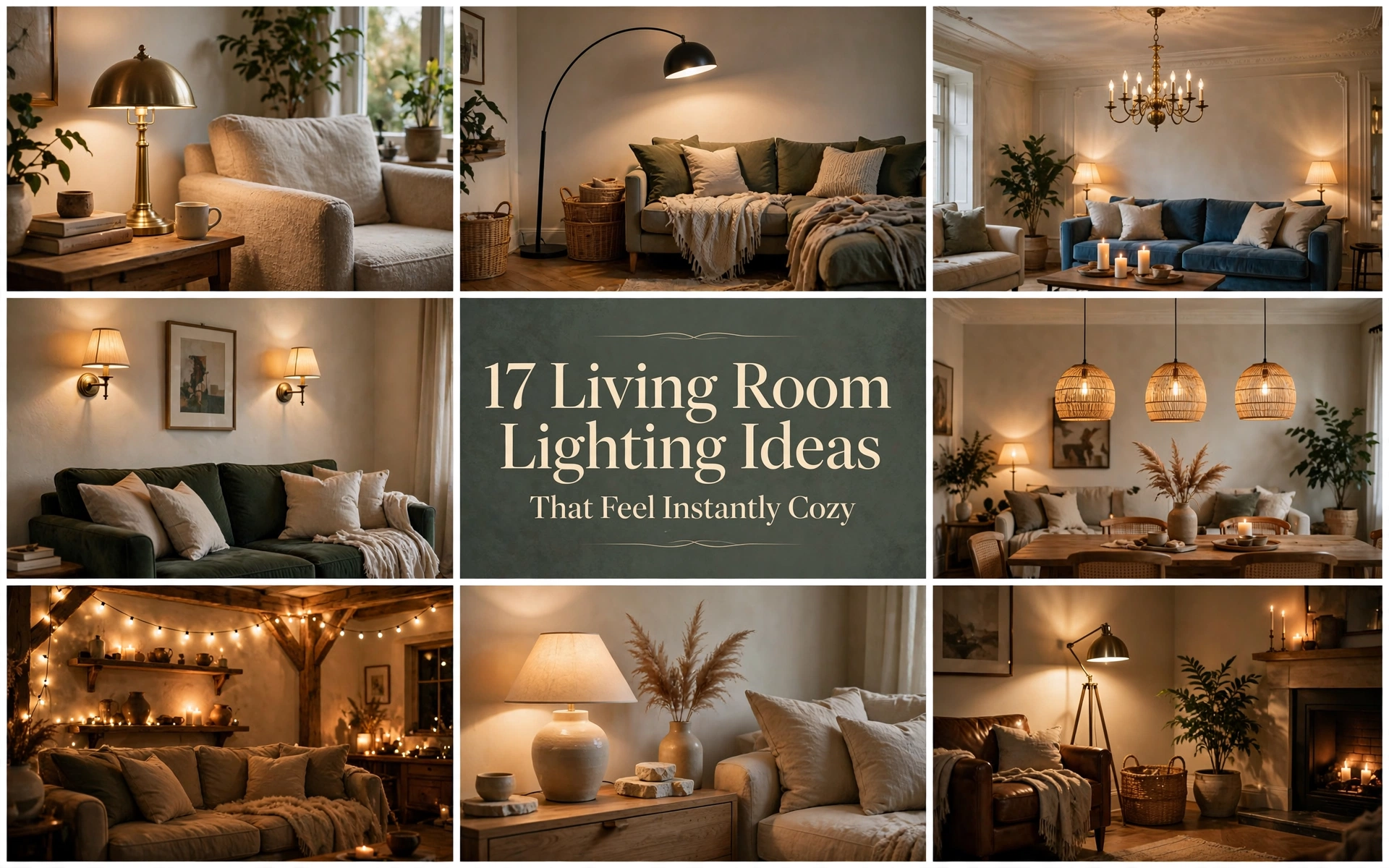
17 Living Room Lighting Ideas That Feel Instantly Cozy
Your living room looks lovely in daylight—then evening arrives, one harsh ceiling light comes on, and every ounce of atmosphere disappears.
The fix is rarely a brighter bulb. It is a better mix of light at different heights. Ahead, you’ll find 17 genuinely usable living room lighting ideas, along with placement tips, affordable alternatives, and upgrades worth splurging on. If you want the quickest transformation, jump to the three-layer lighting formula first.
1. Start With the Three-Layer Lighting Formula

A beautifully lit living room usually has three kinds of light:
- Ambient light: Overall illumination from a ceiling fixture or indirect source
- Task light: Focused light for reading, games, crafts, or working
- Accent light: A softer glow that highlights art, shelving, plants, or architecture
Why does this work? One bright source makes a room look flat. Several softer sources create pools of light, gentle shadows, and depth.
Aim for three to five visible light sources in an average living room. A larger room may need more, while a tiny room can often succeed with one ceiling fixture, one floor lamp, and one table lamp.
Who it’s for: Everyone, but especially anyone whose room feels cold or unfinished at night.
How to recreate it:
- Begin with a dimmable ceiling fixture.
- Place a reading lamp beside the most-used seat.
- Add one accent source near art, shelving, or a plant.
- Switch everything on together, then reduce individual brightness until the room feels balanced.
Common Mistake: Buying three lamps of almost identical height. Put light high, middle, and low in the room so your eye travels through the entire space.
Budget Hack: Use existing lamps but replace mismatched bulbs and shades. Consistent light color can make unrelated fixtures feel intentional.
Luxury Upgrade: Have an electrician create separate dimmer circuits for the ceiling, wall, and architectural lighting.
2. Replace the Basic Ceiling Light With Something Sculptural

A ceiling fixture sits close to the visual center of the room, so even when it is off, it affects the entire design. Replacing a generic dome with a linen drum, plaster pendant, branching fixture, or softly sculptural chandelier immediately gives the room a point of view.
A chandelier does not have to mean crystals or formality. Think oversized paper lanterns, alabaster globes, pleated fabric, aged brass, ceramic, or woven fibers.
Who it’s for: Rooms that feel adequately bright but visually forgettable.
How to recreate it:
- Center the fixture over the seating arrangement, not automatically in the geometric center of the room.
- For an 8-foot ceiling, choose a flush or compact semi-flush design.
- On taller ceilings, allow more vertical presence.
- Keep the bottom high enough that people can comfortably walk beneath it.
Designer Tip: Repeat one material from the fixture elsewhere—perhaps brass in a picture frame or dark bronze in a side table. One repetition is enough.
Common Mistake: Choosing a fixture that is too small. A timid light floating over a substantial sofa arrangement makes the whole room feel under-scaled.
Budget Hack: Install a large paper or fabric lantern shade on an existing pendant fitting.
Luxury Upgrade: Commission hand-finished plaster, Murano-style glass, or artisan metalwork in a scale tailored to the room.
3. Place Table Lamps at Seated Eye Level

Table lamps are the quickest way to make a living room feel inhabited. Their light falls where people actually sit, softening faces and creating an intimate glow that ceiling lights cannot reproduce.
The shade should generally sit around seated eye level. That keeps the bulb hidden while allowing light to spread across the sofa or chair.
Who it’s for: Conversation-focused rooms and homes that need a cozy improvement without electrical work.
How to recreate it:
- Place a lamp on an end table or console close to seating.
- Choose a shade wide enough to balance the table beneath it.
- Use pairs when you want formality; mix different lamps for a collected look.
- Position the shade so the bare bulb is not visible from the sofa.
Designer Tip: A lamp should relate to nearby furniture, not disappear against it. A deep ceramic base can anchor a pale room; clear glass works when the area already feels visually busy.
Common Mistake: Using lamps that are attractive but too short. Add a sturdy book beneath a small lamp or move it to a taller table.
Budget Hack: Replace a tired shade with a pleated, patterned, or linen version.
Luxury Upgrade: Choose handmade ceramic bases and bespoke shades with contrasting trim.
4. Use a Floor Lamp to Rescue a Dark Corner

An unlit corner visually recedes after sunset, making the room feel smaller. A floor lamp pulls that space back into the composition and can balance a bright television, fireplace, or bank of windows on the opposite side.
Who it’s for: Renters, narrow rooms, and layouts with limited table space.
How to recreate it:
- Place the lamp beside a chair, behind the end of a sofa, or near a tall plant.
- Choose a shaded lamp for diffused light.
- Use an adjustable pharmacy-style lamp for reading.
- Select a torchiere only when you specifically want light bounced off the ceiling.
Common Mistake: Pushing the lamp tightly into the corner. Give its shade enough breathing room that it does not look stored away.
Budget Hack: Refresh an inexpensive base with a better-quality fabric shade.
Luxury Upgrade: Invest in a sculptural floor lamp that looks like art during the day.
5. Bring Overhead Light to the Sofa With an Arc Lamp

An arc lamp provides the effect of a pendant without wiring the ceiling. Its long arm reaches over a sofa or chair, creating a pool of useful light while adding a strong architectural curve.
Who it’s for: Renters, rooms without ceiling wiring, and large sectionals that need light near the center.
How to recreate it:
- Tuck the heavy base beside or behind the sofa.
- Let the shade hover over a coffee table or seat—not over a busy walkway.
- Choose a diffused shade if the bulb will be visible from across the room.
- Check the arm’s reach before purchasing.
Designer Tip: Curved lamps are particularly good in boxy rooms because they interrupt all the straight furniture lines.
Common Mistake: Pairing a low arc with a tall family. Check head clearance from both standing and seated positions.
Budget Hack: Look for a simple black arc lamp with a fabric drum shade.
Luxury Upgrade: Choose marble, hand-finished metal, or an iconic mid-century-inspired silhouette.
6. Frame a Fireplace With Wall Sconces

Sconces draw attention to the vertical plane of a room. Positioned on either side of a fireplace, they create symmetry, make the mantel feel more substantial, and provide flattering light without consuming floor or table space.
Who it’s for: Traditional, transitional, and contemporary rooms with a clear architectural focal point.
How to recreate it:
- Mount matching sconces on both sides of the fireplace.
- Keep them visually connected to the mantel rather than drifting toward the room’s corners.
- Select fabric shades for softness or opal glass for a cleaner look.
- Put them on a dedicated dimmer.
Common Mistake: Mounting sconces too high. They should relate to human eye level and the proportions of the mantel.
Budget Hack: Use plug-in sconces with neatly concealed cord covers.
Luxury Upgrade: Add recessed wiring and decorative antique or artisan fixtures.
7. Give Artwork Its Own Picture Light

A picture light does more than illuminate art. It creates a deliberate focal point and gives the room the polished feeling of a gallery or boutique hotel.
It works particularly well above one large canvas, a symmetrical pair of prints, or art hung over a fireplace or console.
Who it’s for: Art lovers and rooms that need character after dark.
How to recreate it:
- Select a light proportional to the artwork rather than the wall.
- Aim the beam across the art without producing glare.
- Use a rechargeable fixture when hardwiring is impractical.
- Keep the light warm enough to harmonize with other lamps.
Common Mistake: Lighting glass-covered art from an angle that reflects directly toward the sofa.
Budget Hack: Install a rechargeable magnetic picture light.
Luxury Upgrade: Use a custom-finished fixture with high-quality, color-accurate LEDs.
8. Make Bookshelves and Built-Ins Glow

Shelf lighting creates depth without making the entire room brighter. It highlights books and objects, separates them from the shadows, and turns built-ins into an evening focal point.
The best shelf lighting is discreet. You should notice the warm wash across the objects before you notice the LEDs.
Who it’s for: Living rooms with bookcases, media cabinetry, alcoves, or open shelving.
How to recreate it:
- Hide LED tape beneath the front edge of each shelf.
- Use a diffuser channel to eliminate visible dots.
- Place miniature lamps on deep shelves for a collected alternative.
- Illuminate selected shelves rather than every compartment if the display feels busy.
Designer Tip: Leave breathing space around objects. Lighting clutter simply creates brighter clutter.
Common Mistake: Using cool white LEDs beside warm lamps.
Budget Hack: Add rechargeable puck lights beneath selected shelves.
Luxury Upgrade: Integrate dimmable, high color-rendering linear LEDs during joinery construction.
9. Wash the Walls Instead of Blasting the Floor

Light aimed at walls makes a room feel broader and softer because the illumination is reflected rather than directed straight down. It is especially effective on limewash, plaster, brick, stone, paneling, or beautifully colored walls.
Who it’s for: Narrow rooms, dark paint colors, and spaces with tactile architectural finishes.
How to recreate it:
- Aim adjustable ceiling spots toward the wall.
- Place an uplight behind a plant or console.
- Use sconces that cast light both upward and downward.
- Allow the surface texture to create subtle shadows.
Common Mistake: Positioning a spotlight so close that it creates a harsh bright oval.
Budget Hack: Hide a small plug-in uplight behind a plant.
Luxury Upgrade: Add recessed wall washers during a renovation for an even architectural glow.
10. Use Portable Lamps Where Outlets Are Missing

Rechargeable lamps let you place light in the middle of a room, on a bookshelf, or atop a console without trailing cables. They are small, but their glow can make a seating arrangement feel noticeably more intimate.
Who it’s for: Renters, old homes with few outlets, and floating furniture layouts.
How to recreate it:
- Place one on a drinks table between two chairs.
- Use one on a shelf or mantel.
- Choose a shaded design that conceals the bright LED source.
- Treat it as accent light, not the room’s primary illumination.
Common Mistake: Filling the room with several unrelated mini lamps. Repeat one design or material for cohesion.
Budget Hack: Start with one lamp on the table used most often.
Luxury Upgrade: Choose weighty metal or hand-blown glass designs with excellent dimming and battery life.
11. Choose Flush Lighting for a Low Ceiling

A low ceiling does not condemn you to a builder-basic dome light. Wide flush mounts, shallow fabric drums, opal globes, and sculptural semi-flush fixtures can add personality while preserving headroom.
Direct some light toward the ceiling when possible. The reflected glow can make the ceiling feel less heavy.
Who it’s for: Rooms with ceilings around eight feet or lower.
How to recreate it:
- Choose width rather than excessive drop.
- Favor diffused shades over exposed bulbs.
- Add floor and table lamps so the ceiling light does not carry the whole room.
- Keep tall furniture away from the center to maintain visual openness.
Common Mistake: Installing many bright recessed downlights and creating a grid of glare.
Budget Hack: Replace only the central fixture, then add a plug-in lamp in the darkest corner.
Luxury Upgrade: Install a shallow architectural fixture with indirect uplight and separate dimming.
12. Light an Open-Plan Living Room by Zone

An open room becomes more comfortable when lighting defines what happens in each area. The living space might have a pendant and floor lamp, while the dining space uses a lower chandelier and the kitchen has brighter task lighting.
The fixtures do not need to match. They only need a shared thread, such as finish, shape, shade material, or color temperature.
Who it’s for: Combined living, dining, and kitchen spaces.
How to recreate it:
- Center the living fixture over the furniture grouping.
- Give the reading chair its own lamp.
- Keep dining and living lights on separate controls.
- Repeat one finish while varying fixture forms.
- Use rugs and lighting together to reinforce each zone.
Designer Tip: Judge the fixtures from all major sightlines before committing. Open-plan lights are often visible together.
Common Mistake: Centering everything on the architecture while ignoring where the furniture sits.
Budget Hack: Define the living zone with two lamps instead of relocating ceiling wiring.
Luxury Upgrade: Create programmable scenes for cooking, dining, entertaining, and late evenings.
13. Brighten a Small Living Room Without Adding Clutter

In a small room, light should occupy vertical and overlooked space. Plug-in sconces, narrow floor lamps, compact table lamps, and reflective surfaces provide layers without taking over tabletops or walkways.
Lighting placed at different heights can also create greater visual depth in a compact room. This approach appears repeatedly in current small-space design guidance.
Who it’s for: Apartments, narrow lounges, and multipurpose rooms.
How to recreate it:
- Mount a swing-arm sconce above the sofa or reading chair.
- Place a narrow floor lamp behind furniture.
- Use one petite lamp on a windowsill or shelf.
- Position a mirror where it can reflect a lamp—not a bare bulb.
- Keep the floor clear around circulation routes.
Common Mistake: Assuming a small room needs only one small light. It still benefits from layers; the fixtures simply need slimmer footprints.
Budget Hack: Use plug-in sconces instead of sacrificing an end table to a lamp.
Luxury Upgrade: Add concealed perimeter or joinery lighting that occupies no usable space.
14. Add Subtle Backlighting Behind the Television

A bright television surrounded by darkness strains the visual balance of a room. A restrained backlight reduces the contrast and makes the screen feel less like a black hole in the decor.
Keep the color neutral and the effect subtle. This is bias lighting, not a rainbow light show.
Who it’s for: Movie watchers and living rooms where the television dominates after sunset.
How to recreate it:
- Attach a dimmable strip behind the television.
- Keep it hidden from direct view.
- Use a neutral white close to the screen’s reference white where accurate viewing matters.
- Pair it with one low lamp elsewhere in the room.
Common Mistake: Using saturated, constantly changing colors during normal viewing.
Budget Hack: Add one USB-powered dimmable strip sized for the television.
Luxury Upgrade: Integrate the screen into illuminated custom cabinetry with concealed cable management.
15. Treat Lampshades as Part of the Color Palette

A lampshade changes both the look of the fixture and the quality of light. White linen feels clean and airy; oatmeal fabric warms the room; pleats add traditional texture; patterned shades introduce color without another cushion.
A darker shade creates focused light above and below, while a pale translucent shade spreads a softer glow.
Who it’s for: Anyone wanting an affordable seasonal refresh or more personality in a neutral room.
How to recreate it:
- Echo a minor color from the rug, art, or upholstery.
- Mix shade shapes while repeating a color or trim.
- Check how the shade looks illuminated as well as switched off.
- Ensure the shade conceals the bulb from normal viewpoints.
Designer Tip: A strong patterned shade often looks more sophisticated on a simple base.
Common Mistake: Choosing a tiny shade for a substantial lamp base.
Budget Hack: Recover an existing shade in remnant fabric or add contrast trim.
Luxury Upgrade: Commission hand-painted, marbled, gathered silk, or block-printed shades.
16. Keep the Bulb Color Consistent

Even a beautifully furnished room feels wrong when one lamp glows orange, another looks blue, and the ceiling light feels like an office.
For most cozy living rooms, begin around 2700K. A cleaner contemporary room may suit 3000K, but consistency matters more than chasing one supposedly perfect number.
Also consider:
- Lumens: The bulb’s brightness
- CRI: How accurately colors appear under the light
- Dimmability: Whether the bulb works smoothly with your dimmer
- Diffusion: Whether the bulb or shade prevents uncomfortable glare
Choose high-CRI bulbs where art, textiles, timber, and paint colors matter.
Who it’s for: Any room that feels visually disjointed despite having several fixtures.
How to recreate it:
- Audit every visible bulb after dark.
- Standardize the color temperature.
- Use lower lumens in exposed decorative lamps.
- Reserve stronger output for shaded task lights.
- Test one bulb before replacing the whole room.
Common Mistake: Buying bulbs based only on wattage. Modern bulbs should be compared by lumen output and light quality.
Budget Hack: Replace the most noticeably mismatched bulb first.
Luxury Upgrade: Install high-CRI, flicker-free architectural lamps with precise dimming control.
17. Put Every Important Light on a Dimmer

The ideal brightness changes throughout the day. You may want generous illumination for cleaning, focused light for reading, and a barely-there glow for watching a film.
Dimming gives the same fixtures multiple roles, which is far more useful than designing one static “perfect” setting.
Who it’s for: Everyone—particularly open-plan homes and rooms used for several activities.
How to recreate it:
- Put the central fixture on a wall dimmer.
- Use plug-in lamp dimmers where compatible.
- Group smart bulbs by room or activity.
- Create simple settings such as Day, Reading, Guests, and Movie.
- Make sure bulbs and dimmers are compatible to avoid flicker.
Designer Tip: Your evening setting should not simply make every fixture equally dim. Keep selected lamps brighter and others low so the room retains depth.
Common Mistake: Installing smart color-changing bulbs everywhere when simple warm dimming would be easier to live with.
Budget Hack: Use plug-in dimmer adapters on compatible lamps.
Luxury Upgrade: Install a whole-room control system with discreet keypads and programmed scenes.
A Simple Lighting Plan You Can Copy Tonight

Before buying anything, stand in the living room after sunset and switch on only the lights you normally use. Notice where the room disappears into darkness and where the light feels uncomfortable.
Then use this sequence:
- Fix glare: Conceal exposed bulbs and overly bright downlights.
- Standardize color: Bring visible fixtures to one color temperature.
- Light your activities: Add a lamp beside the reading chair or sofa.
- Recover one dark area: Use a floor lamp, sconce, or uplight.
- Highlight one feature: Choose art, shelving, a plant, or the fireplace.
- Add dimming: Create an evening setting you will actually use.
Do not buy five lights at once. Add one layer, live with it for a few evenings, and then decide what the room still needs.
Conclusion
Picture the room at the end of the day: the ceiling light lowered, a warm lamp beside your favorite seat, art softly illuminated, and the forgotten corner finally glowing. The furniture has not changed, yet everything feels richer, calmer, and more inviting.
Start with the place where you most want to sit tonight. Give that one spot beautiful light, switch it on after sunset, and watch the rest of the room tell you what it needs next.
Frequently Asked Questions
1. What is the best lighting for a living room?
The best living room lighting combines ambient, task, and accent sources. Use a dimmable ceiling fixture for general light, lamps near seating, and softer accent lighting around art, plants, shelving, or architectural features.
2. How many lights should a living room have?
Most average living rooms benefit from three to five light sources, although size and layout matter more than a fixed number. Include lights at different heights rather than filling the room with similar table lamps.
3. What color temperature is best for living room lighting?
Around 2700K creates a warm, comfortable glow suited to most living rooms. A crisp contemporary scheme may work well at 3000K, but avoid mixing noticeably warm and cool bulbs within the same view.
4. How can I light a living room without ceiling lights?
Combine an arc floor lamp, table lamps, wall-mounted plug-in sconces, and one or two accent lights. Reflecting some light off walls and the ceiling will make the overall illumination feel softer and more generous.
5. How do I make my living room lighting feel cozy?
Use several low-to-medium brightness sources instead of one intense overhead light. Choose warm bulbs, fabric shades, dimmers, and lamps positioned near the places where people sit.
6. What lighting makes a small living room look bigger?
Wall-washing light, slim floor lamps, sconces, and illumination at multiple heights create depth without using much floor space. A strategically positioned mirror can also reflect a shaded lamp and extend the glow.
7. Should living room lamps match?
No. Lamps can differ in shape, height, and material while sharing one connecting detail, such as shade color, metal finish, or design era. Matching pairs create formality; coordinated mismatched lamps feel more collected.
8. Where should floor lamps go in a living room?
Place floor lamps beside reading chairs, at the end of a sofa, behind a sectional, or in an underlit corner. Keep bases and cords outside primary walkways and position shades so bare bulbs do not cause glare.
9. Are recessed lights good for a living room?
Recessed lights can provide useful background illumination, but they should not be the only light source. Use them sparingly, aim adjustable fittings toward walls or features, and place them on a dimmer.
10. How can I improve living room lighting on a small budget?
Start by replacing mismatched bulbs, updating one lampshade, and moving existing lamps closer to seating. Then add a plug-in dimmer, rechargeable picture light, or small uplight in the darkest part of the room.


