
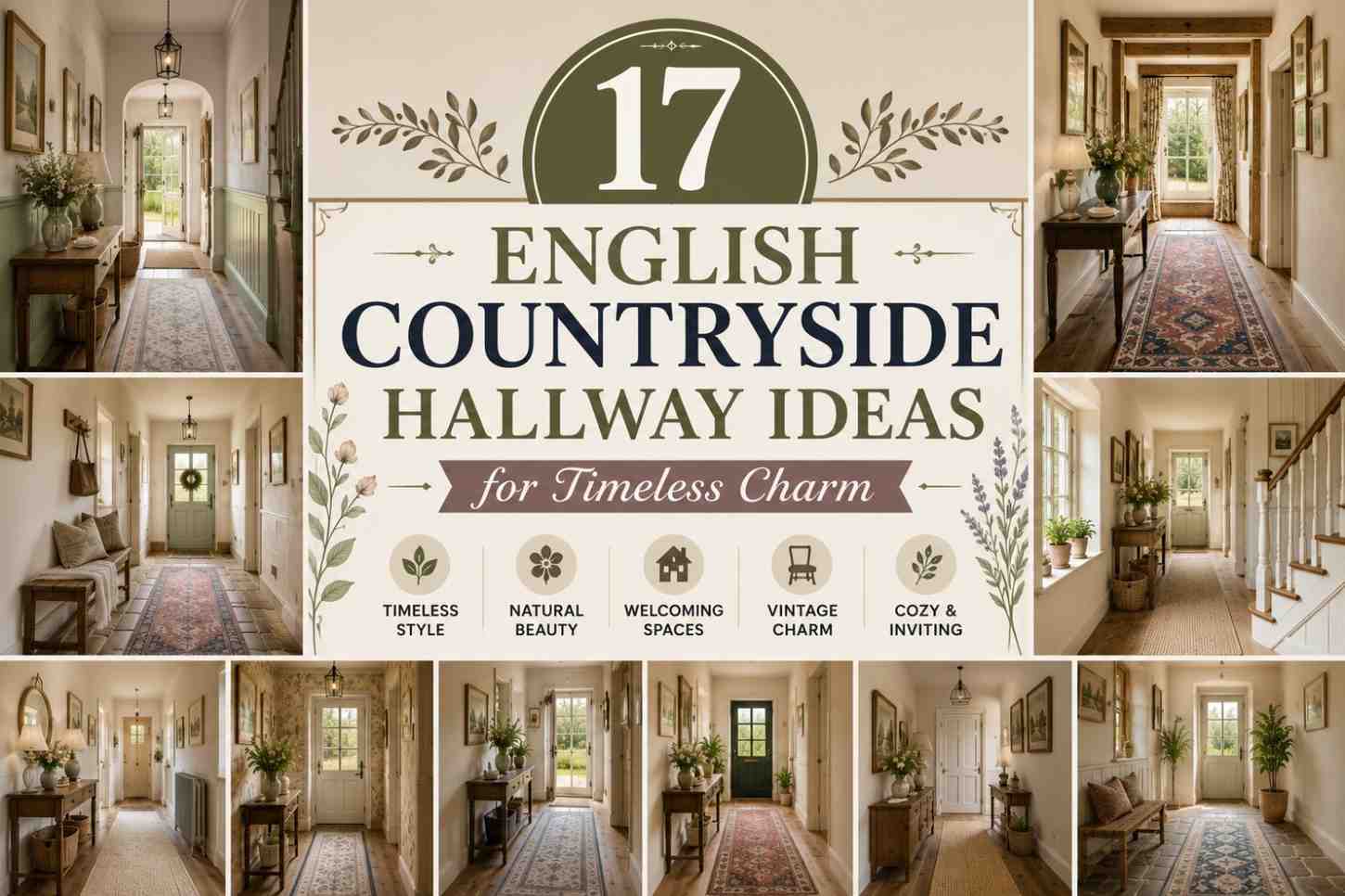
17 English Countryside Hallway Ideas for Timeless Charm
English countryside hallway design is the practice of styling an entryway with rustic textures, muted florals, and weathered antiques that echo the farmhouses and rectories of rural England. This guide collects 17 english countryside hallway ideas, from limewashed walls to reclaimed flagstone, worth pinning before your next renovation.
Step into a real English countryside hallway and the air feels cooler, faintly scented with beeswax polish and old timber. Light falls low and golden through leaded glass, pooling across worn stone underfoot. There’s a stillness here, layered with decades of coats, boots, and half-remembered stories. In my experience, the best ones never look decorated so much as inherited.
Here are 17 ideas worth saving and stealing.
Why English Countryside Works So Well
English countryside style traces back to the farmhouses and manor rectories of the Cotswolds, Yorkshire Dales, and Kent, shaped in part by the Arts and Crafts movement that William Morris championed in the late 1800s as a reaction against mass-produced Victorian excess. Unlike the formal symmetry of grand English country houses, this look favors imperfection, patina, and a lived-in warmth over polish. The core materials of english countryside hallway design include reclaimed oak, limewashed plaster, flagstone, and hand-waxed brass, paired with a color story of warm white, sage green, dusty terracotta, and soft ochre that shifts gently with the seasons.
The style has surged on Pinterest as post-pandemic homeowners trade sterile minimalism for slower, tactile interiors, and as sustainability makes reclaimed timber and secondhand furniture genuinely desirable rather than a compromise. For anyone drawn to a more pared-back approach, a Japandi hallway design offers an interesting counterpoint, trading floral layers for quiet restraint. English countryside hallway ideas still work in small spaces because the look leans on layered texture and warm color rather than square footage, though narrow halls should prioritize slim console tables and wall-mounted storage over anything deep or freestanding.
Style at a Glance
| Element | Core Trait 1 | Core Trait 2 |
| Philosophy | Lived-in warmth over polish | Imperfection embraced as character |
| Materials | Reclaimed oak, flagstone | Limewashed plaster, waxed brass |
| Color palette | Warm white, sage green | Terracotta, soft ochre |
1. Sage Green Half-Walls with Warm White Trim

Vibe: Grounded and quietly confident.
Why it works: This idea uses color blocking, a proportion trick where a darker tone below the chair rail visually anchors the space while a lighter shade above keeps ceilings feeling tall. Sage green hides scuffs from boots and umbrellas, a practical nod that many purely aspirational hallway ideas skip. The warm white trim above softens the contrast so the effect reads as heritage rather than dated two-tone paint.
How to get it: Paint everything below chair-rail height (about 32 inches) in a chalky sage such as Farrow & Ball’s Green Smoke, then keep the upper wall in a warm off-white rather than stark white. Use a flat or matte finish, not eggshell, to avoid a plasticky sheen that reads modern instead of English countryside hallway.
Shop the Look
| Item | Approx. Price | Where to Find/Style |
| Chalky sage paint | $60/gallon | Farrow & Ball or Backdrop |
| Wooden chair rail molding | $8/ft | Local millwork shop |
| Brass picture rail hooks | $18/pair | Rejuvenation |
| Botanical print, framed | $35 | Etsy vintage sellers |
| Matte finish sealer | $25 | Hardware store |
2. Reclaimed Flagstone Underfoot

Vibe: Raw and timeworn.
Why it works: Flagstone brings genuine texture layering underfoot, a principle where varied surface heights and tones catch light differently throughout the day. Reclaimed stone carries chips, veining, and slight color variation that new tile simply cannot replicate, which is exactly what separates authentic countryside hallway flooring from a modern imitation. It also handles muddy boots and wet umbrellas without showing every mark.
How to get it: Source reclaimed flagstone or a porcelain lookalike with irregular edges rather than uniform rectangles, and lay it with wide, slightly uneven grout lines in a warm buff tone. If you want the aged look without the cost of true reclaimed stone, honed limestone-effect porcelain is the most effective approach for matching the texture on a budget.
Shop the Look
| Item | Approx. Price | Where to Find/Style |
| Reclaimed flagstone tile | $12/sq ft | Salvage yards |
| Limestone-effect porcelain | $6/sq ft | Floor & Decor |
| Buff grout | $22/bag | Hardware store |
| Coir doormat | $30 | H&M Home |
| Boot tray | $25 | Rejuvenation |
Quick Win: Can’t retile? A large buff-and-grey stone-print vinyl runner mimics the look for under $80 and lifts out for cleaning.
3. Brass Lantern Pendant at the Threshold

Vibe: Hushed and welcoming.
Why it works: A lantern at the threshold uses light behavior deliberately, drawing the eye upward and softening the transition from outdoors to in. Brass with real patina, rather than lacquered brass, ages gracefully and reflects candle-like warmth instead of a harsh white glow. British lighting makers such as Vaughan built entire catalogs around this exact fixture type, which is part of why it reads as authentically English rather than trend-driven.
How to get it: Choose an unlacquered brass lantern with amber or slightly frosted glass panes, hang it low enough to feel intimate (roughly 78 inches from the floor), and fit a warm 2700K bulb. Skip cool white LEDs entirely, since they flatten the amber glow that makes this fixture feel period-correct.
Shop the Look
| Item | Approx. Price | Where to Find/Style |
| Unlacquered brass lantern | $220 | Vaughan Designs |
| Amber glass panes (if custom) | $45 | Local glazier |
| Warm 2700K bulb | $8 | Any hardware store |
| Ceiling medallion | $30 | Ballard Designs |
| Brass coat hooks | $22/pair | Anthropologie |
4. Gallery Wall of Foxhunt Prints and Family Portraits

Vibe: Layered and personal.
Why it works: This idea relies on asymmetric grouping rather than a rigid grid, a display method that reads as accumulated over time instead of purchased in a set. Mixing gilt, wood, and painted frame widths adds visual texture without adding clutter, since the wall color underneath stays consistent. Foxhunt and equestrian prints in particular are a shorthand for rural English heritage that Pinterest audiences recognize instantly.
How to get it: Group 8 to 12 frames of varying sizes with no more than 3 inches between them, keeping frame finishes to two families (gilt and dark wood) so the mix feels curated rather than random. If you want an instant sense of history, the most effective approach is hunting estate sales for genuine vintage prints rather than buying reproductions.
Shop the Look
| Item | Approx. Price | Where to Find/Style |
| Vintage foxhunt print | $40 | Estate sales |
| Gilt frame, medium | $35 | HomeGoods |
| Dark wood frame | $28 | World Market |
| Brass picture light | $60 | Rejuvenation |
| Family portrait mat board | $12 | Craft store |
5. Limewashed Plaster Walls

Vibe: Soft and quiet.
Why it works: Limewash creates natural tonal variation as the mineral pigment settles unevenly, a finish that flat paint cannot fake regardless of brand or price. This texture layering catches shadow differently throughout the day, which is why designers favor it over standard emulsion for period homes. If you want that lived-in, softly clouded wall look, applying true limewash rather than a faux finish is the most effective approach.
How to get it: Apply limewash in thin, uneven coats with a natural bristle brush, working in small sections and allowing each layer to carbonate for a day before the next. Leave brush marks visible rather than smoothing them out, since that irregularity is what reads as authentic rather than artificially aged.
Shop the Look
| Item | Approx. Price | Where to Find/Style |
| Limewash paint kit | $85 | Bauwerk Colour |
| Natural bristle brush | $20 | Art supply store |
| Pale grey pottery vase | $28 | Etsy |
| Simple brass sconce | $55 | Schoolhouse |
| Small floating shelf | $22 | IKEA |
Quick Win: No time for true limewash? A limewash-effect paint additive stirred into flat emulsion mimics the cloudy texture in one coat.
6. Weathered Oak Console with Turned Legs

Vibe: Sturdy and storied.
Why it works: A console with turned legs introduces proportion and craft detail at a scale the eye reads immediately upon entering. Genuine oak develops a richer patina over decades than veneer ever will, and small dents or worn edges add authenticity rather than detracting from it. Furniture from British makers like Ercol, though mid-century rather than antique, shows how turned-leg silhouettes have stayed a constant thread through English furniture history.
How to get it: Look for a solid oak or elm console around 32 to 36 inches tall with visibly turned or tapered legs, not a boxy modern silhouette, and leave the top bare except for one tray and one small stack of linens. Avoid matching the wood tone exactly to your flooring, since a slight contrast reads as collected rather than purchased as a set.
Shop the Look
| Item | Approx. Price | Where to Find/Style |
| Weathered oak console | $340 | Chairish |
| Brass drawer pulls | $9/each | Anthropologie |
| Linen napkin stack | $24 | Ballard Designs |
| Ceramic catch-all bowl | $18 | Etsy |
| Woven tray | $30 | Serena & Lily |
7. Terracotta Runner Down a Stone Hall

Vibe: Warm and inviting.
Why it works: A terracotta runner introduces color through a functional object rather than paint, softening a cold stone floor underfoot while adding contrast against grey or buff tones. Warm reds and rust tones are grounding in a way that gray or navy runners are not, which is part of why they photograph so well against stone. It’s worth noting that southwestern desert hallway ideas lean on similar terracotta and rust tones, but pair them with clean lines rather than the layered patterning used here.
How to get it: Choose a flat-woven wool runner in terracotta or rust with a small geometric or floral border, sized to leave 4 to 6 inches of stone visible on each side. Secure it with a felt rug pad so it doesn’t shift on stone, and vacuum rather than shake it to preserve the wool fibers.
Shop the Look
| Item | Approx. Price | Where to Find/Style |
| Terracotta wool runner | $180 | Dash & Albert |
| Felt rug pad | $35 | Rug Pad USA |
| Rust throw pillow (bench) | $28 | Target |
| Small terracotta pot | $15 | Local nursery |
| Wool basket for umbrellas | $32 | Etsy |
8. Slim Wall-Mounted Bench for Narrow Entries

Vibe: Efficient and calm.
Why it works: In a narrow hall, floor space is the scarcest resource, so a wall-mounted bench solves the negative space problem by keeping the floor clear for foot traffic. Anyone drawn to this pared-back logic might also enjoy browsing a Japandi hallway design for more ideas on maximizing a tight footprint. Choosing a bench under 12 inches deep keeps the walkway usable even in halls under 40 inches wide.
How to get it: Mount a floating oak bench, 10 to 12 inches deep, at seat height (about 18 inches), and hang a row of hooks 12 inches above it rather than adding a freestanding coat rack. This vertical stacking is the single most space-efficient layout for a countryside hallway ideas entryway under 4 feet wide.
Shop the Look
| Item | Approx. Price | Where to Find/Style |
| Floating oak bench | $150 | Etsy |
| Wall mounting brackets | $18 | Hardware store |
| Cream wool cushion | $32 | West Elm |
| Row of brass hooks | $40 | Rejuvenation |
| Slim shoe basket | $25 | The Container Store |
Quick Win: No wall studs where you need them? A narrow entry ladder shelf leans against the wall and needs zero mounting hardware.
9. Reclaimed Herringbone Brick Floor

Vibe: Earthy and grounded.
Why it works: Herringbone brick uses pattern to create visual movement down a hallway, drawing the eye forward even in a short or narrow space. Reclaimed clay pavers carry natural tonal variation from firing, echoing the same handmade irregularity found in Georgian-era garden paths and kitchen floors across the English countryside. That historical link is part of what makes this flooring choice feel authentic rather than trend-driven.
How to get it: Lay thin reclaimed brick pavers (about half an inch thick) in a 45-degree herringbone pattern with minimal grout lines, sealing with a matte, non-glossy sealant. Choose pavers with visible color variation from batch to batch rather than a uniform single tone, since consistency is what makes new brick read as new.
Shop the Look
| Item | Approx. Price | Where to Find/Style |
| Reclaimed brick pavers | $9/sq ft | Salvage yards |
| Thin-set mortar | $28/bag | Hardware store |
| Matte paver sealant | $40 | Home improvement store |
| Woven jute doormat | $28 | Serena & Lily |
| Potted fern | $22 | Local nursery |
10. Leaded Glass Fanlight Above the Door

Vibe: Luminous and storied.
Why it works: A leaded fanlight controls light behavior in a specific way, breaking direct sun into a diamond-patterned shadow that moves across the floor throughout the day. This is a hallmark of English cottage architecture, distinct from the plain transom windows used in many American entries. It brings daylight into a windowless hall without sacrificing privacy at street level.
How to get it: If your door lacks a fanlight, add a half-moon or rectangular leaded glass panel above the frame rather than a plain sidelight, choosing clear glass with amber or bottle-green accent diamonds for authenticity. Keep the surrounding trim simple so the glasswork stays the visual focus.
Shop the Look
| Item | Approx. Price | Where to Find/Style |
| Leaded glass fanlight | $450 | Custom glazier |
| Amber accent glass diamonds | $60 | Stained glass supplier |
| Simple white trim molding | $6/ft | Hardware store |
| Sheer curtain (privacy option) | $20 | IKEA |
| Small brass sill hooks | $14 | Etsy |
11. Row of Wellington Boots and Woven Baskets

Vibe: Practical and warm.
Why it works: This idea leans on functional styling, where everyday objects like boots and baskets double as decor rather than being hidden away. Willow and rattan baskets add natural texture layering against a painted or stone floor, softening hard surfaces without adding fabric that traps moisture from wet boots. It’s a small detail, but one that instantly signals a working countryside home rather than a showroom.
How to get it: Line up 2 to 3 pairs of boots on a slim boot tray, then flank them with one or two woven willow baskets for scarves, dog leads, or umbrellas. If you want the shelf to feel curated rather than cluttered, the most effective approach is limiting visible items to one category per basket.
Shop the Look
| Item | Approx. Price | Where to Find/Style |
| Boot tray | $28 | Rejuvenation |
| Willow storage basket | $34 | Serena & Lily |
| Dried lavender bunch | $12 | Local florist |
| Small chalkboard label | $8 | Etsy |
| Umbrella stand | $45 | World Market |
12. Antique Settle Bench with Storage

Vibe: Sturdy and hushed.
Why it works: A settle bench, with its high back and hinged storage seat, is a genuine piece of English furniture history rather than a modern reproduction, historically used to block drafts near a front door. That high back also creates a sense of enclosure at the entry, a small architectural gesture that makes a hallway feel more like a room than a pass-through. Antique dealers often compare its proportions to an Ercol settle, though true settles predate that mid-century brand by centuries.
How to get it: Position the settle perpendicular to the door rather than flat against a wall, so its high back partially shields the hallway from drafts and street-facing views. Use the hinged seat for out-of-season boots or blankets, keeping the visible top surface to one folded throw and a single cushion.
Shop the Look
| Item | Approx. Price | Where to Find/Style |
| Antique settle bench | $650 | 1stDibs |
| Wool blanket | $58 | Schoolhouse |
| Linen cushion | $34 | Etsy |
| Wrought iron coat hook | $16 | Rejuvenation |
| Small side stool | $40 | Chairish |
13. Dusty Ochre Paneling to Chair Rail Height

Vibe: Warm and enveloping.
Why it works: Ochre paneling uses color to lower a hallway’s visual ceiling and make a long, narrow run feel more intimate rather than tunnel-like. Raised panel molding adds shadow and dimension that flat drywall cannot offer, a texture layering trick borrowed directly from Georgian and early Victorian paneled halls. If you want a hallway to feel enveloping rather than sterile, painting below the chair rail in a warm ochre is the most effective approach.
How to get it: Install simple raised panel molding to 34 inches, then paint it in a dusty ochre such as Farrow & Ball’s India Yellow diluted to a muted tone, keeping the upper wall in warm white. Use an eggshell finish on the paneling for subtle sheen that catches evening lamplight.
Shop the Look
| Item | Approx. Price | Where to Find/Style |
| Raised panel molding kit | $180 | Home improvement store |
| Dusty ochre eggshell paint | $58/gallon | Farrow & Ball |
| Small brass wall sconce | $65 | Schoolhouse |
| Framed botanical print | $38 | Etsy |
| Painter’s tape and primer | $25 | Hardware store |
14. Encaustic Victorian Tile Floor

Vibe: Intricate and grounded.
Why it works: Encaustic tile relies on pattern repetition to add visual interest to a floor without needing any additional decor, a technique widely used in Victorian and Edwardian entryways to signal the era’s fascination with mechanized precision craft. Its geometric borders naturally frame a hallway’s length, guiding the eye down the space. Readers drawn to this level of pattern detail may also enjoy exploring dedicated Victorian hallway ideas for further tile and border combinations.
How to get it: Choose a terracotta, cream, and charcoal encaustic pattern with a contrasting geometric border, and let the floor carry the room’s visual weight by keeping walls a single warm white. Seal cement tile with a penetrating sealant rather than a topical gloss to preserve its matte, chalky finish.
Shop the Look
| Item | Approx. Price | Where to Find/Style |
| Encaustic cement tile | $14/sq ft | Cement Tile Shop |
| Penetrating tile sealant | $35 | Hardware store |
| Charcoal grout | $20/bag | Hardware store |
| Slim entry runner | $60 | World Market |
| Small storage bench | $120 | Etsy |
Quick Win: Full retiling too costly? Peel-and-stick encaustic-pattern vinyl tiles deliver the look for a weekend project under $150.
15. Open the Hall to the Stairwell

Vibe: Expansive and airy.
Why it works: Removing a wall or partial partition between the hall and staircase applies the design principle of borrowed space, letting one area’s light and volume extend visually into another. This layout was common in Edwardian terrace homes, where hallways were narrow but stairwell windows brought in extra daylight that a closed-off hall would trap out. It also creates a natural spot to tuck a slim console beneath the stair run.
How to get it: If structurally possible, remove or open up any partial wall between the entry and the base of the stairs, and carry the same runner color from the hall onto the first several stair treads. This visual continuity is what makes the two spaces read as one welcoming sequence rather than two disconnected rooms.
Shop the Look
| Item | Approx. Price | Where to Find/Style |
| Wool stair runner | $220 | Dash & Albert |
| Brass stair rods | $85/set | Rejuvenation |
| Under-stair console table | $180 | Chairish |
| Small table lamp | $48 | Schoolhouse |
| Wall-mounted mirror | $75 | Anthropologie |
16. Wall Sconces Flanking a Mirror

Vibe: Intimate and polished.
Why it works: Flanking sconces create symmetry around a focal point, a classic proportion device that anchors an otherwise narrow wall and gives the eye somewhere to rest. Wall-mounted lighting also frees up console surface space compared to table lamps, an important consideration when the surface is only 10 to 14 inches deep. The warm glow at eye level flatters faces in the mirror, making it a genuinely functional spot to check your reflection before heading out.
How to get it: Mount two matching brass sconces with fluted or frosted glass shades at eye height, spaced evenly on either side of an oval or arched mirror, and dim them to a warm, low glow rather than full brightness for daily use.
Shop the Look
| Item | Approx. Price | Where to Find/Style |
| Brass wall sconce, fluted glass | $95/each | Schoolhouse |
| Oval antique-style mirror | $140 | Wayfair |
| Dimmer switch | $22 | Hardware store |
| Dried flower stems | $18 | Etsy |
| Small ceramic vase | $24 | Anthropologie |
17. Fresh Garden Flowers in a Stoneware Jug

Vibe: Fresh and unfussy.
Why it works: A loose, garden-style arrangement uses negative space between stems rather than a tightly packed bouquet, which reads as gathered from a garden instead of ordered from a florist. Stoneware, with its handmade unevenness, continues the same texture layering found throughout this style, from limewashed walls to reclaimed flagstone. It’s a small, changeable detail that keeps a hallway feeling alive rather than static.
How to get it: Cut a loose mix of seasonal stems, such as sweet peas, roses, and greenery, and arrange them asymmetrically in a hand-thrown stoneware jug rather than a uniform glass vase. Let a few stems lean outward instead of trimming everything to the same height.
Shop the Look
| Item | Approx. Price | Where to Find/Style |
| Hand-thrown stoneware jug | $42 | Etsy |
| Seasonal flower bunch | $15 | Local florist or garden |
| Small brass tray | $20 | World Market |
| Floral scissors | $12 | Garden supply store |
| Linen table runner | $28 | Serena & Lily |
How to Start Your English Countryside Hallway Transformation
The single most effective first move is repainting the walls in a warm, chalky white such as Farrow & Ball’s Slipper Satin, since every other layer, from oak furniture to brass hardware, reads correctly against that warm base and incorrectly against a cool, blue-toned white.
The most common mistake is mixing too many wood tones at once, pairing honey oak flooring with a grey-washed console and a dark walnut mirror frame in the same small space. This breaks the sense of a single, gathered-over-time collection, so the fix is choosing one dominant wood tone and letting only small accent pieces, like a picture frame, vary from it.
Three items under $50 can start the transformation immediately: a woven willow basket for boots, a set of brass coat hooks, and a stoneware jug for fresh stems. If your renovation plans extend beyond the entry, the same warm, textured palette translates well into an adjoining powder room; browsing Victorian bathroom ideas is a useful next step for continuing the look.
A realistic timeline for a full hallway refresh, from paint to flooring to furniture sourcing, runs 4 to 8 weeks, largely dictated by how quickly secondhand or reclaimed pieces turn up.
Frequently Asked Questions About English Countryside Hallways
What is the difference between English countryside and English cottage hallway style?
English countryside style draws from farmhouse and rectory interiors with a slightly more structured, historically grounded material palette, while English cottage style leans more heavily on cozy clutter, chintz fabrics, and smaller-scale rooms. The two overlap significantly, but countryside style tends to favor flagstone, oak, and limewash over the cottage look’s heavier reliance on patterned wallpaper and upholstered furniture. Both share a rejection of sleek, mass-produced finishes in favor of texture and age.
What colors work best for an English countryside hallway?
The best colors for an English countryside hallway are warm white, sage green, dusty terracotta, and soft ochre, chosen because they read as natural pigments rather than synthetic ones. Farrow & Ball’s Old White, Green Smoke, and India Yellow are commonly used starting points. Cool-toned greys and stark whites tend to clash with the style’s warm wood and brass tones.
How much does an English countryside hallway makeover cost?
An English countryside hallway makeover costs between $500 and $4,000 for a basic setup, depending heavily on whether flooring is replaced or refreshed with paint and textiles. A budget refresh using paint, a runner, hooks, and secondhand furniture can land near $500, while reclaimed stone or brick flooring pushes costs toward the higher end. Lighting fixtures and antique furniture are usually the largest variable expenses.
Does English countryside style work in a modern new-build home?
Yes, English countryside style works in a modern new-build home, though it requires more intentional layering since the architecture itself won’t supply period detail. Adding raised panel molding, warm limewash-effect paint, and reclaimed or antique furniture pieces introduces the texture and history a new build lacks. Keeping hardware and lighting in aged brass rather than chrome also helps bridge the gap. For homeowners extending the palette into an adjoining bathroom, reviewing vanity ideas for bathroom styling can help keep the transition seamless.
What flooring is best for an English countryside hallway?
The most effective flooring for an English countryside hallway is reclaimed flagstone, encaustic tile, or reclaimed brick, since all three carry natural tonal variation that new, uniform materials lack. Budget-conscious homeowners often choose limestone-effect porcelain or peel-and-stick tile as a close substitute. Wood floors work as well, provided they’re left unfinished or lightly waxed rather than glossy-sealed.
Ready to Create Your Dream English Countryside Hallway?
From sage-painted walls and reclaimed flagstone to brass lanterns and a loosely gathered jug of garden flowers, these 17 ideas prove that an english countryside hallway is built from color, material, and light working together, not any single showpiece. Starting small, with one wall color or a single basket of wellingtons, is a genuine strategy, not a compromise. Today, pick one idea, likely the paint or the boot storage, and put it in place before the weekend ends. The philosophy behind this style, warmth over polish, is exactly how the finished space will feel: settled, welcoming, unhurried. I’ve seen how small changes like these can completely transform a space, so save your favorites, try one this week, and pass the ideas along to anyone dreaming of their own countryside entry.


