
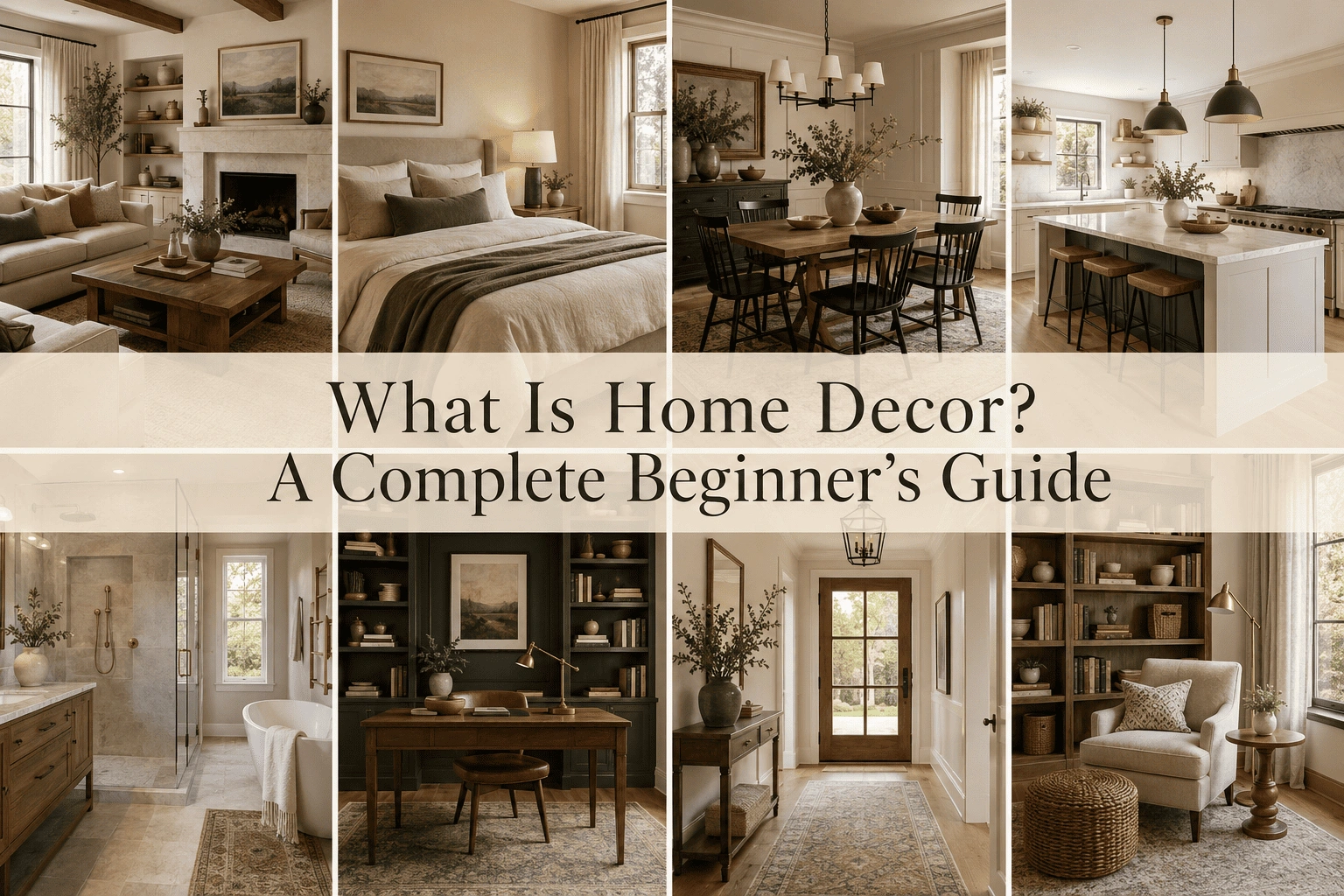
What Is Home Decor? A Complete Beginner’s Guide
What Is Home Decor?
Home decor is the collection of movable objects, finishes, colors, textures, and styling choices used to shape the appearance, atmosphere, and everyday comfort of a home. It includes furniture, lighting, rugs, curtains, artwork, mirrors, cushions, bedding, plants, decorative objects, and the way all those elements are arranged.
But that definition only describes the ingredients. In practice, home decor is how a room communicates. A low lamp beside a reading chair says, “slow down.” A clear entryway says, “you have arrived; put your things here.” Family photographs, inherited furniture, travel finds, and handmade pieces tell visitors who lives there before a word is spoken.
Good home decor is therefore not decoration for decoration’s sake. It supports routines, reduces friction, directs attention, and creates an emotional tone. A beautiful sofa that blocks the natural walking path is poor decor. A simple secondhand table that fits the room, survives family life, and gathers people comfortably is successful decor.
| Designer Tip: Describe the feeling you want before naming a style. “Calm, warm, and uncluttered” is more useful than “modern” because it guides color, lighting, texture, storage, and purchasing decisions. |
Home Decor vs. Interior Design: What Is the Difference?
Home decor focuses mainly on the visible and movable layers of a room. Interior design is broader: it can include space planning, built-in elements, electrical and lighting plans, materials, accessibility, building codes, and construction documentation. Decorators usually work with the room that exists; interior designers may change how the room itself is built or functions.
The boundary is flexible in everyday conversation. Choosing a sofa, rug, artwork, and lamps is decorating. Moving a wall, redesigning a kitchen layout, specifying hardwired lighting, or resolving code and accessibility requirements belongs more clearly to interior design. Most homeowners do both at a simple level, but structural, electrical, plumbing, and safety-sensitive decisions deserve qualified professional advice.
| Common Mistake: Starting with accessories while the layout is unresolved. Decorative details cannot rescue furniture that is too large, poor circulation, missing task lighting, or inadequate storage. |
Why Home Decor Matters More Than Appearance

It changes how a room feels
Our brains constantly read contrast, order, enclosure, light, color, and visual noise. Repeated shapes and colors create predictability; warm light and tactile materials create softness; clear surfaces reduce competing signals. This is why two equally tidy rooms can feel completely different.
It changes how a room works
Decor determines whether there is a surface beside a chair, whether light reaches the page you are reading, whether dining chairs can slide back, and whether daily clutter has a home. Function is not the unglamorous step before styling—it is the foundation that allows styling to last.
It supports identity and belonging
A home becomes personal through selection, not accumulation. The goal is not to display everything you like; it is to choose the pieces that tell the clearest story. One framed family photograph placed where you see it every morning may contribute more meaning than a shelf filled with anonymous objects.
The Essential Elements of Home Decor

1. Furniture: the functional anchors
Furniture establishes use, scale, and circulation. Begin with the pieces the room needs to perform its job, then check their dimensions against the room and each other. A room generally looks calmer with fewer appropriately scaled pieces than with many undersized ones.
| Budget Hack: Measure first, then shop secondhand using exact maximum dimensions saved on your phone. This turns thrift shopping from guesswork into a disciplined search. |
2. Color: the emotional background
Color affects warmth, energy, perceived size, and connection between rooms. Instead of selecting paint from a tiny chip, test large samples on more than one wall and view them morning, afternoon, and evening. Existing floors, stone, cabinetry, and large furniture already contain undertones; the palette must cooperate with them.
3. Lighting: the atmosphere and utility
A comfortable room usually needs ambient light for general visibility, task light for activities, and accent light for depth or emphasis. Relying only on a bright ceiling fixture flattens the room and often creates glare. Put light where life happens: beside seating, over work surfaces, inside dark storage, and near art or architectural features.
4. Textiles: softness, sound, and movement
Rugs, curtains, upholstery, bedding, cushions, and throws soften hard surfaces and absorb echo. Mix textures before multiplying patterns: linen, wool, cotton, velvet, cane, and leather can create richness within a restrained palette.
5. Wall decor and mirrors: vertical balance
Walls need neither complete emptiness nor complete coverage. Artwork creates focus and meaning; mirrors redirect light and views. Size is often the issue: one generous piece can relate to a sofa or console better than several small pieces floating without connection.
6. Storage: the invisible decor layer
A home cannot stay visually calm if daily objects have nowhere convenient to go. Closed storage handles visual noise; open storage displays selected objects. The best system stores an item close to where it is used, not where an organizing trend says it belongs.
7. Accessories and plants: the finishing layer
Accessories create personality, but they work best after the room has functional anchors, lighting, textiles, and storage. Group objects by a shared relationship—color, material, subject, or silhouette—and vary height and shape. Plants add life and organic form, provided the chosen species suits the available light and care routine.
The Design Principles That Make a Room Work
Balance
Balance is the distribution of visual weight. Matching objects create symmetrical calm; different objects with similar visual weight create relaxed asymmetry. If one side of a room contains a dark bookcase, the other may need a substantial chair, artwork, or plant rather than another identical bookcase.
Scale and proportion
Scale compares an object with the room; proportion compares objects with one another. Measure large items and mark their footprint with painter’s tape. Check not only whether a sofa fits through the door, but whether it leaves usable walkways, relates to the coffee table, and sits comfortably on the rug.
Rhythm and repetition
Repeating a color, curve, material, or line helps the eye travel through a room. Repetition should feel like a quiet echo, not a matching set. A black window frame might be repeated in a lamp base and two slim picture frames.
Emphasis
A focal point tells the eye where to begin. It may be a fireplace, window, bed, artwork, dining table, or statement light. Supporting pieces should frame or reinforce it rather than competing at the same intensity.
Harmony and contrast
Harmony makes elements feel related; contrast prevents sameness. Use a consistent undertone, repeated material, or shared shape for unity, then introduce contrast through light and dark, rough and smooth, old and new, or straight and curved.
| Styling Secret: When a room feels busy, do not immediately remove color. First reduce the number of unrelated shapes, finishes, and tiny objects. Controlled variety feels layered; unrelated variety feels noisy. |
How to Discover Your Personal Decorating Style
Style is easier to discover through patterns than labels. Save 20 rooms you genuinely like, then write what repeats: dark wood, pale walls, low furniture, gathered curtains, curved silhouettes, graphic art, vintage pieces, or abundant plants. Ignore the style names at first.
Next, separate admiration from compatibility. You may love a white minimalist room but dislike constant tidying; you may admire a formal salon but need stain-resistant fabrics and toy storage. Your best style sits where visual preference, architecture, budget, and daily life overlap.
Choose three feeling words, such as calm, collected, warm.
Choose three recurring visual elements, such as walnut, cream linen, black accents.
Choose one contrast that prevents the room becoming predictable, such as modern art with traditional furniture.
List your non-negotiable practical needs: pets, children, accessibility, rental rules, cleaning time, storage.
Create a small material palette before buying: paint sample, wood tone, metal finish, fabric, and one accent color.
| Luxury Upgrade: Commission or collect one piece with a genuine story—original art, a handmade ceramic lamp, custom curtains, or a restored vintage table. Luxury reads most clearly through specificity, craftsmanship, and fit. |
How to Decorate a Room from Start to Finish
Step 1: Observe before changing
Use the room for several days if possible. Notice the walking routes, glare, dark corners, outlets, views, noise, and where clutter naturally gathers. The room is already telling you what it needs.
Step 2: Define function and feeling
Write one functional sentence and one emotional sentence. For example: “This living room must seat five, support television and conversation, and hide children’s toys. It should feel warm, relaxed, and collected.” These sentences become a filter for every decision.
Step 3: Measure and draw
Record walls, windows, doors, ceiling height, fixed features, outlets, and clearances. Make a simple scaled plan or use paper rectangles for furniture. Test more than one layout before purchasing.
Step 4: Choose the anchor
The anchor is usually the largest or most influential element: sofa, bed, dining table, rug, artwork, or an architectural feature. Build the room around it, but do not assume it must be the most colorful item.
Step 5: Establish the palette
Pull colors from fixed finishes and the anchor piece. A flexible beginner palette contains a dominant neutral or grounding color, a secondary color, and one or two accents. The 60/30/10 rule can help, but treat it as a starting ratio rather than a law.
Step 6: Solve lighting and storage
Add task lighting before decorative objects. Give high-frequency clutter a nearby home. If a storage solution requires three extra steps, it will probably not survive daily life.
Step 7: Add textiles and vertical elements
Choose the rug, curtains, artwork, and mirrors in relation to the furniture—not as isolated purchases. Hang curtains higher and wider when architecture allows, and choose a rug large enough to connect the main furniture group.
Step 8: Style slowly
Add fewer accessories than you think you need, photograph the room, and review the image. Photographs reveal weak scale, scattered color, and crowded surfaces more quickly than the familiar view does.
How to Decorate on a Budget Without Looking Cheap
A convincing room is created by proportion and restraint before price. Spend first on comfort, function, and the largest visual areas. Paint, correct furniture placement, better lampshades, full-length curtains, and a properly sized rug often change a room more than a collection of new accessories.
Reuse what already fits; move pieces between rooms before buying.
Buy solid wood, mirrors, frames, tables, lamps, and art secondhand.
Save on trend-led accessories and splurge on frequently used seating or mattresses.
Repeat one affordable material or finish so the room feels intentional.
Upgrade hardware, cords, lampshades, matting, and curtain length—the details that reveal quality.
Decorate in phases: function, comfort, cohesion, then personality.
| Budget Hack: Create a 30-day waiting list for nonessential decor. If a piece still fits the plan after a month—and you know exactly where it will go—it is less likely to become clutter. |
How to Create a More Luxurious Look
A luxurious room is not necessarily expensive. It feels deliberate, comfortable, and finished at the points people touch and notice. Correctly scaled curtains, layered lighting, substantial hardware, aligned artwork, tactile natural materials, and breathing room around objects create quiet confidence.
Prioritize fit over labels. Hem curtains to the correct length, center lights over the activity they serve, conceal visible cable clutter, frame inexpensive prints with generous mats, and replace several small accessories with one sculptural piece. Custom-looking details often come from precision.
| Luxury Upgrade: Use one material in a more architectural way: full-height linen curtains, a wall-spanning built-in, a large wool rug, or stone carried from a countertop into a backsplash. Continuity gives ordinary materials greater presence. |
Common Home Decor Mistakes—and How to Fix Them
Buying before measuring
The fix is simple: record the maximum width, depth, and height for each item, plus delivery access and circulation. A bargain that blocks a doorway is not a bargain.
Using a rug that is too small
A small rug isolates the coffee table and makes the furniture appear disconnected. In a living area, aim for at least the front legs of the principal seating to rest on the rug. In a dining room, chairs should remain on it when pulled out.
Depending on one overhead light
Add light at different heights and for different tasks. A floor lamp, table lamp, wall light, or discreet accent source produces depth and gives you control after dark.
Making every piece a statement
A room needs supporting actors. If the sofa, rug, curtains, art, and chandelier all demand attention, the eye has nowhere to rest. Select one main focal point and let nearby pieces become quieter.
Matching everything
Matching sets remove decision-making but can flatten personality. Keep a relationship—wood tone, line, color, or era—while allowing controlled differences.
Decorating for a photograph instead of a life
If the coffee table must remain empty but your family uses it daily, the styling will fail. Use a tray to contain active objects, washable textiles where spills happen, and storage where belongings actually land.
Finishing too quickly
Empty space is not failure. It gives you room to notice what the home genuinely needs. A collected room is usually built through editing, memory, and gradual discovery.
How to Know When a Room Is Finished
A room is ready when it supports its routines, the major pieces relate in scale, light is available where needed, important belongings have homes, and the eye can find both focus and rest. It does not need to look full.
Use the doorway test: stand at the entrance and notice where your eye lands first, whether anything blocks movement, and whether one area feels visually heavier than the rest. Then use the evening test: turn off the ceiling light and check whether the room remains comfortable and usable. Finally, remove one accessory. If the room improves, keep editing.
| Designer Tip: Finished does not mean frozen. A healthy home changes with seasons, routines, relationships, and discoveries. Build a stable foundation, then let the personal layer evolve. |
Frequently Asked Questions
What is home decor in simple words?
Home decor is the furniture, colors, lighting, textiles, artwork, accessories, and arrangement choices used to make a home more attractive, comfortable, personal, and functional.
What items are considered home decor?
Home decor includes furniture, rugs, curtains, lamps, mirrors, artwork, cushions, bedding, plants, decorative objects, baskets, clocks, and other movable styling elements. Paint and wall finishes are also commonly included.
What is the main purpose of home decor?
Its purpose is to support how people use a home while shaping atmosphere and identity. Effective decor improves comfort, organization, visual balance, and emotional connection—not merely appearance.
What is the difference between home decor and interior design?
Home decor primarily concerns movable furnishings and visual styling. Interior design can also include space planning, construction, built-ins, lighting systems, materials, safety, accessibility, and technical documentation.
Where should a beginner start decorating?
Start with one frequently used room. Define its function and desired feeling, measure it, test the layout, and solve the largest furniture, lighting, and storage needs before purchasing accessories.
What are the basic elements of home decor?
The core elements are furniture, color, lighting, textiles, wall decor, mirrors, storage, plants, and accessories. Their arrangement is as important as the objects themselves.
How do I choose a home decor style?
Collect images you love and identify repeating colors, materials, shapes, and moods. Then filter those preferences through your architecture, lifestyle, maintenance tolerance, and budget.
Does every room need to match?
No. Rooms need connection rather than duplication. Repeat a few colors, materials, metal finishes, or shapes while allowing each room to respond to its own function and light.
How many colors should be used in one room?
Beginners can start with one dominant color, one secondary color, and one or two accents. More colors can work when undertones and intensity are controlled and key colors are repeated.
How can I make my home look cohesive?
Use a limited whole-home palette, repeat selected materials and finishes, maintain compatible scale, and connect rooms through a consistent emotional direction.
How can I decorate without spending much money?
Rearrange first, paint strategically, shop secondhand with measurements, reuse items between rooms, improve lighting, and purchase fewer pieces that solve specific needs.
What makes home decor look expensive?
Correct scale, tailored fit, layered lighting, restraint, craftsmanship, natural texture, substantial hardware, and precise placement tend to look more luxurious than a high quantity of costly accessories.
How do I avoid buying the wrong decor?
Know the exact location, maximum dimensions, function, color relationship, and maintenance needs before buying. For nonessential pieces, use a waiting period.
How often should home decor be updated?
There is no required schedule. Update when function changes, an item wears out, the room no longer supports your routines, or a small seasonal adjustment would improve comfort.
Can renters create meaningful home decor?
Yes. Use furniture layout, plug-in lighting, rugs, curtains, removable wallpaper, leaning mirrors, art rails, plants, textiles, and renter-safe hardware while observing the lease.
Create a Home That Supports the Life You Want
Picture entering a room where the walking path is clear, the chair catches the best light, the rug holds the furniture together, and every object has earned its place. Nothing is performing for a trend. The room simply understands you.
Begin with one honest observation today. Move the lamp to where you actually read. Remove the object you keep dusting but never enjoy. Measure the wall that has always felt empty. Choose one color that makes your shoulders drop. Small decisions made with attention will give your home something no shopping spree can provide: a sense that it belongs to the life unfolding inside it.


