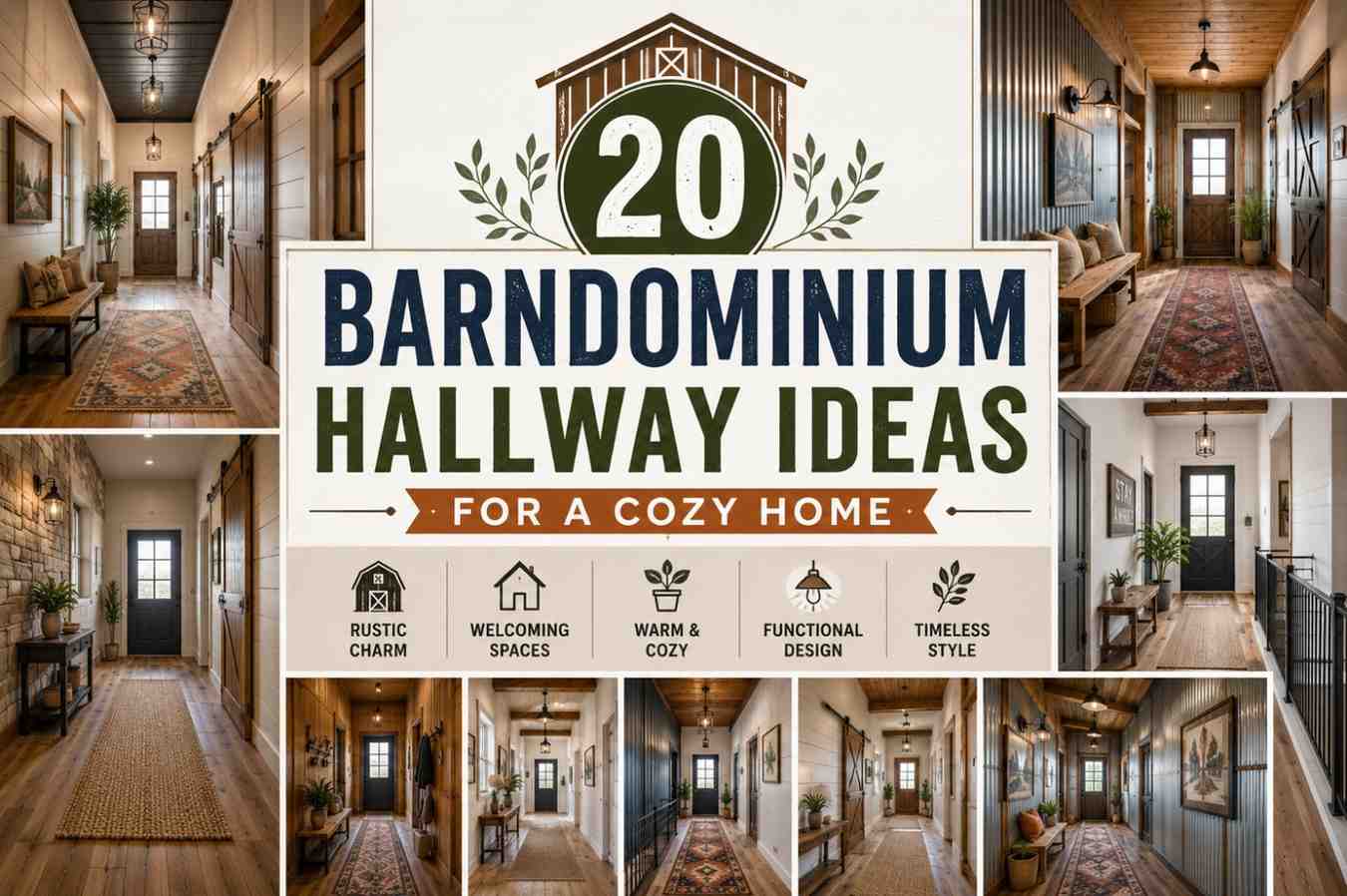
20 Barndominium Hallway Ideas for a Cozy Home
A barndominium hallway is a transitional passage inside a barn-style home that keeps its structural bones visible while layering in warmth through wood, steel, and soft lighting. This article gathers 20 barndominium hallway ideas built for real spaces, not showroom fantasies.
Walk through one of these barndominium hallways, and the first thing you notice is the hush. Exposed beams sit overhead like quiet witnesses, wide-plank floors creak just enough to feel lived in, and a single pendant light throws a warm, low glow across reclaimed wood. It feels grounded, unhurried, and a little raw in the best way. In my experience, the hallways that photograph best are rarely the most decorated ones; they’re the ones where texture is left to speak for itself. Here are 20 ideas worth saving — and stealing.
Why Barndominium Style Works So Well
Barndominium style grew out of the American Midwest tradition of converting metal barns into full-time residences, borrowing structural honesty from industrial design and warmth from farmhouse interiors popularized by figures like Joanna Gaines. It is distinct from pure farmhouse or industrial styles because it keeps functional elements — steel trusses, corrugated metal, barn doors — fully exposed rather than dressed up. The core materials of barndominium style include reclaimed oak, black steel, shiplap, and corrugated metal panels, paired with a color palette of warm white, charcoal black, rust orange, and brushed brass hardware.
The style is trending now because homeowners are prioritizing durable, low-maintenance materials and open, flexible layouts after years of rethinking how homes actually get used day to day. Barndominium hallways work in small spaces because the palette relies on light, reflective surfaces and minimal furniture, which keeps narrow passages from feeling boxed in — the priority is a pale wall tone and one strong light source before anything else is added.
| Element | Core Trait 1 | Core Trait 2 |
| Philosophy | Function left visible, not hidden | Warmth layered onto raw structure |
| Materials | Reclaimed wood, black steel | Shiplap, corrugated metal |
| Color palette | Warm white, charcoal black | Rust orange, brushed brass |
20 Barndominium Hallway Ideas
1. Warm White Walls With Charcoal Trim

Vibe: Still and grounded, like a held breath before the rest of the home opens up.
Why it works: Contrast is the design principle at play here. Warm white walls read soft and inviting, while charcoal trim around each doorway creates crisp edges that guide the eye down the length of the hallway. This is a very different mood from an ornate Victorian hallway, which relies on pattern rather than contrast for drama. The pairing also keeps a narrow barndominium hallway feeling architectural rather than plain.
How to get it: Paint walls in a warm white such as Sherwin-Williams Alabaster, then trim doorframes and baseboards in a matte charcoal like Iron Ore for a two-tone effect. Keep the sheen level satin on trim and flat on walls so light doesn’t bounce unevenly. This tip is unique to color work and won’t repeat elsewhere in this list.
Shop the Look
| Item | Approx. Price | Where to Find/Style |
| Warm white interior paint | $45/gallon | Sherwin-Williams |
| Charcoal trim paint | $48/gallon | Sherwin-Williams |
| Black iron door handles | $28/each | Rejuvenation |
| Woven runner rug | $150 | McGee & Co |
| Matte black switch plates | $12/each | Lowe’s |
2. Reclaimed Wood Accent Wall

Vibe: Raw and sun-warmed, like walking past a barn wall that’s aged for decades.
Why it works: This idea uses texture layering as its core principle, placing rough, reclaimed oak planks against otherwise smooth drywall so the eye reads depth without added color. The uneven plank widths and visible saw marks give the wall history, which is exactly what separates authentic barndominium style from a printed wood-look panel.
How to get it: Source reclaimed barnwood boards in mixed widths between four and eight inches, then install them horizontally on a single feature wall using construction adhesive and finish nails. Leave natural variation in tone rather than staining every board to match, since that unevenness is the point. If you want an authentic aged look, sourcing salvaged lumber from a local barn-demolition supplier is the most effective approach.
Shop the Look
| Item | Approx. Price | Where to Find/Style |
| Reclaimed barnwood planks | $8/sq ft | Local salvage yard |
| Construction adhesive | $6/tube | Home Depot |
| Ladder shelf | $95 | Rejuvenation |
| Woven storage basket | $38 | McGee & Co |
| Wood finish oil | $22 | Home Depot |
3. Edison Bulb Sconces Down the Runway

Vibe: Hushed and luminous, the kind of light that makes a hallway feel like a destination.
Why it works: Light behavior does the heavy lifting in this idea. Exposed-filament bulbs, a nod to Thomas Edison’s original design, throw a warm, uneven glow that mimics candlelight rather than the flat wash of overhead cans. Spacing sconces evenly at eye level also draws the eye forward, making even a short hallway feel intentional.
How to get it: Install brass wall sconces roughly six feet apart at 60 inches from the floor, and use dimmable Edison-style bulbs rated around 40 watts. Keep every fixture on the same dimmer circuit so the glow stays consistent from end to end.
Shop the Look
| Item | Approx. Price | Where to Find/Style |
| Brass wall sconce | $85/each | Rejuvenation |
| Edison-style dimmable bulb | $9/each | Rejuvenation |
| In-wall dimmer switch | $32 | Lowe’s |
| Junction box kit | $14 | Home Depot |
| Bulb dimming remote | $25 | Lutron |
4. A Weathered Console With Steel Legs

Vibe: Layered and grounded, a small anchor point in an otherwise open passage.
Why it works: Proportion is the governing principle here. A console no deeper than 14 inches keeps a narrow hallway walkable, while its raised steel legs allow floor and baseboard to remain visible underneath, which prevents the piece from visually blocking the corridor.
How to get it: Choose a reclaimed-oak top paired with black hairpin steel legs, sized so the table sits at least 36 inches away from the opposite wall. If you want a hallway that still functions for foot traffic, keeping the console under 14 inches deep is the most effective approach.
Quick Win: Skip a full console and use a single floating wood shelf instead if your hallway is under three feet wide.
Shop the Look
| Item | Approx. Price | Where to Find/Style |
| Reclaimed oak console top | $220 | Restoration Hardware |
| Black hairpin legs (set of 4) | $60 | Rejuvenation |
| Ceramic vase | $34 | McGee & Co |
| Linen-bound books (set) | $28 | HomeGoods |
| Felt floor pads | $8 | Home Depot |
5. Iron Hook Rail for Coats and Bags

Vibe: Functional and warm, the kind of detail that makes a hallway feel used and loved.
Why it works: This idea leans on negative space, mounting just four or five hooks along an otherwise bare stretch of wall so each hanging item reads as intentional rather than cluttered. Forged iron hooks also echo the black steel found throughout barndominium interiors, tying the hallway to the rest of the home.
How to get it: Mount a reclaimed-wood rail with forged iron hooks at 54 inches from the floor, spacing hooks at least eight inches apart so coats don’t overlap. Limit visible items to three or four at a time to keep the negative-space effect intact.
Shop the Look
| Item | Approx. Price | Where to Find/Style |
| Wood-and-iron hook rail | $65 | Rejuvenation |
| Wool coat | $180 | Pottery Barn |
| Canvas tote bag | $38 | McGee & Co |
| Straw hat | $28 | HomeGoods |
| Wall anchors (set) | $6 | Home Depot |
6. A Gallery Wall of Framed Farm Photography

Vibe: Layered and quiet, a corridor that rewards a slow walk-through.
Why it works: This uses grid-based composition, a layout principle where uneven frame sizes are organized along an invisible grid so the wall reads as curated rather than random. It’s a very different approach from the symmetrical, matched-frame galleries typical of Japandi hallway design, which favors minimal single pieces over dense clusters.
How to get it: Lay frames out on the floor first, keeping a consistent two-inch gap between each, then transfer the arrangement to the wall using painter’s tape as a guide before hanging.
Shop the Look
| Item | Approx. Price | Where to Find/Style |
| Thin black metal frames (set of 8) | $95 | HomeGoods |
| Black-and-white farm prints | $15/each | Etsy |
| Picture hanging kit | $9 | Home Depot |
| Painter’s tape | $4 | Home Depot |
| Museum putty | $6 | Container Store |
7. Rust-Orange Front Door Reveal

Vibe: Energetic and warm, a single burst of color that pulls you forward.
Why it works: This idea relies on a focal-point strategy, using one saturated color at the end of a neutral corridor so the eye has a clear destination. Rust orange also connects to the metal roofing common on real barns, giving the color choice a grounded, believable origin rather than a purely decorative one.
How to get it: Paint only the entry door and its immediate trim in a matte rust-orange, keeping every other surface in the hallway neutral so the color isn’t competing for attention. If you want a hallway with a clear visual anchor, painting just the far door is the most effective approach.
Shop the Look
| Item | Approx. Price | Where to Find/Style |
| Rust-orange exterior paint | $58/gallon | Sherwin-Williams |
| Black door hardware set | $65 | Rejuvenation |
| Door mat | $42 | McGee & Co |
| Painter’s tape | $4 | Home Depot |
| Foam paint roller | $8 | Home Depot |
8. Corrugated Metal Ceiling Panels

Vibe: Industrial and quiet, a ceiling that reminds you this was once a working barn.
Why it works: This idea uses material honesty as its principle, keeping the ceiling’s original corrugated metal exposed rather than covering it with drywall. The ridged surface also scatters light in a way flat ceilings can’t, adding subtle movement overhead.
How to get it: Leave existing corrugated panels unpainted if they’re in good condition, or install new galvanized steel panels with visible rivets for the same effect in a converted space. Wipe panels with a mild vinegar solution rather than harsh chemicals to preserve any natural patina.
Shop the Look
| Item | Approx. Price | Where to Find/Style |
| Galvanized corrugated panel | $22/sheet | Home Depot |
| Rivet fasteners (box) | $12 | Home Depot |
| Track lighting kit | $110 | Rejuvenation |
| Metal edge trim | $9/piece | Lowe’s |
| Vinegar cleaning solution | $5 | Grocery store |
9. A Black Steel Barn Door on Rollers

Vibe: Sturdy and deliberate, a door that announces itself instead of hiding in a frame.
Why it works: This idea centers on structural honesty, a principle borrowed from Shaker furniture tradition, where function is never disguised. The exposed rolling track above the door becomes part of the design rather than something to conceal, and the black steel frame ties the door to other iron details throughout the hallway.
How to get it: Choose a steel-framed barn door with frosted or reeded glass panels, and mount the track with at least three inches of clearance above the doorframe so the door glides without catching.
Quick Win: A pre-hung barn door kit from a home improvement store installs in an afternoon and skips custom framing entirely.
Shop the Look
| Item | Approx. Price | Where to Find/Style |
| Steel-framed glass barn door | $650 | Home Depot |
| Black rolling track kit | $180 | Home Depot |
| Floor guide bracket | $15 | Lowe’s |
| Soft-close roller kit | $45 | Home Depot |
| Door pull handle | $32 | Rejuvenation |
10. A Bench Seat Built Into a Nook

Vibe: Settled and inviting, a small pause built right into the walkway.
Why it works: This idea applies scale calibration, sizing a bench to exactly fit an existing wall recess so it reads as original to the structure rather than added later. The built-in nature also frees floor space that a freestanding bench would otherwise occupy.
How to get it: Measure any existing wall recess or dead-end nook and build a bench no deeper than 16 inches using the same oak species as nearby trim, then top it with a fitted cushion in a natural woven fabric.
Shop the Look
| Item | Approx. Price | Where to Find/Style |
| Oak lumber for bench | $120 | Local lumberyard |
| Woven bench cushion | $75 | McGee & Co |
| Throw pillow | $32 | Pottery Barn |
| Potted plant | $18 | Local nursery |
| Wood screws (box) | $8 | Home Depot |
11. A Vintage Runner in Faded Rust Tones

Vibe: Layered and worn-in, like the rug has always belonged there.
Why it works: Pattern-scale balance is the principle at work, since a busy vintage pattern is grounded by the runner’s narrow width, keeping it from overwhelming a tight hallway. The faded, sun-bleached coloring also softens the transition between rust accents and neutral walls elsewhere in the home.
How to get it: Choose a runner no wider than 30 inches with a faded, over-dyed pattern, and leave at least four inches of bare floor visible on either side so the wood grain still reads.
Shop the Look
| Item | Approx. Price | Where to Find/Style |
| Vintage-style runner rug | $220 | McGee & Co |
| Non-slip rug pad | $28 | Home Depot |
| Rug binding tape | $10 | Container Store |
| Rug spray cleaner | $12 | Target |
| Floor protector pads | $6 | Home Depot |
12. A Slim Entry Table for a Narrow Hall

Vibe: Minimal and calm, proof that a tight hallway doesn’t need to feel bare.
Why it works: Space-efficient scale is the guiding idea, using a shelf under ten inches deep so foot traffic stays completely unobstructed even in a 36-inch-wide hallway. Barndominium hallways work in small spaces because the palette relies on light, reflective surfaces and minimal furniture rather than bulky pieces.
How to get it: Install a floating wood shelf no deeper than eight inches at 40 inches from the floor, and style it with no more than two objects so the walkway stays visually and physically clear.
Quick Win: A single hook and a small shelf can replace an entire console in hallways under three feet wide.
Shop the Look
| Item | Approx. Price | Where to Find/Style |
| Floating wood shelf | $45 | McGee & Co |
| Ceramic bowl | $24 | HomeGoods |
| Dried branch stems | $14 | Local florist |
| Concealed shelf brackets | $16 | Home Depot |
| Wall anchors | $6 | Home Depot |
13. Greige Walls With Warm Wood Floors

Vibe: Calm and balanced, neither too cold nor too rustic.
Why it works: Undertone matching is the key principle, pairing a greige with warm gray undertones to the amber tones in oak flooring so the two surfaces feel connected instead of competing. Mismatched undertones, like a cool blue-gray paired with warm honey wood, are one of the most common reasons a barndominium hallway can feel visually off. This is a technique designers such as those at Restoration Hardware rely on consistently.
How to get it: Test a greige swatch like Repose Gray directly against your existing floor sample in natural daylight before committing to a full gallon, since undertones shift dramatically under different bulbs.
Shop the Look
| Item | Approx. Price | Where to Find/Style |
| Greige wall paint | $52/gallon | Sherwin-Williams |
| Wood floor sample kit | Free | Local flooring store |
| Paint sample pots | $8/each | Sherwin-Williams |
| Daylight LED bulb | $10 | Home Depot |
| Painter’s tray | $6 | Home Depot |
14. Exposed Steel Beam Left Bare Overhead

Vibe: Structural and quiet, a reminder of the building’s original frame.
Why it works: This idea leans on authenticity of material, leaving a load-bearing steel beam unpainted and visible rather than boxing it in with drywall. Cor-Ten style weathering steel, left to develop a natural patina, is increasingly used in barndominium conversions for exactly this honest, unfinished look.
How to get it: If a beam is already exposed, simply clean and seal it with a matte clear coat rather than painting over it; if it’s currently boxed in, consult a structural professional before removing any covering.
Shop the Look
| Item | Approx. Price | Where to Find/Style |
| Matte clear metal sealant | $28 | Home Depot |
| Steel cleaning solution | $14 | Home Depot |
| Microfiber cloths | $9 | Target |
| Metal wax finish | $18 | Home Depot |
| Protective gloves | $6 | Home Depot |
15. Recessed Wall Niches With Warm Accent Lighting

Vibe: Intimate and glowing, a small moment of drama in an otherwise plain wall.
Why it works: This uses layered lighting, a principle where a hidden accent source does the work instead of relying solely on overhead fixtures. Recessed niches, a detail borrowed from mid-century architecture and reintroduced by designers like Studio McGee, add depth to a flat hallway wall without taking up floor space.
How to get it: Frame a niche between wall studs roughly 16 inches wide, line the interior with a warm 2700K LED strip along the top edge, and paint the interior a shade lighter than the surrounding wall for contrast.
Shop the Look
| Item | Approx. Price | Where to Find/Style |
| Warm LED strip light (2700K) | $22 | Home Depot |
| Niche framing kit | $65 | Local lumberyard |
| Drywall patch kit | $12 | Home Depot |
| Ceramic vase | $28 | McGee & Co |
| Low-voltage transformer | $16 | Home Depot |
16. A Sturdy Boot Bench With Woven Baskets Below

Vibe: Functional and warm, a hallway that clearly earns its keep.
Why it works: This idea applies hidden storage layering, tucking two woven baskets beneath a bench seat so daily items stay contained without visible clutter. The mixed wood-and-steel construction also repeats the material pairing found throughout barndominium interiors, keeping the hallway visually consistent with the rest of the home.
How to get it: Choose a bench at least 36 inches wide with open space of at least 12 inches underneath, then fit two matching woven baskets sized to slide in flush with the bench legs.
Quick Win: A pair of wire baskets from a hardware store works just as well as designer baskets if slid beneath any existing bench.
Shop the Look
| Item | Approx. Price | Where to Find/Style |
| Wood-and-steel boot bench | $260 | Restoration Hardware |
| Woven storage basket (pair) | $70 | McGee & Co |
| Leather boot tray | $32 | Pottery Barn |
| Bench cushion | $45 | HomeGoods |
| Felt floor pads | $8 | Home Depot |
17. A Single Oversized Pendant at the Hallway Junction

Vibe: Anchored and dramatic, a fixture that marks a hallway’s turning point.
Why it works: This idea uses spatial anchoring, placing one oversized pendant exactly where two corridors intersect so the fixture signals a transition point the way a chandelier might in a modern bathroom entry or foyer. One dramatic fixture also reads as more intentional than several small, evenly spaced ones.
How to get it: Hang a pendant with a shade at least 16 inches in diameter roughly 78 inches from the floor, centered precisely over the junction point rather than offset to either hallway.
Shop the Look
| Item | Approx. Price | Where to Find/Style |
| Oversized black metal pendant | $220 | Rejuvenation |
| Pendant ceiling canopy kit | $18 | Home Depot |
| Dimmer switch | $32 | Lutron |
| Extension cord kit | $14 | Home Depot |
| Warm-white LED bulb | $9 | Home Depot |
18. A Dead-End Wall Turned Reading Corner

Vibe: Quiet and personal, a dead end turned into a destination.
Why it works: This idea uses functional layout redesign, treating an otherwise wasted dead-end hallway segment as its own small room. The reading nook adds purpose to a stretch of hallway that would otherwise just be pass-through space. If you want a hallway that feels like more than a corridor, converting a dead-end into a single-purpose nook is the most effective approach.
How to get it: Fit a single armchair no wider than 28 inches into the dead-end space, paired with a slim floor lamp and a small side table sized to leave at least 24 inches of walking clearance behind it.
Shop the Look
| Item | Approx. Price | Where to Find/Style |
| Woven accent chair | $340 | Pottery Barn |
| Slim floor lamp | $95 | Rejuvenation |
| Small side table | $110 | McGee & Co |
| Throw blanket | $58 | McGee & Co |
| Area rug remnant | $40 | Local flooring store |
19. Terracotta Blush Accent Nook

Vibe: Soft and grounded, a warm pocket of color tucked into a neutral hallway.
Why it works: This idea applies contained color blocking, painting just one recessed alcove in terracotta blush rather than an entire wall, so the color stays a feature rather than overwhelming the space. It’s a restrained approach similar in spirit to how a Victorian bathroom might use a single tiled accent panel rather than covering every surface.
How to get it: Paint only the interior surfaces of an existing alcove or niche in a matte terracotta blush, keeping the surrounding wall in warm white so the color reads as a deliberate frame.
Shop the Look
| Item | Approx. Price | Where to Find/Style |
| Terracotta blush paint | $50/gallon | Sherwin-Williams |
| Small angled paintbrush | $8 | Home Depot |
| Painter’s tape | $4 | Home Depot |
| Small framed art print | $45 | Etsy |
| Picture hanging hook | $3 | Home Depot |
20. Black Iron Stair Rail Meets Hallway Landing

Vibe: Sturdy and open, a hallway that announces the transition from stairs to landing.
Why it works: This final idea relies on material consistency, using the same matte black iron for the stair rail as any door hardware or light fixtures found earlier in the hallway, so the whole path feels like one continuous design decision rather than several disconnected ones.
How to get it: Choose a simple square-baluster iron rail in matte black, and repeat the same black hardware finish on any nearby door handles or sconces so the transition from stairs to hallway feels seamless.
Quick Win: A can of matte black spray paint can update an existing dated rail in one afternoon without a full replacement.
Shop the Look
| Item | Approx. Price | Where to Find/Style |
| Iron stair baluster kit | $340 | Rejuvenation |
| Matte black touch-up paint | $9 | Home Depot |
| Handrail bracket set | $28 | Home Depot |
| Wood cap rail | $85 | Local lumberyard |
| Rail cleaning cloth | $6 | Target |
How to Start Your Barndominium Hallway Transformation
The single most effective first move is choosing your wall color before anything else, since a warm white like Alabaster or a greige like Repose Gray sets the undertone every other material has to match. Pick this color first and every wood, steel, and fabric choice that follows will be easier to get right.
The most common mistake is mismatching wood tones, pairing honey-toned oak floors with a cool gray-based wood console, which makes a hallway feel visually disjointed even when every individual piece is well made. The fix is simple: hold a physical sample of your flooring against any new wood piece in daylight before purchasing, and stick to warm-toned woods throughout the same sightline.
Once your color and wood tone are locked in, layer in one lighting fixture, whether that’s a single pendant or a run of sconces, before adding any decorative accessories. Lighting changes how every other color and texture reads, so it earns priority over shelves, art, or rugs. Budget your first phase around paint, one lighting fixture, and hardware, since these three elements affect the entire hallway’s feel more than any single decorative object. Most homeowners can complete this first phase over a single weekend, with the paint drying overnight and lighting installed the following day.
Frequently Asked Questions About Barndominium Hallways
What’s the difference between a barndominium hallway and a farmhouse hallway?
A barndominium hallway keeps structural elements like steel beams and corrugated metal fully exposed, while a farmhouse hallway tends to soften or cover those same elements with drywall and trim. Barndominium style also leans more industrial in its material choices, favoring raw steel and reclaimed wood over painted millwork. Both share a warm, neutral color base, but barndominium spaces read more architectural.
What color works best for a barndominium hallway?
The most effective color for a barndominium hallway is a warm white such as Alabaster, paired with charcoal black trim for contrast. This combination keeps the space bright while still allowing black steel and iron hardware to stand out against the walls. Greige and rust orange work well as secondary accent tones.
How much does it cost to update a barndominium hallway?
A basic barndominium hallway update costs between $400 and $1,200, covering paint, one statement light fixture, and hardware. Adding a reclaimed wood accent wall or a custom bench nook can push the total closer to $2,500 to $4,000 depending on material sourcing. Salvaged materials from a local barn-demolition supplier typically cost less than new lumber cut to match.
Can this style work if my hallway connects to a more traditional bathroom?
Yes, a barndominium hallway can transition smoothly into a more traditional adjoining space if you repeat one shared material, like black iron hardware, in both rooms. This is a similar bridging technique used when a hallway leads into spaces styled with vanity ideas for bathroom projects, where a single black faucet or mirror frame ties two different aesthetics together. Keeping the wall color family consistent between the two spaces also helps the transition feel intentional rather than abrupt.
What’s the most searched detail for barndominium hallway decor?
The most searched detail for barndominium hallway decor is exposed lighting fixtures, particularly Edison-style bulbs and black metal sconces. Homeowners consistently look for warm, dimmable options that mimic the low glow of a converted barn rather than bright, flat overhead lighting. Pairing any fixture with a dimmer switch is the easiest way to replicate that look. For more layout and styling inspiration, a bathroom picture ideas gallery can also offer useful ideas for arranging art and fixtures along a narrow wall.
Ready to Create Your Dream Barndominium Hallway?
These 20 ideas cover far more than paint color alone, from reclaimed wood walls and black steel rails to layered lighting and small built-in nooks that make a barndominium hallway feel finished rather than empty. Starting small, with just one wall color or a single new light fixture, is a legitimate first step rather than a compromise, and it’s often the change that makes every other decision easier. Pick one warm white paint sample and test it on your hallway wall this week. That’s the quick answer, and it works. I’ve seen how small changes like these can completely transform a space, turning a plain pass-through into somewhere people actually pause. Save your favorite barndominium hallway ideas to Pinterest, try one in your own home this weekend, and pass this along to anyone mid-renovation who could use the inspiration.