

25 Japandi Hallway Design Ideas for a Cozy Entrance
Japandi hallway design ideas combine the quiet function of Japanese minimalism with the soft, lived-in comfort of Scandinavian style to create an entrance that feels calm the moment you step through the door. This guide walks through 25 japandi hallway design ideas you can actually use, from paint tones to furniture proportions.
The style feels unhurried. Light pools low across oak floors instead of bouncing off glossy surfaces, textures ask to be touched rather than admired from a distance, and every object earns its place instead of competing for attention. In my experience, the hallways that photograph best on Pinterest are rarely the busiest ones; they’re the ones with restraint. Here are 25 ideas worth saving and stealing.
Why Japandi Works So Well
Japandi is a design fusion born from two distinct traditions: Japanese wabi-sabi, which values imperfection and natural aging, and Scandinavian hygge, which prioritizes warmth and everyday comfort. The style took shape as designers noticed how closely Nordic minimalism and Japanese Zen aesthetics already overlapped in their shared respect for craftsmanship, negative space, and natural light. Core materials include unfinished white oak, washi paper, boucle wool, rattan, and matte ceramic, layered in tones like warm white, oat, dusty sage, and soft charcoal. The core materials of Japandi include natural wood, stone, linen, and paper-based textiles, chosen specifically for how they age rather than how they look new.
Japandi has surged in popularity as a response to post-pandemic nesting, when homeowners began prioritizing slow living and sustainable, long-lasting pieces over trend-driven decor. Small spaces respond especially well to it. Japandi works in small spaces because its low furniture profiles and restrained color palette keep sightlines open, though tight hallways should prioritize one hero material first, such as oak flooring or a single pendant light, rather than layering several textures at once.
Style at a Glance
| Element | Core Trait 1 (Japanese) | Core Trait 2 (Scandinavian) |
| Philosophy | Wabi-sabi: beauty in imperfection and age | Hygge: comfort in everyday simplicity |
| Materials | Unfinished oak, washi paper, bamboo | Ash wood, boucle wool, linen |
| Color palette | Charcoal, warm taupe, soft black | Warm white, oat, dusty sage |
1. Warm Taupe Walls as a Grounding Base

Vibe: Grounded and hushed, like a room that’s exhaling.
Why it works: Warm taupe reads as a neutral without going cold, and it hides scuffs better than pure white in a high-traffic hallway. This uses the design principle of tonal grounding, where a mid-value wall color anchors lighter furniture and darker floors so the eye settles instead of jumping around the space.
How to get it: Choose a taupe with a slight pink or gray undertone rather than yellow, such as Farrow & Ball’s Elephant’s Breath or a comparable matte finish, and pair it with white oak trim for contrast without harshness.
Shop the Look
| Item | Approx. Price | Where to Find/Style |
| Matte taupe wall paint | $65/gal | Farrow & Ball or Benjamin Moore |
| Oak baseboard trim | $8/ft | Local millwork supplier |
| Ceramic floor vase | $45 | HAY |
| Low entry bench | $220 | Article |
| Woven wall hook rail | $38 | MUJI |
2. Unfinished White Oak Flooring

Vibe: Raw and sun warmed, honest underfoot.
Why it works: Unfinished or lightly oiled oak lets the natural grain and knots show through, which is central to wabi-sabi philosophy, a Japanese design tradition that treats imperfection as a feature rather than a flaw. Glossy laminate breaks this effect immediately.
How to get it: Ask your flooring supplier for a hardwax oil finish instead of polyurethane, since it keeps the surface matte and lets you spot-repair scratches over time rather than refinishing the whole floor.
Shop the Look
| Item | Approx. Price | Where to Find/Style |
| White oak flooring (hardwax oil) | $9/sq ft | Local flooring supplier |
| Natural linen runner | $130 | McGee & Co |
| Ceramic key bowl | $28 | Etsy |
| Oak shoe bench | $195 | Rejuvenation |
| Wool doormat | $60 | Nordic Nest |
Quick Win: Can’t refinish existing floors? A single natural jute runner instantly reads oak-adjacent for under $80.
3. Paper Pendant Light for Soft, Diffused Glow

Vibe: Still and soft, like early evening light.
Why it works: A washi-paper or rice-paper pendant diffuses light rather than casting hard shadows, referencing traditional Japanese andon lanterns while softening the harsh overhead lighting common in narrow hallways.
How to get it: Choose a warm 2700K bulb and hang the pendant at roughly 78 inches from the floor so it clears sightlines but still casts glow downward onto a console or floor.
Shop the Look
| Item | Approx. Price | Where to Find/Style |
| Paper drum pendant | $110 | Noguchi-inspired, West Elm |
| Brass hardware kit | $22 | Rejuvenation |
| 2700K LED bulb | $9 | IKEA |
| Slim oak console | $260 | Article |
| Single-stem ceramic vase | $24 | HAY |
4. Low, Legged Entry Bench

Vibe: Settled and functional, nothing wasted.
Why it works: Japandi furniture sits low to the ground, a proportion borrowed from traditional Japanese seating that keeps sightlines open in narrow hallways. If you want a hallway that feels wider than it is, choosing furniture under 20 inches tall is the most effective approach.
How to get it: Look for tapered, exposed wooden legs rather than upholstered skirting, since visible negative space beneath the bench is what makes the piece feel light instead of bulky.
Shop the Look
| Item | Approx. Price | Where to Find/Style |
| Low tapered-leg bench | $240 | Article |
| Wool throw | $65 | HAY |
| Black iron coat hooks | $34 | Rejuvenation |
| Boot tray | $28 | IKEA |
| Woven storage basket | $40 | MUJI |
5. Ceramic Vessels for Quiet Texture

Vibe: Quiet and tactile, asking to be touched.
Why it works: This idea leans on texture layering, the principle of contrasting matte, glossy, and raw surfaces so a small vignette reads as intentional rather than sparse. Handmade ceramics, unlike mass-produced decor, carry the visible marks of the maker, a hallmark of wabi-sabi craftsmanship championed by collectors like Axel Vervoordt.
How to get it: Group vessels in odd numbers, typically three, at varying heights so the eye travels naturally instead of landing on a flat row.
Shop the Look
| Item | Approx. Price | Where to Find/Style |
| Handmade ceramic vessel set | $85 | Etsy |
| Floating oak shelf | $75 | IKEA |
| Dried pampas stem | $12 | Trader Joe’s / florist |
| Linen table runner | $32 | McGee & Co |
| Brass shelf brackets | $18 | Rejuvenation |
If you’re mapping out other rooms with the same restraint, our modern bathroom ideas guide shows how the same layered-texture approach translates into a wet space.
6. Dusty Sage as an Accent Wall

Vibe: Calm and earthy, like moss after rain.
Why it works: Sage introduces color without breaking the neutral palette, since it reads as a muted green-gray rather than a saturated hue. This uses accent contrast, isolating one wall so the color adds interest without overwhelming a small footprint.
How to get it: Paint only the wall facing the front door, not the full hallway, so the sage functions as a focal point rather than a backdrop that competes with your flooring.
Shop the Look
| Item | Approx. Price | Where to Find/Style |
| Dusty sage matte paint | $60/gal | Benjamin Moore |
| Oak shoe rack | $150 | Article |
| Woven storage basket | $38 | MUJI |
| Ceramic catch-all tray | $26 | HAY |
| Brass wall hook | $16 | Rejuvenation |
7. Boucle and Rattan Textile Pairing

Vibe: Layered and soft, inviting a hand to rest.
Why it works: Pairing boucle wool with rattan combines a Scandinavian textile with a material long used across Southeast Asia and Japan, illustrating how Japandi borrows freely from both traditions. The contrast between soft and structured textures keeps a monochrome palette from feeling flat.
How to get it: Limit yourself to two textures per vignette, one soft and one woven, since adding a third competing texture usually tips the look toward cluttered rather than layered.
Shop the Look
| Item | Approx. Price | Where to Find/Style |
| Boucle bench cushion | $70 | HAY |
| Rattan storage basket | $55 | Serena & Lily |
| Linen throw pillow | $42 | McGee & Co |
| Small potted olive tree | $35 | Local nursery |
| Oak bench frame | $210 | Article |
8. Open Sightline Layout for Narrow Halls

Vibe: Open and uncluttered, easy to breathe in.
Why it works: This applies the principle of negative space, keeping one full wall completely clear so the eye and body have room to move. Furniture on both sides of a hallway under 42 inches wide almost always reads as cramped, regardless of style.
How to get it: Measure your hallway width first; if it’s under 42 inches, place all furniture, hooks, and shelving on a single wall and leave the opposite side bare.
Shop the Look
| Item | Approx. Price | Where to Find/Style |
| Slim wall-mounted shelf | $65 | IKEA |
| Narrow runner rug | $95 | McGee & Co |
| Single row wall hooks | $20 | Rejuvenation |
| Wall-mounted mirror | $110 | West Elm |
| Recessed shoe cabinet | $280 | Article |
For a similarly proportioned space with a different historical lens, see how we handled layout constraints in our victorian hallway ideas guide.
9. Slatted Oak Room Divider as Entry Furniture

Vibe: Filtered and calm, like light through a shoji screen.
Why it works: A slatted divider references the traditional Japanese shoji screen while functioning as furniture rather than a full wall, letting light pass through instead of blocking it. This solves the common problem of open-plan entries that feel exposed the moment you open the front door.
How to get it: Choose a divider with at least 40 percent open space between slats so light and airflow still move through, rather than a solid panel that recreates the closed-off feeling you’re trying to avoid.
Shop the Look
| Item | Approx. Price | Where to Find/Style |
| Slatted oak room divider | $320 | Article |
| Floor cushion | $58 | HAY |
| Low console table | $240 | Rejuvenation |
| Paper table lamp | $75 | MUJI |
| Ceramic incense holder | $22 | Etsy |
Quick Win: No budget for a full divider? A single slatted screen panel from IKEA under $60 creates the same filtered effect.
10. Woven Wall Art as a Focal Point

Vibe: Warm and layered, a soft focal point.
Why it works: A woven textile piece adds pattern and dimension without introducing bright color, keeping the room within the neutral spectrum central to Japandi hallway design ideas while still giving the eye something to land on.
How to get it: Hang the piece so its bottom edge sits at roughly eye level for someone standing at the door, which draws the gaze upward and makes a low-ceilinged hallway feel taller.
Shop the Look
| Item | Approx. Price | Where to Find/Style |
| Handwoven wall hanging | $90 | Etsy |
| Narrow entry console | $230 | McGee & Co |
| Dried flower bundle | $18 | Local florist |
| Ceramic catch-all bowl | $26 | HAY |
| Brass hanging rod | $14 | Rejuvenation |
11. Soft Black Door and Trim for Contrast

Vibe: Crisp and grounded, an anchor point.
Why it works: Soft black, a near-black with a warm undertone rather than true jet black, gives the entry a defined edge using the design principle of value contrast, where one dark element makes surrounding neutrals feel intentional rather than washed out.
How to get it: Paint just the door and its immediate trim in matte soft black, then keep every other surface within three shades of warm white so the contrast stays isolated to one focal element.
Shop the Look
| Item | Approx. Price | Where to Find/Style |
| Soft black matte door paint | $55/qt | Benjamin Moore |
| Matte black door handle | $45 | Rejuvenation |
| Oak boot tray | $32 | Article |
| Potted snake plant | $28 | Local nursery |
| Woven doormat | $40 | Nordic Nest |
12. Natural Stone Threshold Tile

Vibe: Raw and grounded, weatherproof by design.
Why it works: A stone threshold marks the transition from outdoors to indoors, a practical Japanese design tradition called genkan that separates dirty and clean zones. It also solves the real problem of wood flooring wearing out near entry doors.
How to get it: Choose honed rather than polished stone, since a matte finish hides water marks and dust far better in a high-traffic entry.
Shop the Look
| Item | Approx. Price | Where to Find/Style |
| Honed natural stone tile | $12/sq ft | Local tile supplier |
| Metal transition strip | $20 | Home improvement store |
| Minimalist shoe rack | $140 | Article |
| Boot scraper | $24 | Rejuvenation |
| Weatherproof doormat | $45 | Nordic Nest |
13. Layered Warm and Cool Lighting

Vibe: Layered and hushed, no single bright point.
Why it works: Relying on one overhead fixture creates flat, even light that reveals every hard edge in a small hallway. Layering a wall sconce with a floor lamp uses the principle of light behavior, where multiple lower-wattage sources create shadow and depth instead of a single harsh pool.
How to get it: Keep every bulb in the hallway at 2700K or warmer, and avoid mixing warm and cool color temperatures, which is the fastest way to make a Japandi space feel clinical instead of calm.
Shop the Look
| Item | Approx. Price | Where to Find/Style |
| Brass wall sconce | $85 | Rejuvenation |
| Paper-shaded floor lamp | $120 | MUJI |
| 2700K dimmable bulbs | $12 | IKEA |
| Low oak bench | $210 | Article |
| Ceramic vase | $30 | HAY |
14. Floating Oak Console with Hidden Storage

Vibe: Streamlined and quiet, storage kept invisible.
Why it works: A floating console keeps the floor visually clear, reinforcing the negative-space principle that makes narrow hallways feel wider. Hidden storage lets you tuck away mail and keys, which is central to the Scandinavian idea that a calm room requires calm systems, not just calm colors.
How to get it: Mount the console at 34 to 36 inches from the floor, the same height as a standard side table, so it visually reads as furniture rather than a shelf.
Shop the Look
| Item | Approx. Price | Where to Find/Style |
| Floating oak console | $310 | Article |
| Concealed drawer hardware | $25 | Rejuvenation |
| Ceramic catch-all tray | $26 | HAY |
| Unscented soy candle | $30 | MUJI |
| Wall mounting brackets | $18 | Home improvement store |
15. Minimalist Coat Hook Rail

Vibe: Functional and restrained, nothing excessive.
Why it works: A wall-mounted oak rail with matte black hooks keeps outerwear off the floor and bench, addressing the everyday clutter that undermines a Japandi entry faster than the wrong paint color ever could.
How to get it: Limit the rail to as many hooks as household members, plus one guest hook, so it never becomes a catchall for every coat you own.
Shop the Look
| Item | Approx. Price | Where to Find/Style |
| Oak coat hook rail | $58 | Article |
| Matte black hook hardware | $22 | Rejuvenation |
| Canvas tote hook | $10 | MUJI |
| Wall anchor kit | $6 | Home improvement store |
| Small entry mirror | $85 | West Elm |
Quick Win: Swap mismatched hooks for three matching matte black ones this weekend; it’s the fastest visible upgrade on this list.
16. Terracotta Blush Accent Details

Vibe: Warm and sun-touched, a gentle blush of color.
Why it works: Terracotta blush introduces warmth without breaking the neutral base, since its muted, dusty quality keeps it closer to a Japandi neutral than a saturated accent color. It’s a small color move with outsized visual impact against oak and warm white.
How to get it: Limit terracotta to one or two small objects, such as a planter or a single ceramic dish, rather than a full wall, so it functions as an accent rather than a competing statement color.
Shop the Look
| Item | Approx. Price | Where to Find/Style |
| Terracotta blush planter | $32 | HAY |
| Oak floating shelf | $70 | IKEA |
| Small succulent | $12 | Local nursery |
| Linen napkin set | $24 | McGee & Co |
| Ceramic dish | $20 | Etsy |
17. Linen Wall Panels for Acoustic Softness

Vibe: Soft and cocooning, quieter underfoot echoes.
Why it works: Hard-surfaced hallways with tile or hardwood floors tend to echo, and linen-wrapped panels absorb sound while adding visual texture. This is a material choice that solves an acoustic problem most homeowners never think to address until they notice it.
How to get it: Install panels only on the upper third of the wall, above head height, so they soften sound without lowering the visual ceiling of a narrow space.
Shop the Look
| Item | Approx. Price | Where to Find/Style |
| Linen acoustic wall panel | $95 each | Etsy |
| Wall mounting adhesive strips | $15 | Home improvement store |
| Low oak bench | $210 | Article |
| Paper table lamp | $75 | MUJI |
| Wool cushion | $40 | HAY |
If echo and moisture are both issues in a connected mudroom, our bathroom remodel ideas article covers material choices that hold up in damp, high-traffic zones.
18. Vertical Storage for Narrow Footprints

Vibe: Efficient and calm, height doing the work.
Why it works: When floor space is limited, building storage upward instead of outward uses vertical layout to keep the walking path clear. If you want maximum storage without narrowing the hallway, a tall, slim cabinet under 16 inches deep is the most effective approach.
How to get it: Measure your hallway’s clear width first and subtract at least 36 inches for walking clearance before choosing cabinet depth, so the piece never crowds the path.
Shop the Look
| Item | Approx. Price | Where to Find/Style |
| Tall narrow oak cabinet | $340 | Article |
| Brass cabinet pull | $14 | Rejuvenation |
| Small potted plant | $25 | Local nursery |
| Interior shelf dividers | $18 | MUJI |
| Anti-tip wall anchor | $10 | Home improvement store |
19. Woven Rattan Bench Seat

Vibe: Textured and grounded, breathable to sit on.
Why it works: A woven rattan seat introduces natural texture without upholstery, which is easier to maintain in an entryway exposed to dirt and moisture than fabric. It reinforces material honesty, a design principle in Japandi where surfaces show what they’re actually made of.
How to get it: Choose a bench with a removable rattan panel rather than a glued one, so it can be swapped or repaired individually if it wears before the frame does.
Shop the Look
| Item | Approx. Price | Where to Find/Style |
| Rattan-seat oak bench | $260 | Serena & Lily |
| Linen throw | $55 | McGee & Co |
| Rattan care oil | $14 | Hardware store |
| Boot tray | $28 | Article |
| Wall hook rail | $34 | Rejuvenation |
20. Dried Botanicals Instead of Fresh Florals

Vibe: Still and quiet, low maintenance by design.
Why it works: Dried branches and grasses fit the wabi-sabi appreciation for natural aging, since they change texture over time instead of wilting and needing replacement. It’s a practical, low-maintenance accessory choice that still delivers organic softness.
How to get it: Use one or two stems maximum in a single vase, since a full dried bouquet tends to read as rustic-farmhouse rather than Japandi.
Shop the Look
| Item | Approx. Price | Where to Find/Style |
| Dried pampas stem | $12 | Local florist |
| Matte ceramic vase | $34 | HAY |
| Oak console corner shelf | $65 | IKEA |
| Linen table runner | $28 | McGee & Co |
| Brass candle holder | $20 | Rejuvenation |
21. Charcoal Black Accent Trim

Vibe: Crisp and defined, framing the space.
Why it works: Painting window and door trim in charcoal black instead of white creates architectural definition, a technique borrowed from Scandinavian minimalism that uses dark trim to frame views rather than blend into walls.
How to get it: Use a satin, not matte, finish specifically on trim, since trim needs to be wipeable while walls stay matte for a softer overall look.
Shop the Look
| Item | Approx. Price | Where to Find/Style |
| Charcoal satin trim paint | $58/qt | Benjamin Moore |
| Painter’s tape | $8 | Hardware store |
| Oak floating shelf | $70 | IKEA |
| Ceramic accessory tray | $22 | HAY |
| Brass switch plate | $15 | Rejuvenation |
22. Matte Black Iron Hardware Throughout

Vibe: Precise and restrained, small details doing big work.
Why it works: Matching hardware finishes across hooks, handles, and light switches creates visual consistency, a design principle that keeps small metal details from reading as mismatched clutter in a compact hallway.
How to get it: Replace every visible metal fixture, hinges, switch plates, and door hardware, with matte black iron in the same finish family, since even two slightly different blacks will read as an error up close.
Shop the Look
| Item | Approx. Price | Where to Find/Style |
| Matte black door hardware set | $65 | Rejuvenation |
| Matte black switch plates | $10 | Hardware store |
| Matte black cabinet pulls | $8 each | Rejuvenation |
| Oak cabinet front | $180 | Article |
| Iron wall hooks | $24 | HAY |
23. Skylight or Transom Window for Natural Light

Vibe: Luminous and open, light as the main decor.
Why it works: Natural light is the single most valuable material in a Japandi hallway, since it activates every other texture in the room. A transom window above the door uses light behavior to brighten a typically dark, windowless zone without sacrificing wall space for furniture.
How to get it: If a structural transom isn’t possible, a frosted glass front door panel achieves a similar diffused-light effect at a fraction of the renovation cost.
Shop the Look
| Item | Approx. Price | Where to Find/Style |
| Frosted glass door panel insert | $180 | Home improvement store |
| Transom window kit | $400+ | Local contractor |
| Sheer linen curtain | $35 | IKEA |
| Oak console | $240 | Article |
| Wall sconce | $85 | Rejuvenation |
24. Compact Multi-Function Console for Studio Entries

Vibe: Efficient and considered, every inch working.
Why it works: In studio apartments where the entry is really just a wall, not a room, one multi-function piece that combines storage, a drop zone, and hooks prevents the space from needing five separate items. This is where the small-space limitation of Japandi is most honest: you prioritize function first and let styling follow.
How to get it: Choose a console under 12 inches deep with an integrated hook rail built into the top edge, so you gain three functions without adding a second piece of furniture.
Shop the Look
| Item | Approx. Price | Where to Find/Style |
| Slim multi-function console | $290 | Article |
| Small catch-all tray | $22 | HAY |
| Compact potted plant | $20 | Local nursery |
| Integrated hook rail | Included | Article |
| Wall anchor kit | $6 | Hardware store |
For readers furnishing an equally compact work-from-home nook, our attic office ideas guide applies the same space-first thinking to a different room.
25. Dimmable Wall Sconces for Evening Warmth
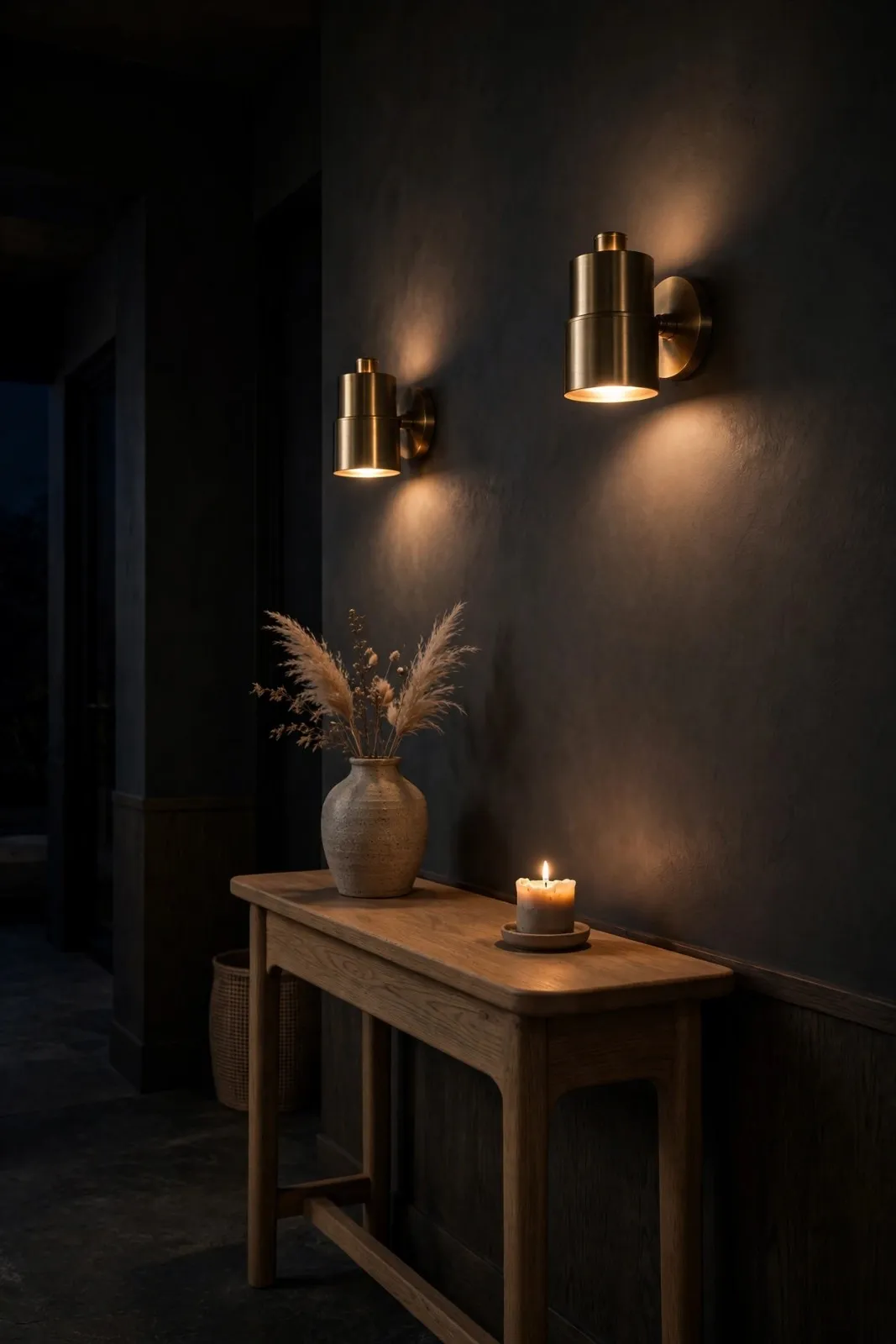
Vibe: Intimate and hushed, evening arrivals softened.
Why it works: A dimmable sconce lets the hallway shift from bright and functional in the morning to soft and welcoming at night, using the same fixture for two different moods rather than installing separate lighting layers. It’s the last detail that makes japandi hallway design ideas feel finished rather than staged.
How to get it: Install a smart dimmer switch behind a single warm-toned sconce so brightness can drop to 20 percent for evening arrivals without buying a second lamp.
Shop the Look
| Item | Approx. Price | Where to Find/Style |
| Brushed brass dimmable sconce | $95 | Rejuvenation |
| Smart dimmer switch | $40 | Lutron |
| Warm 2700K bulb | $9 | IKEA |
| Oak console | $240 | Article |
| Unscented soy candle | $28 | MUJI |
How to Start Your Japandi Hallway Transformation
The single most effective first move is choosing your flooring or wall tone before anything else, since every other decision, from bench color to hardware finish, is easier to make once you have one grounding surface to build around. Start with a warm white or oak-toned base and let accessories introduce contrast later.
The most common mistake is over-decorating too early, layering rugs, art, plants, and storage all at once before the base palette settles. This breaks the calm that defines Japandi hallway design ideas in the first place, because the eye never gets a resting point. Fix it by adding one element at a time and living with it for a week before introducing the next.
From there, focus on function before ornament. Add hooks and storage that solve real daily friction, keys, shoes, mail, before reaching for decorative objects. Once the functional layer feels resolved, bring in one textural piece, like a woven basket or ceramic vase, and stop there. A hallway refresh following this order typically takes two to three weekends, most of it spent waiting on paint to cure rather than shopping.
Frequently Asked Questions About Japandi Hallway Decor
What’s the difference between Japandi and Scandinavian hallway design?
Japandi differs from pure Scandinavian design by incorporating Japanese material philosophy, particularly wabi-sabi and low-profile furniture, alongside Nordic hygge comfort. Scandinavian hallways tend to lean brighter and whiter, while Japandi introduces more charcoal, oak, and darker grounding tones. Both share a preference for function over ornament.
What colors work best in a Japandi hallway?
The most effective colors for a Japandi hallway are warm white, oat, dusty sage, warm taupe, and soft charcoal. These tones stay within a narrow value range so nothing competes for attention. Avoid true black or bright white, both of which read as too stark for the style’s warmth.
How much does a Japandi hallway makeover cost?
A Japandi hallway refresh costs between $300 and $1,200 for a basic setup, depending on whether you’re repainting, adding furniture, or replacing flooring. Paint and accessories alone can achieve the look for under $400, while flooring changes push the budget toward the higher end.
Can Japandi work with an existing traditional or Victorian home?
Yes, Japandi can work in a traditional or Victorian home if you keep original architectural details, like trim and moldings, and simplify everything else around them. The contrast between ornate millwork and minimal furniture often looks intentional rather than mismatched; our victorian hallway ideas guide shows how that pairing plays out in practice.
What’s the most searched Japandi hallway element people want to recreate?
The most searched element is the low wooden entry bench, since it appears in nearly every viral Japandi hallway photo. Shoppers specifically look for tapered oak legs and a seat height under 18 inches, which keeps the piece visually light in narrow spaces.
Ready to Create Your Dream Japandi Hallway?
Twenty-five ideas, spanning color, material, lighting, and layout, all point back to the same truth: restraint is the design move, not the compromise. Starting small, with one wall color or a single bench, isn’t a lesser version of the look; it’s how every well-executed Japandi hallway actually gets built. Pick the one idea that solves your most immediate frustration, whether that’s a shoe pile by the door or a too-bright overhead light, and start there today.
I’ve seen how small changes like these can completely transform how a home feels the moment you walk in, quieter, warmer, more like an exhale than an errand. These japandi hallway design ideas are meant to be tried in pieces, not installed all at once. Pin your favorites, try the low bench or the paper pendant this weekend, and pass this along to anyone still living with a cluttered, overlit entry.
If you’re extending the same calm palette into other rooms, our green sunroom ideas and sunroom decorating ideas guides carry the natural-material approach into sun-filled spaces.


