
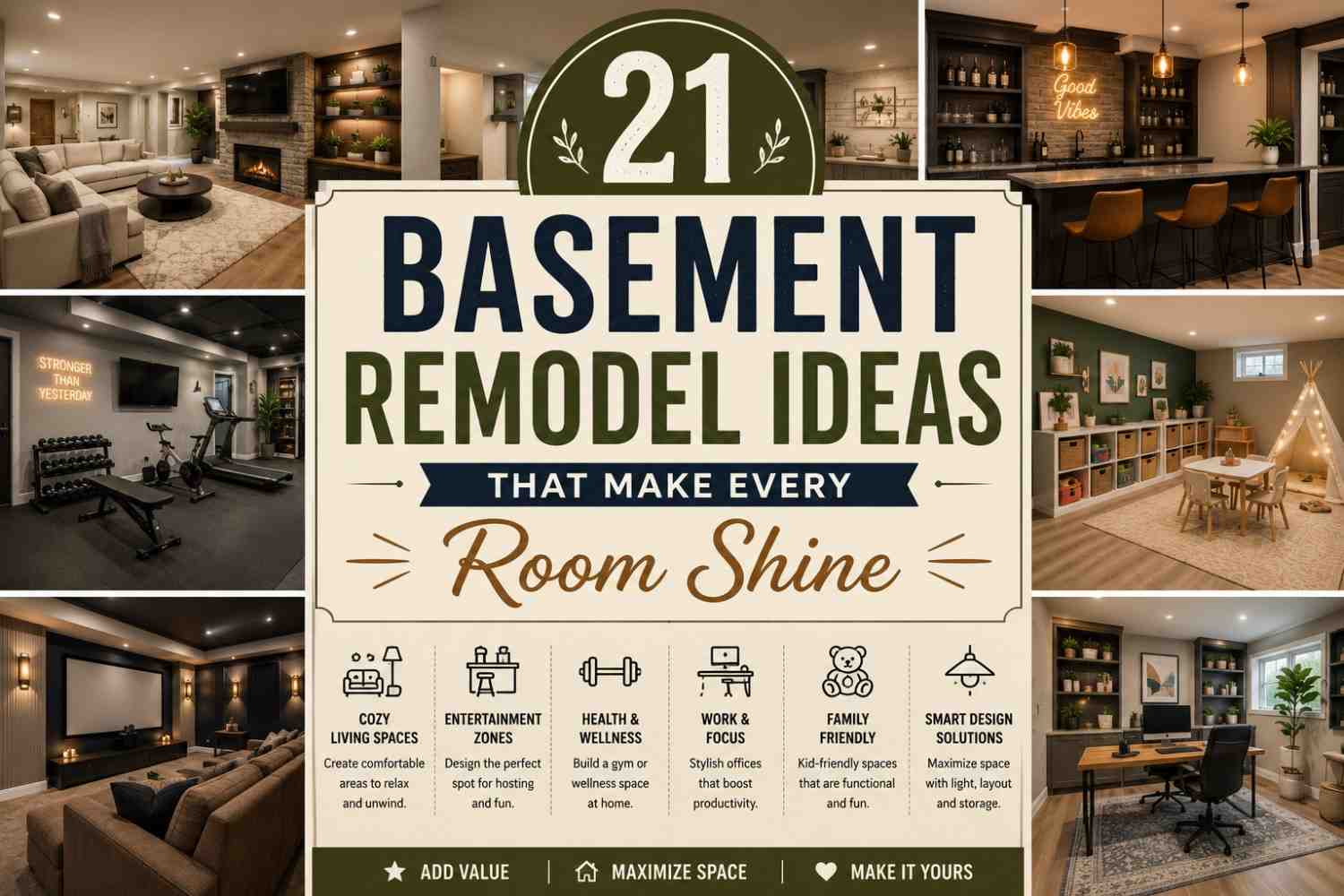
21 Basement Remodel Ideas That Make Every Room Shine
Picture a basement that feels nothing like storage. Warm light instead of a glaring bulb, solid floors instead of cold concrete, walls that actually earn their place. These basement remodel ideas show you exactly how to get there, and it doesn’t take a massive budget. In my experience, the basements that transform most dramatically aren’t the ones with the biggest spend; they’re the ones where lighting and flooring get fixed first.
Here are 21 ideas to help you remodel your basement, your way.
1. Warm Greige Walls for a Cozy Basement Glow

Vibe: Grounded and cozy despite the lack of natural light.
Why it works: Warm greige uses color temperature to counteract a basement’s naturally cool, low-light conditions, a principle that matters more below grade than anywhere else in the house. Unlike a stark white, greige holds enough pigment to avoid looking flat under artificial light alone.
How to get it: Choose a greige with a warm undertone, like Sherwin-Williams Perfect Greige, and test it under your actual basement lighting before committing, since basement bulbs shift color more than daylight does. Paint the ceiling one shade lighter than the walls to keep the low ceiling from feeling like a lid.
Shop the Look:
| Item | Approx. Price | Where to Find/Style |
| Warm greige paint (1 gal) | $58 | Sherwin-Williams |
| Ceiling paint, lighter shade | $52 | Sherwin-Williams |
| Neutral throw pillow set | $34 | Target |
| Walnut floor lamp | $89 | West Elm |
| Baseboard trim (per 8ft) | $14 | Home Depot |
2. Luxury Vinyl Plank Flooring for Warmth Underfoot

Vibe: Warm and durable, flooring built for a room that floods risk.
Why it works: Luxury vinyl plank uses a waterproof core layer, applying the design principle of material honesty in reverse, since it visually mimics wood grain while performing like a moisture barrier. This matters in basements where concrete slab moisture is a real, ongoing limitation.
How to get it: Choose a rigid-core LVP with at least a 20-mil wear layer for basement use, and install a thin foam underlayment beneath it to reduce the cold, hard feel of concrete. If you want a basement that feels warm despite sitting on slab, LVP with underlayment is the most effective approach.
Shop the Look:
| Item | Approx. Price | Where to Find/Style |
| Luxury vinyl plank (per sq ft) | $3.50 | LL Flooring |
| Foam underlayment | $0.45/sq ft | Home Depot |
| Vapor barrier film | $28/roll | Lowe’s |
| Transition strips | $18 | Home Depot |
| Jute area rug | $95 | Rugs USA |
Quick Win: Skip full-room installation and lay LVP just in the main seating zone, leaving the utility area as bare, sealed concrete.
3. Recessed LED Lighting to Banish Basement Shadows

Vibe: Bright and functional, light that reaches every corner.
Why it works: Recessed LEDs solve the light behavior problem basements face most, a single central fixture leaving corners dark, by distributing illumination evenly across a low ceiling. Spacing them roughly four feet apart avoids the shadow pooling that happens with fewer, larger fixtures.
How to get it: Install 4-inch LED can lights on a 4-foot grid at 3000K, which reads as warm white without tipping into the yellow cast that makes basements feel dated. Add a dimmer switch so the same fixtures work for both a home theater setting and a bright playroom.
Shop the Look:
| Item | Approx. Price | Where to Find/Style |
| 4″ LED recessed light (each) | $22 | Home Depot |
| Dimmer switch | $28 | Lutron |
| Junction box kit | $9 | Lowe’s |
| Trim ring, white | $6 | Home Depot |
| Wire connectors (pack) | $5 | Amazon |
4. A Sectional Sofa Built for Basement Movie Nights

Vibe: Relaxed and inviting, furniture scaled for lounging, not formality.
Why it works: A deep-seat sectional applies proportion differently than upstairs seating does, prioritizing lounging depth over the upright posture furniture in a formal living room is built for. Unlike the symmetry-driven furniture arrangements found in formal living room ideas, a basement sectional is arranged around sightlines to the screen rather than a fireplace or focal wall.
How to get it: Measure your basement’s lowest clearance point before ordering, since a chaise sectional with high arms can look bulky under an 8-foot ceiling. Choose a performance fabric over standard upholstery, given basements run more humid than main-floor rooms.
Shop the Look:
| Item | Approx. Price | Where to Find/Style |
| Performance fabric sectional | $1,450 | Article |
| Knit throw blanket | $42 | Anthropologie |
| Round wood coffee table | $220 | McGee & Co |
| Media console | $310 | West Elm |
| Removable slipcover (spare) | $65 | IKEA |
5. Layered Rugs to Soften a Concrete Basement Floor

Vibe: Layered and soft against an otherwise hard, cold surface.
Why it works: Stacking a large jute rug under a smaller patterned wool rug uses texture layering to add visual and physical softness where a basement most lacks it, directly on the floor. The size contrast between the two rugs also defines the seating zone without needing a wall.
How to get it: Size the base jute rug so all furniture legs sit on it, then center a smaller accent rug within it at roughly two-thirds the width. Keep both rugs low-pile, since basement humidity can trap moisture in thick wool.
Shop the Look:
| Item | Approx. Price | Where to Find/Style |
| Large jute base rug | $180 | Rugs USA |
| Patterned wool accent rug | $145 | McGee & Co |
| Rug pad, moisture-resistant | $38 | Amazon |
| Rug grippers (corner set) | $9 | Home Depot |
| Fabric refresher spray | $12 | Target |
Quick Win: A single 5×7 rug over bare concrete does most of the work if a full layered look isn’t in the budget yet.
6. A Deep Charcoal Accent Wall for a Home Theater Corner

Vibe: Cinematic and hushed, a wall built to disappear behind the screen.
Why it works: A deep charcoal wall uses contrast and light absorption, a functional design principle for media rooms, since dark matte paint reduces screen glare more effectively than a bright wall would. If you want richer color and better screen quality in a basement theater corner, painting only that wall dark, not the whole room, is the most effective approach.
How to get it: Use a true matte finish, not eggshell, directly behind and beside the screen only, keeping adjacent walls lighter so the room doesn’t feel like a cave when the lights come up.
Shop the Look:
| Item | Approx. Price | Where to Find/Style |
| Matte charcoal paint (1 gal) | $56 | Behr |
| LED backlight strip | $24 | Amazon |
| Blackout curtain panel | $38 | Target |
| Floor speaker stand (pair) | $65 | Best Buy |
| Cable management kit | $16 | Amazon |
7. Shiplap Paneling to Warm Up Basement Walls

Vibe: Warm and textured, breaking up an otherwise flat drywall run.
Why it works: Horizontal shiplap adds texture layering to a basement wall without adding depth-eating furniture, using shadow lines between planks to create visual interest under artificial light. It also disguises minor wall imperfections common in unfinished basement framing.
How to get it: Install prefinished MDF shiplap rather than raw pine, since MDF resists basement humidity swings better and skips the need for repainting. Leave a small gap at the baseboard for expansion, a step often missed that leads to buckling.
Shop the Look:
| Item | Approx. Price | Where to Find/Style |
| Prefinished MDF shiplap (per sq ft) | $2.20 | Home Depot |
| Finish nailer (rental) | $35/day | Home Depot |
| Wood filler | $6 | Amazon |
| Small framed print | $28 | Society6 |
| Caulk, paintable | $5 | Home Depot |
8. A Fold-Down Murphy Bed for a Basement Guest Suite

Vibe: Compact and functional, a guest room that disappears by day.
Why it works: A murphy bed solves the small space problem basements often face, needing a guest room without dedicating permanent square footage to a bed frame. Folding vertically into a cabinet wall keeps the floor clear for a desk or gym setup the rest of the week.
How to get it: Order a queen or full murphy bed kit with built-in side cabinets rather than a bare frame, since the cabinets double as nightstand and storage space when the bed is down.
Shop the Look:
| Item | Approx. Price | Where to Find/Style |
| Murphy bed cabinet kit | $1,100 | Wayfair |
| Brass cabinet pulls | $22 | Rejuvenation |
| Fold-down nightstand shelf | $45 | Amazon |
| Reading lamp, wall-mounted | $38 | West Elm |
| Cream bedding set | $85 | Parachute |
Quick Win: A daybed with a trundle achieves the same dual-use goal without any cabinetry installation.
9. A Wet Bar Cart Instead of a Built-In Bar

Vibe: Relaxed and social without the cost of plumbing.
Why it works: A rolling bar cart uses furniture flexibility as its core principle, delivering the social function of a wet bar without the cabinetry, plumbing, or square footage a built-in requires. It can also relocate for parties or storage, which fixed millwork can’t.
How to get it: Choose a two-tier brass or black metal cart no wider than 30 inches, keeping it near an outlet for a mini fridge, and style the top shelf with no more than five glassware pieces.
Shop the Look:
| Item | Approx. Price | Where to Find/Style |
| Brass bar cart | $195 | CB2 |
| Mini fridge, compact | $140 | Best Buy |
| Cocktail glass set (6) | $48 | Anthropologie |
| Small ice bucket | $26 | World Market |
| Bar tool set | $34 | Williams Sonoma |
10. Wall Sconces to Layer Light Beyond Overhead Cans

Vibe: Warm and layered, light at eye level instead of only overhead.
Why it works: Wall sconces add a second lighting layer, a principle basements especially need since recessed cans alone create flat, shadowless light that can feel clinical. Mounting sconces at eye height brings warmth into a room that otherwise relies entirely on ceiling fixtures.
How to get it: Install sconces at 60 inches from the floor along any wall longer than eight feet, spaced six feet apart, and pair them with warm 2700K bulbs to contrast the cooler recessed lighting above.
Shop the Look:
| Item | Approx. Price | Where to Find/Style |
| Brass wall sconce (each) | $68 | Rejuvenation |
| Fabric drum shade | $24 | Pottery Barn |
| 2700K bulb (2-pack) | $10 | Amazon |
| Dimmer wall plate | $22 | Lutron |
| Sconce mounting hardware | $12 | Home Depot |
11. Soft Sage Green for a Basement Home Office Nook

Vibe: Calm and focused, a color chosen for concentration, not drama.
Why it works: Soft sage uses a muted, low-saturation green shown to support focus in workspaces, applying the same color psychology principle found in green sunroom ideas, where green connects a room to a natural, calming register even without a view outside. In a basement without windows, this substitutes for the daylight a sunroom gets naturally.
How to get it: Paint just the desk nook wall in sage rather than the full room, and add a full-spectrum desk lamp to compensate for the lack of natural light basements typically lack.
Shop the Look:
| Item | Approx. Price | Where to Find/Style |
| Soft sage paint (1 gal) | $54 | Benjamin Moore |
| Wood desk | $260 | CB2 |
| Full-spectrum desk lamp | $45 | Amazon |
| Small potted pothos | $18 | The Sill |
| Woven desk organizer | $22 | Target |
12. Acoustic Ceiling Tiles for a Quieter Basement

Vibe: Clean and functional, quiet built into the architecture itself.
Why it works: Acoustic ceiling tiles apply a material property most basements need but skip, sound absorption, since concrete floors and drywall walls otherwise bounce noise between a media area and a home gym. A textured tile absorbs more sound than a flat painted drywall ceiling.
How to get it: Choose a low-profile acoustic tile with an NRC rating above 0.55 for a basement doubling as both a theater and workout space, and keep the grid finish matte white to avoid drawing the eye upward in a low-ceiling room.
Shop the Look:
| Item | Approx. Price | Where to Find/Style |
| Acoustic ceiling tile (per sq ft) | $2.80 | Armstrong Ceilings |
| Suspension grid kit | $85 | Home Depot |
| Acoustic wall panel (accent) | $32 each | Amazon |
| Yoga mat storage rack | $28 | Target |
| Sound-dampening rug pad | $34 | Rugs USA |
13. A Gallery Wall to Personalize a Windowless Stairwell

Vibe: Intimate and layered, a passage that earns a second look.
Why it works: Filling a stairwell with tightly spaced framed pieces uses the same negative-space-in-reverse principle found in Victorian hallway ideas, where density reads as curated rather than cluttered in a narrow passage. A basement stairwell benefits even more, since it usually has no window to draw the eye instead.
How to get it: Hang frames following the stair angle rather than a strict horizontal line, keeping two to three inches of spacing between each piece, and add small step lights along the stringer to illuminate the art after dark.
Shop the Look:
| Item | Approx. Price | Where to Find/Style |
| Mixed frame set (6) | $68 | Etsy |
| Small art prints (set) | $54 | Society6 |
| Stair step LED lights | $42 | Amazon |
| Stair runner rug | $110 | Rugs USA |
| Picture hanging kit | $10 | Amazon |
14. An Open-Concept Basement Zoned by Rug Placement

Vibe: Open and organized, zones defined without a single wall.
Why it works: Using two differently shaped rugs to separate functions applies layout logic that suits open basements, where full walls would eat into an already limited ceiling height and natural light. Each rug boundary tells the eye where one activity ends and another begins.
How to get it: Choose rugs in contrasting shapes, rectangular for seating, round for a game table, rather than matching sets, since shape contrast reads more clearly than color contrast from across an open room.
Shop the Look:
| Item | Approx. Price | Where to Find/Style |
| Rectangular charcoal rug | $165 | Rugs USA |
| Round wood-tone rug | $120 | McGee & Co |
| Game table, round | $340 | Wayfair |
| Sectional sofa (see idea 4) | — | Article |
| Furniture felt pads | $8 | Amazon |
Quick Win: Even one bold rug under the main seating area, with bare floor elsewhere, visually defines a zone without a second purchase.
15. A Built-In Window Seat Under an Egress Window

Vibe: Bright and restful, the one spot in the basement that catches real sun.
Why it works: A built-in bench beneath an egress window uses proportion and light behavior together, positioning seating exactly where natural daylight actually reaches, the same logic that makes sunroom decorating ideas prioritize window-facing furniture above anything else. In a basement, that single window well is often the only light source worth designing around.
How to get it: Build the bench seat storage 16 to 18 inches deep with a hinged lid, and size the cushion to the exact window well width so the seat reads as built-in rather than added on.
Shop the Look:
| Item | Approx. Price | Where to Find/Style |
| Built-in bench frame kit | $220 | Home Depot |
| Custom cushion, cream | $95 | Etsy |
| Storage bench hinges | $14 | Amazon |
| Small side table | $65 | West Elm |
| Throw pillow pair | $38 | Target |
16. A Statement Pendant Over a Basement Game Table

Vibe: Focused and social, light that pulls people to the table.
Why it works: A single low-hung pendant uses light behavior to create a pool of focused illumination, drawing attention and activity to one spot the way a chandelier does over a dining table. This works especially well paired with dimmable recessed cans elsewhere in the room.
How to get it: Hang the pendant 30 to 34 inches above the tabletop, centered exactly over the table rather than the room, and choose a shade that directs light downward rather than diffusing it upward into a low ceiling.
Shop the Look:
| Item | Approx. Price | Where to Find/Style |
| Black metal pendant light | $110 | Schoolhouse |
| Edison filament bulb | $9 | Amazon |
| Adjustable hanging kit | $16 | Home Depot |
| Round game table (see idea 14) | — | Wayfair |
| Ceiling junction box | $8 | Lowe’s |
17. Warm White Trim to Brighten Low Basement Ceilings

Vibe: Bright and tailored, definition without visual weight.
Why it works: Painting trim a shade lighter than the walls uses contrast at the architectural level, sharpening the edges of a low-ceilinged basement room without adding height-eating crown molding. This is a direct-answer move: if you want a basement to read taller than it is, keeping trim lighter than walls is the most effective approach.
How to get it: Use a satin finish warm white on baseboards and door casing, since the slight sheen catches light differently than the matte wall color and defines the room’s edges more clearly.
Shop the Look:
| Item | Approx. Price | Where to Find/Style |
| Warm white satin paint (qt) | $26 | Benjamin Moore |
| Baseboard trim (per 8ft) | $14 | Home Depot |
| Angled trim brush | $12 | Amazon |
| Caulk, paintable | $5 | Home Depot |
| Painter’s tape | $8 | Amazon |
18. Waterproof Engineered Wood for a Basement That Floods Occasionally

Vibe: Durable and warm, flooring engineered to survive what basements throw at it.
Why it works: Waterproof engineered wood uses the same sealed-core construction logic found in modern bathroom ideas, where moisture resistance matters as much as appearance. In a basement, that same waterproof core protects against occasional seepage without sacrificing the look of real wood grain.
How to get it: Choose engineered planks with a fully waterproof click-lock core rather than solid hardwood, and leave a quarter-inch expansion gap at every wall, since basement humidity causes more seasonal movement than upstairs flooring.
Shop the Look:
| Item | Approx. Price | Where to Find/Style |
| Waterproof engineered wood (per sq ft) | $4.20 | LL Flooring |
| Foam underlayment | $0.45/sq ft | Home Depot |
| Expansion gap spacers | $9 | Amazon |
| Transition strips | $18 | Home Depot |
| Moisture meter (concrete test) | $32 | Amazon |
19. A Fold-Out Craft Station for a Narrow Basement Corner

Vibe: Compact and practical, a workspace that folds away when not needed.
Why it works: A wall-mounted fold-out table solves the small space challenge of a narrow basement corner by eliminating the need for permanent floor footprint, using the same principle as a murphy bed but scaled for hobby work rather than sleeping.
How to get it: Mount the table bracket at 30 inches from the floor for standing craft work, and add a slim wall cabinet above it for supply storage so nothing sits on the floor when the table is folded up.
Shop the Look:
| Item | Approx. Price | Where to Find/Style |
| Fold-down wall table kit | $85 | Amazon |
| Slim wall storage cabinet | $110 | IKEA |
| Task lamp, clamp-mount | $24 | Target |
| Small storage bins (set) | $28 | The Container Store |
| Wall anchors (heavy duty) | $9 | Home Depot |
20. Woven Baskets for Basement Storage That Still Looks Styled

Vibe: Organized and warm, storage that doesn’t look like storage.
Why it works: Woven baskets add texture layering to open shelving while solving a basement’s most common function, holding overflow items, without resorting to plastic bins that read as purely utilitarian. Grouping baskets by size on open shelves also keeps the eye reading the wall as intentional rather than cluttered.
How to get it: Use matching baskets in three graduated sizes per shelf rather than mismatched bins, and label the fronts with small tags so the system stays functional as well as tidy.
Shop the Look:
| Item | Approx. Price | Where to Find/Style |
| Woven storage basket set (3) | $62 | Target |
| Open wood shelving unit | $145 | IKEA |
| Basket label tags | $8 | The Container Store |
| Shelf brackets (set) | $22 | Home Depot |
| Felt shelf liner | $12 | Amazon |
Quick Win: Two baskets on an existing shelf, not a full shelving overhaul, is enough to tidy a small storage corner immediately.
21. A Half Wall to Separate a Basement Playroom from a Lounge

Vibe: Organized and playful, two rooms in one footprint.
Why it works: A half wall applies layout logic that a basement can rarely afford to lose with a full wall, dividing function while keeping sightlines and light open across the room. Capping it in wood at counter height also gives the playroom side a natural display ledge for toys or art.
How to get it: Build the half wall to 42 inches high, matching standard stair railing code, and cap it with a 6-inch wood shelf that can hold bins on the playroom side without blocking the sightline into the lounge.
Shop the Look:
| Item | Approx. Price | Where to Find/Style |
| Framing lumber (half wall) | $95 | Home Depot |
| Wood cap rail (per 8ft) | $32 | Lowe’s |
| Drywall sheets (2) | $24 | Home Depot |
| Primary-color toy bins | $34 | Target |
| Corner guard trim | $10 | Amazon |
How to Start Your Basement Remodel Transformation
The single most effective first move for any basement remodel ideas project is fixing the lighting layer before touching paint or furniture, since a warm 3000K recessed layout changes how every color and material reads afterward. Lighting anchors the whole basement the way a wall color anchors an upstairs room.
The most common mistake is choosing flooring before testing the basement for moisture, which leads to buckled planks within a year. This happens because concrete slabs release vapor unevenly across a room; the fix is running a simple moisture test with a $30 meter before ordering any flooring material, waterproof or not.
For a basement that stays functional long-term, sequence the work: lighting first, flooring second, then wall color and furniture once both are settled. A basic lighting and flooring pass typically takes a long weekend, while a full remodel with built-ins like a murphy bed or half wall can run two to three weeks depending on contractor availability.
Frequently Asked Questions About Basement Remodel Ideas
What is a basement remodel compared to a basement finish?
A basement remodel involves redesigning an already-finished space with new lighting, flooring, and layout, while a basement finish covers a previously unfinished, bare-concrete space for the first time. Both projects share similar material choices, but a remodel usually skips framing and electrical rough-in since that infrastructure already exists.
What colors work best for basement remodel ideas?
The most effective colors for basement remodel ideas are warm greige, soft sage, and warm white, chosen specifically to counteract a basement’s lack of natural daylight. Deep charcoal works well as a contained accent in media areas but can feel heavy if used across an entire room without a window.
How much does a basement remodel cost for a basic setup?
A basic basement remodel costs between $2,500 and $8,000, covering paint, lighting, and flooring for a single-room layout. Adding a wet bar, built-in murphy bed, or half wall typically pushes the total past $12,000 depending on material choices and local labor rates.
Do basement remodel ideas work in older homes with low ceilings?
Yes, basement remodel ideas work in older homes with low ceilings when recessed lighting and light trim colors are prioritized over crown molding or bulky furniture. Choosing rug-based zoning over full walls also keeps a low-ceilinged basement from feeling boxed in.
What is the most searched basement remodel upgrade?
The most searched basement remodel upgrade is flooring, specifically waterproof luxury vinyl plank, followed closely by lighting improvements. Homeowners search flooring first because it directly addresses the moisture and cold-underfoot issues that make basements feel unfinished even after painting.
Ready to Create Your Dream Basement?
Between warmer color choices, moisture-smart flooring, layered lighting, and simple layout zoning, these 21 basement remodel ideas prove a full renovation isn’t required to make the space feel finished. Starting with lighting and one flooring zone is the right move, not a shortcut; it lets every later choice, paint, furniture, trim, build on a foundation that already works. The single best action to take today is running a basement moisture test before buying any flooring material. Done right, a remodeled basement should feel like the rest of the house extended downward, not a separate, forgotten level. I’ve seen how small changes like better lighting can completely transform a space, so save your favorites, try one idea this month, and pass this along to anyone planning their own basement remodel.